

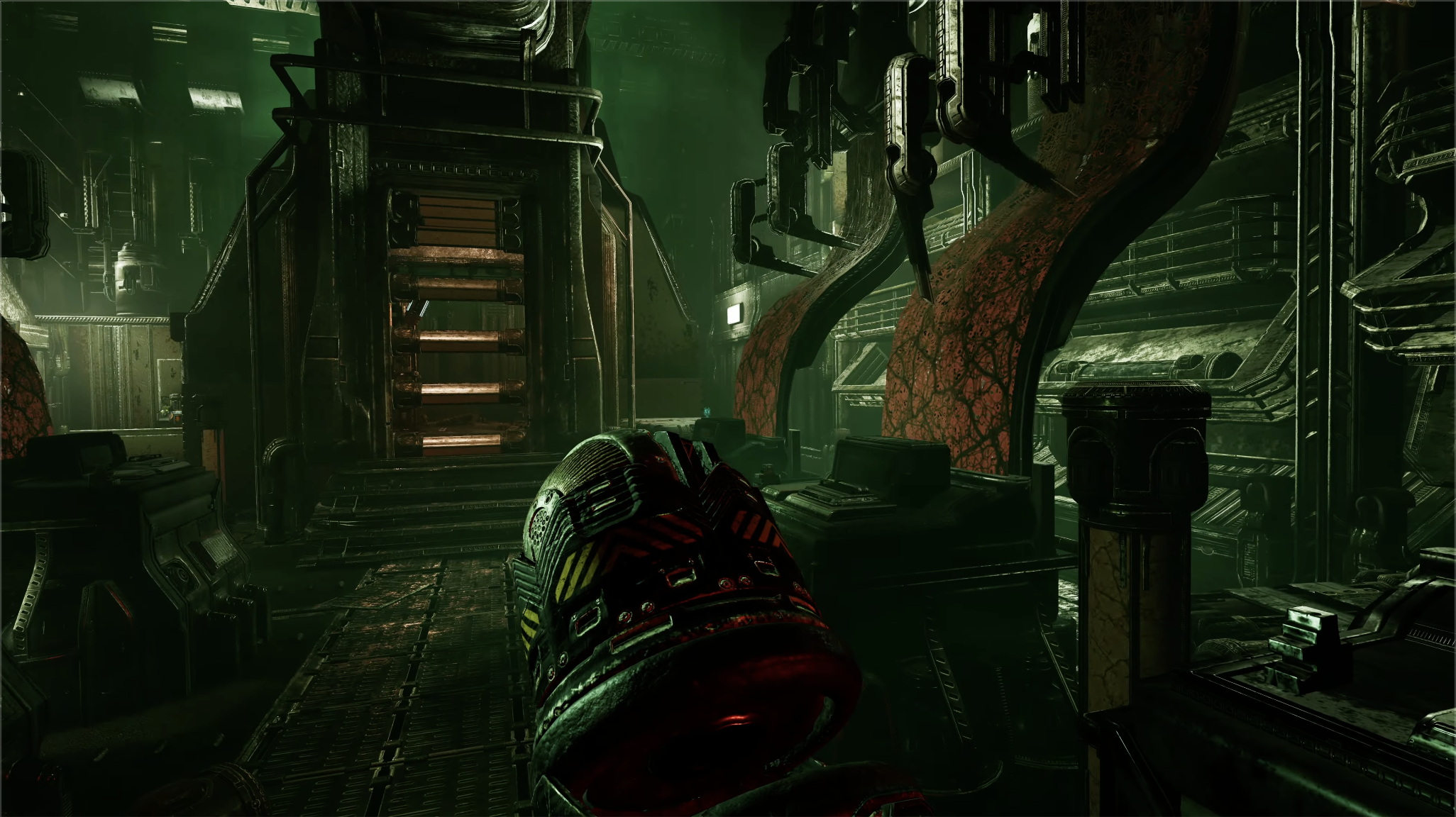
No VR horror game has managed to put Dead Space’s strategic dismemberment system into motion-controller hands with the tactile physicality that Half-Life: Alyx brought to the rest of its design — but Rustmourne, an indie PC VR survival horror title, is attempting exactly that synthesis, and it is targeting an early 2027 release on SteamVR and Oculus PC. A new gameplay trailer premiered at the VR Games Showcase August 2026 confirmed the window and offered the most detailed look yet at how the game’s ammo-scarce, limb-targeting combat feels from inside a headset.
The developer, the Rustmourne Team, cites three inspirations in its own words: Dead Space, Half-Life: Alyx, and Doom 3, as described in developer posts on Steam. That third name matters. Where Dead Space contributes the tactical dismemberment premise and Half-Life: Alyx sets the standard for VR-native physical interaction, Doom 3 contributes something older and arguably more essential for a game set in a decaying megastructure: the oppressive dark that turns every flickering corridor into an argument for keeping a weapon raised.
Why VR Horror Has Needed This Game
The broader VR horror genre has produced excellent titles in the last few years — Alien: Rogue Incursion’s relentless xenomorph dread, Resident Evil 4’s landmark conversion of flatscreen action to first-person physicality, The Walking Dead: Saints and Sinners’ weighty melee combat — but none of them attempted Dead Space’s specific design proposition: enemies as puzzles requiring limb targeting, where deciding in real time which limb to remove and accepting the consequence of the choice is the game’s central mechanic. In Dead Space, that mechanic required a thumbstick-moved cursor. In VR, it requires the player’s physical arm, wrist, and hand — and the tremor of an extended session or a close encounter becomes part of the system.
Evan Marcus, co-founder of VR.org and one of VR horror’s more incisive observers, described Rustmourne’s design bet this way following its June reveal: the game is about deciding to run hide fight in the moment. That three-option loop is the Dead Space loop, transposed. Marcus’s piece also provides the most useful framework for understanding why VR specifically amplifies it: what researchers call the plausibility illusion in VR, the brain’s deeply irrational insistence that what surrounds it in a headset is real. When that illusion is working, dismembering a creature at arm’s length is categorically different from clicking on it.
UploadVR’s Mike Johnson, writing at the time of Rustmourne’s June announcement, flagged the genre stakes directly. Invoking the name of Half-Life: Alyx has been a double-edged sword for developers. Since its release in 2020, Alyx has set a high bar for other VR games to clear, narrative shooter or otherwise, and the results have been mixed at best. That caveat is the honest state of the genre. Alyx’s benchmark is not primarily graphical or narrative — it is interactional. Games that have reached for it and missed typically did so at the point where physical interaction was asked to feel consequential and didn’t.
What the Design Actually Asks of a Player
Rustmourne’s VR-native design commits to several specific choices that distinguish it from a straightforward flatscreen port. Each weapon has a distinct reload animation physical mechanic built for motion controllers — there are no universal “press X to reload” solutions, and the game’s design implies that reloading the wrong weapon at the wrong moment in a corridor carries real risk.
Sound-reactive AI is the second structural pillar. The megastructure’s creatures are sensitive to noise, which means the player’s physical behavior — how loudly they move, what environmental objects they disturb, whether they fire when they could have fled — functions as a detection system. In VR, unlike on a flatscreen, the player’s actual footsteps and movements are tracked; the game can plausibly build threat around the player’s physical choices in a way that flatscreen horror can only approximate through abstract mechanics.
The third element is ammo scarcity, a survival horror staple that in VR gains additional texture because the player who runs out of ammunition cannot simply quick-swap to a backup — they must physically manage their inventory under duress. Every choice carries a physical cost.
A Story That Gives You No Ground to Stand On
You wake up inside a vast, decaying megastructure with no memory of who you are or why you are there. The corridors around you are not empty — half-biological, half-mechanical beings, described by the developer as the tortured products of a world where things “rot and renew endlessly”, have been using them longer than you have. The game’s central question — why were you awakened here, and can you get out alive — is the kind of amnesiac premise survival horror has used before, but Rustmourne adds a specific wrinkle: a mysterious voice keeps pulling you back from death, and resurrection carries a cost. That cost is left undefined in the materials shown so far, which is the right call for a horror game that wants its resurrection mechanic to feel like a trap rather than a safety net.
The emotional register is claustrophobic industrial grotesque. Creature design praised by community discussion threads, and from the trailer footage, the aesthetic sits between the necromorphs of Dead Space — bodies mutated into something that should not be upright but is — and the rusted-over machinery of Doom 3’s UAC Mars facility. The game is rated for adult audiences and does not soften its content descriptions: graphic limb dismemberment, body horror, and story themes addressing trauma and pain are all explicitly flagged. That transparency is appropriate for a genre where the gap between “horror” and “overwhelming” is a real design concern.
How VR-Native Design Changes the Calculus at Release
PC VR had 4.3 million monthly active players on Steam as of Q1 2025, representing an 18% year-over-year increase. It is a dedicated, engaged audience — not a mass market — and it is an audience that has spent six years knowing what a great VR game feels like because it can compare everything to Half-Life: Alyx. An indie studio targeting this audience with a game that explicitly invokes Alyx as a design benchmark is making a confident bet.
The PC VR-exclusive nature of the release is itself a design commitment. Standalone headsets like the Meta Quest line are the dominant hardware category in VR by unit sales, but PC VR’s GPU-rendered visual fidelity, tracked-controller precision, and absence of standalone thermal throttling are meaningful advantages for a game whose design depends on precise motion-controller aim and atmospheric rendering. The minimum and recommended hardware requirements confirm the scope of that commitment: minimum specifications call for an Intel i5-4590 or AMD FX 8350 with an Nvidia GTX 970 or AMD Radeon R9 390, while the recommended configuration (RTX 2080 or RX 5700 XT, 8 GB RAM) targets 4K/120fps rendering. At recommended spec, the game is asking the GPU to render two 4K frames simultaneously at 120Hz — a demanding but achievable target for mid-to-high-end hardware from 2019 onward.
What Questions Remain Before Launch
The Steam community page for Rustmourne has surfaced several design questions that the developer has not yet publicly answered. Left-handed support community discussion — whether the game’s interaction systems can be fully mirrored for left-handed players — is a practical accessibility question for the VR-native mechanic design, where weapon handling and reload animations are built around specific controller orientations. The game currently shows right-handed weapon positioning in its trailers, and no formal statement on left-hand support has been published.
The AI disclosure community thread on Steam has also raised the question of whether generative AI tools were used in the game’s production. The developer has not issued a public statement on this and the Steam store page shows no AI content disclosure. In an era when Valve requires disclosure of generative AI use, the absence of disclosure means either the tools were not used or the policy question has not yet been addressed formally. The community interest in a clear answer is consistent with broader industry dynamics around AI transparency in game development.
Both questions remain open and are worth watching as the game approaches its early 2027 window.
Is Rustmourne Right for You?
PC VR ownership is required — no console or standalone (Quest) version has been announced. If you own compatible hardware (SteamVR or Oculus PC), the game is available to wishlist on Steam now, where a 5,000 wishlist milestone post from the developer confirmed the mark was surpassed within days of its June announcement. The Rustmourne Team is active on Discord, X, and Bluesky for development updates.
For VR horror fans who have waited for a game that takes the Dead Space design seriously as a VR proposition rather than an inspiration label, Rustmourne is the most specific attempt that direction has produced. Whether it clears the Alyx bar at launch is a question for early 2027.
Frequently Asked Questions
Is there a Dead Space VR game?
Dead Space itself has never received an official VR adaptation. Rustmourne is an original indie game by the Rustmourne Team that draws directly on Dead Space’s strategic dismemberment system — the mechanic where targeting specific enemy limbs changes their behavior and threat level — and rebuilds it for motion controllers in VR. It is not affiliated with EA or the Dead Space franchise.
What VR headsets does Rustmourne support?
Rustmourne is a PC VR-only title compatible with any SteamVR-supported headset or Oculus PC headset. This includes the Valve Index, Meta Quest used. Valve’s upcoming Steam Frame headset would also be compatible. No standalone Quest version, PlayStation VR2 version, or flatscreen version has been announced, per the platform requirements on Steam
How is Rustmourne’s combat different from other VR horror games?
Most VR horror games use combat either as a flatscreen-ported mechanic (point and shoot with a thumbstick) or deprioritize it entirely in favor of stealth or avoidance. Rustmourne’s stated design centers on strategic dismemberment — like Dead Space, different limb removals produce different tactical outcomes — but implemented with physical weapon handling built for motion controllers, where each weapon has a distinct reload mechanic designed for tracked hands rather than adapted from a gamepad. The sound-reactive AI also makes the player’s physical behavior part of the detection system, which changes what “playing quietly” means in a headset.
When will Rustmourne come out?
The Rustmourne Team confirmed an early 2027 release window at the August 13 VR Games Showcase. No specific date within that window has been announced. The game is available to wishlist Rustmourne on Steam at store.steampowered.com/app/3775210.
ⓒ 2026 TECHTIMES.com All rights reserved. Do not reproduce without permission.
