

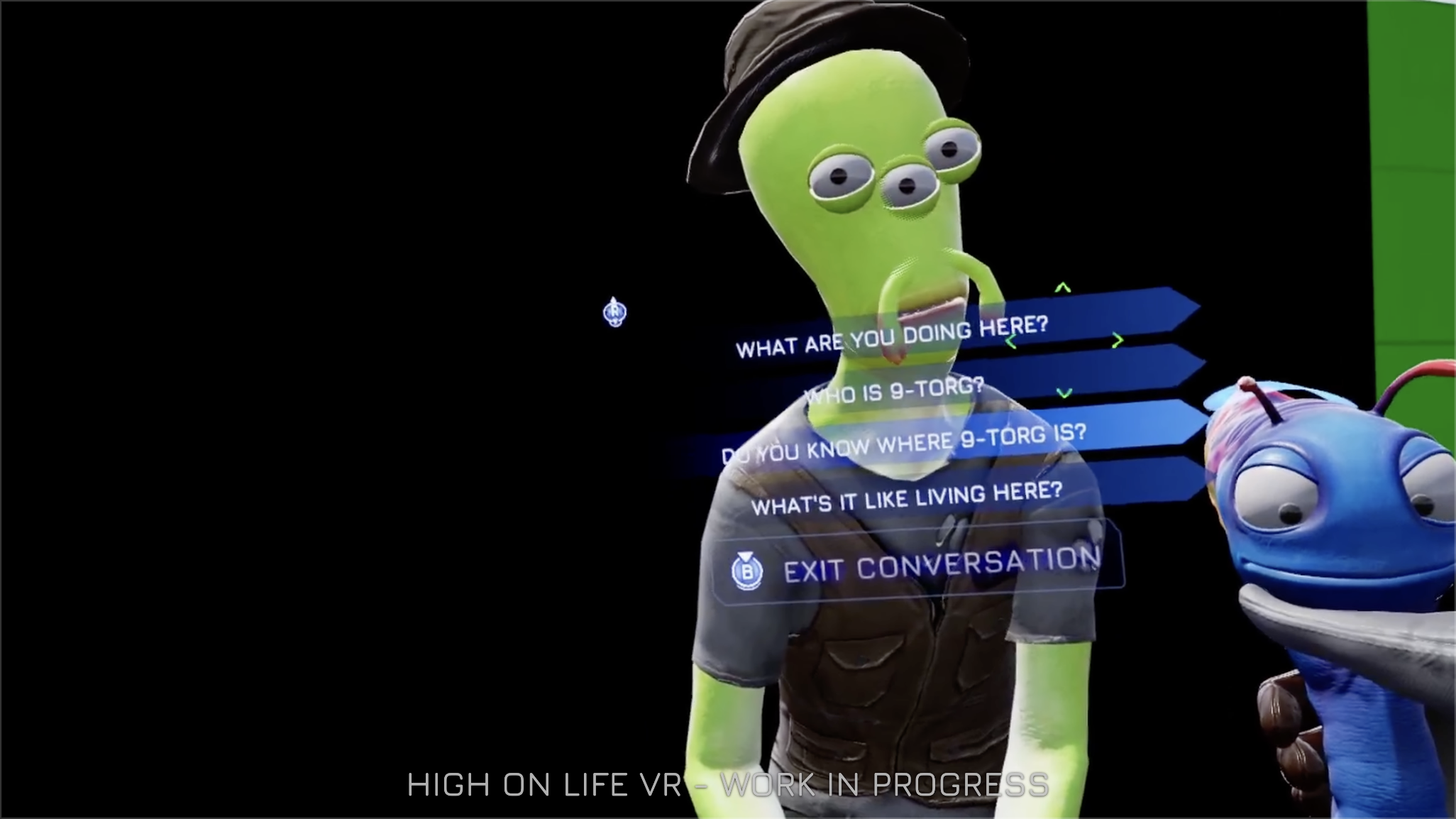
High On Life VR is coming to Meta Quest 3 and 3S, PlayStation VR2, and PC via SteamVR in 2027 — and the studio behind it has made clear from the start that this is not a port. Flat2VR Studios, the VR developer that grew out of a modding community into one of the most respected official-conversion houses in the industry, announced the project on August 13 as the closing act of the August VR Games Showcase, working alongside Squanch Games, the Burbank-based studio that originally released the game in December 2022.
Every talking alien gun will have physical reload mechanics. Every menu, every pause screen, and the in-game Warp Remote will be fully diegetic — embedded inside the game world itself rather than floating as traditional heads-up display overlays. The engineering challenge of running this content-rich, absurdist comedy game at a stable 72 frames per second on the Quest 3’s standalone mobile hardware is, in the words of producer Alastair Burns, “remarkable.” He means it as a compliment to the hardware and a description of what the studio is attempting simultaneously.
The partnership was announced alongside Squanch Games’ official statement on August 13. Burns described the collaboration as something that “was just meant to be” — Squanch Games originally built its early projects in VR before pivoting to flatscreen development, making the adaptation a homecoming of sorts.
What Flat2VR Studios Is Actually Building
Flat2VR’s approach to VR adaptation has a specific name inside the studio: “VR-ification.” It is not the same as porting. In a port, the game runs in a headset. In a VR-ification, the game is rebuilt around the physical reality of what it feels like to occupy the world in first person — which, for a game whose central gimmick is that your weapons are living, talkative alien creatures, means confronting every interaction from scratch. That distinction — between a port and a conversion — is one Flat2VR emphasizes explicitly in its public communications.
The precedent for understanding what this actually requires comes from the studio’s previous project, Roboquest VR. CEO Jasmine Uniza — who previously served as a Technical Program Manager at Meta overseeing Quest Pro hardware development and at Apple on iPhone operations — described the process of designing manual reload mechanics for the roguelite shooter as an illustration of what “VR-ification” demands: roughly 80 weapons rebuilt for VR reloads, with game-balance implications reconsidered each time. “Do you even understand how much work it is to just do one weapon,” Uniza said. A roguelite shooter with fast-paced combat added the additional complication that manual reload gestures, if poorly designed, break pacing entirely. The studio spent significant time finding the balance.
High On Life VR carries the same mandate with a more complex product. The Gatlians — the sentient alien gun characters — are not just weapons; they are characters with voice acting, distinct personalities, and constant running commentary. Voiced by performers including J.B. Smoove, Tim Robinson, and others, they react to the player’s actions and to each other. In VR, Game Director Emily O’Neal wants players to feel that they are holding “living, breathing creatures” — which means the animation rigs for each weapon have to convey personality through the physical interaction, not just function.
“We are really focused on making the VR interactions with these weapons feel really unique,” O’Neal said in the official announcement. “They are living, breathing creatures that you can reload, poke, and pull.”
The Story Behind the Guns
Before any of the technical engineering, there is a game worth caring about. High On Life opens with a newly graduated teenager with nothing going on, whose life plan gets upended when the G3 Cartel — an alien drug operation led by a villain named Garmantuous — invades Earth and begins converting human beings into narcotics. The central dramatic question of the game is straightforward: can a completely unprepared kid, armed with a team of opinionated alien guns and a murder-happy sentient knife named Knifey, actually take down an interstellar cartel?
What makes the premise work is the emotional register. Design director Erich Meyr described the original game as “Blade Runner meets The Muppets” in a 2022 interview with IGN — absurdist sci-fi comedy, constant fourth-wall-aware improvisation, and a world where a fish-shaped gun voiced by J.B. Smoove delivers sociological commentary on bounty hunting while you are actively conducting bounty hunting. The original released in December 2022 and reached 25 million players, generating close to $11 million from approximately 200,000 Steam copies in its first month alone despite receiving mixed critical reviews that were largely divided on whether you found the humor funny. That gap between critical reception and audience response suggests a fanbase genuinely attached to the game’s specific irreverent tone — which is exactly the kind of audience that shows up to a VR adaptation announcement. According to sales estimates reported by Softonic, High On Life 2 had sold approximately 137,700 Steam copies by August 2026.
In VR, Burns describes the comedy landing differently: immersion slows down how fast players move through the world’s gags. “I take more time, I’m caught up in the joke, it lands more,” he said.
The Diegetic UI Problem — and Why It Matters Here
One of the less-discussed engineering challenges in flat-to-VR adaptation is what happens to the user interface. In flatscreen games, health bars, ammo counters, minimaps, and pause menus float on the screen as transparent overlays — non-diegetic elements that exist outside the game world and are visible only to the player, not to any character in the fiction. In VR, those floating overlays break presence almost instantly. Players are aware they are looking at a screen layer, not a world. As Archiact’s diegetic UI design analysis notes, this is a “loved-by-all, understood-by-few” design principle that is difficult to execute well.
Diegetic UI solves this by embedding information into the game world itself — ammo displayed on the weapon, health represented by a character’s physical state, menus accessible as in-world objects. The most famous flatscreen example is Dead Space, whose health bar appears as a literal glowing strip on Isaac Clarke’s spine. In VR, diegetic UI is the standard approach precisely because it does not remind players that they are playing.
High On Life‘s science fiction setting turns out to be exceptionally well-suited to this approach. O’Neal noted that the futuristic technology world Squanch Games built “really lends itself to VR” — everything from the Warp Remote to the pause screen is being implemented as diegetic, in-world AR-like interfaces. The pause screen becoming an in-world object is a non-trivial design challenge, but it is also the kind of detail that, when done correctly, produces the sensation Burns described: being in Blim City, not staring at it.
Engineering a Rich Game for Standalone Hardware
The three target platforms for High On Life VR do not all have the same performance constraints, and the most demanding target from an engineering standpoint is the standalone Quest 3.
PC SteamVR runs on desktop GPU hardware with no practical performance ceiling for a game of this scope. PlayStation VR2 connects to the PS5, a dedicated gaming console with significant GPU headroom and hardware-accelerated eye-tracked foveated rendering. Quest 3 and Quest 3S are standalone devices — all computation runs on the onboard Snapdragon mobile processor, with no external hardware assist. The default target framerate for Quest standalone performance optimization is 72 frames per second, meaning each frame must complete in approximately 13.9 milliseconds.
Burns described the engineering challenge plainly: “What cannot be ignored is the sheer technical challenge of taking something so rich and, frankly, huge, and engineering it in such a way that it all sings on a Quest 3, at 72fps stable. Remarkable machine that the Quest 3 is, it has been wicked good fun to push it really hard.”
The techniques required to hit that target on content originally built for desktop hardware include fixed foveated rendering — reducing resolution at the edges of the frame where peripheral vision is least sensitive — ASTC texture compression mandatory on the Quest platform, draw-call reduction, and mobile Vulkan API compliance. Flat2VR has demonstrated it can navigate this problem: Roboquest VR‘s Quest version was delayed from May to July 23, 2026 specifically to reach stable performance targets, and shipped to broadly positive reception.
Flat2VR’s Path From Modding Community to Official Adapter
Flat2VR Studios did not start as a commercial studio. The company grew from the Flat2VR modding community — an online group of enthusiasts who built unofficial VR mods for flatscreen games because no publisher was authorizing official versions. The community’s breakthrough moment came when one of its developers, known as Kabalistic, built a VR mod for Half-Life 2 that was so technically accomplished that Valve provided source code access and allowed it to be listed on the Steam store as an official free download — an almost unprecedented publisher-to-modder gesture.
That moment, described by Flat2VR COO Eric Masher in a Voices of VR interview as the catalyst for the studio’s commercial direction, demonstrated that IP holders could benefit from working with modding communities rather than against them. The studio then partnered with Andreessen Horowitz’s a16z GAMES SPEEDRUN program (which provided $750,000 in seed funding) and investment firm Hartmann Capital to formalize.
The studio’s first announced commercial projects were FlatOut VR, Roboquest VR, WRATH: Aeon of Ruin VR, and Trombone Champ: Unflattened. At the same August VR Games Showcase where High On Life VR was announced, Flat2VR also unveiled an official VR port of System Shock
VR.org noted that the studio has been “quietly building a reputation for not embarrassing the games they touch” — a specific kind of credibility that matters when the IP being adapted has an active fanbase.
Where and When: Wishlist Now, Play Later
High On Life VR is currently available to wishlist on the Meta Horizon Store, Steam, and the PlayStation Store ahead of a planned 2027 release. No specific release date within that window has been announced, and no pricing has been disclosed.
The development team has already indicated that achieving stable performance on Quest 3 hardware has required significant iterative testing. Given that Roboquest VR itself slipped its original launch window by approximately two months to hit stability targets — and that High On Life represents a substantially more content-rich adaptation challenge — a patient approach to the release window is both prudent and consistent with Flat2VR’s publicly stated quality priorities.
Frequently Asked Questions
What platforms will High On Life VR support, and are any of them more demanding than others?
High On Life VR targets Meta Quest 3 and Quest 3S, PlayStation VR2, and PC via SteamVR. The Quest 3 version is the most technically demanding from an engineering standpoint because the headset runs entirely on mobile hardware — everything must render at 72 frames per second on an onboard mobile processor with no external GPU. The PS VR2 version connects to the PS5 and has substantially more headroom; the PC version has essentially no hardware ceiling. Flat2VR Studios has described the Quest 3 performance target as the central engineering challenge of the project.
Who is Flat2VR Studios, and why are they the ones making this?
Flat2VR Studios grew out of an online VR modding community whose developers built unofficial VR versions of flatscreen games. The company’s commercial breakthrough came when Valve gave source code access to a Flat2VR developer who had built a VR mod for Half-Life 2, allowing it to be published officially on Steam. The studio subsequently secured seed funding from Andreessen Horowitz and Hartmann Capital and began producing official licensed VR adaptations. Their most recent VR-ification, Roboquest VR, required redesigning manual reload mechanics for approximately 80 weapons from scratch — which provides a baseline for understanding the scope of what they are undertaking with High On Life VR.
How different is the VR version from the original High On Life?
The studio is describing it as a ground-up VR rebuild rather than a port. Changes confirmed so far include physical reload mechanics for every Gatlian weapon (the sentient alien guns have to feel like you are physically holding living things), fully diegetic in-world UI for every menu and interface element, and reworked city and shop interactions. The team has also noted a design tension they are actively working through: High On Life‘s world rewards players who interact with everything, but overly manual gesture systems can slow combat pacing, so the team is testing between multi-step physical gestures and streamlined quick activations for different interactions.
When should players realistically expect High On Life VR to launch?
No specific date within the 2027 window has been announced. Given that Roboquest VR slipped its original launch window by approximately two months to reach stable performance targets on Quest hardware — and that High On Life VR is a significantly more content-rich project — players who wishlist now should expect a release sometime in 2027 but should not hold a specific month expectation. Flat2VR has demonstrated a willingness to delay rather than ship rough work, which is the right call for a project of this technical ambition.
ⓒ 2026 TECHTIMES.com All rights reserved. Do not reproduce without permission.
