

Hi! I’m Rick Lane, and you might remember me from such columns as Reality Bytes, RPS’ erstwhile monthly goggle at the world of virtual reality. I’ve spent the last couple of years trapped between the second and third dimensions, my flattened body doomed to forever spin to face the camera. But RPS has whipped out its bicycle pump and popped me back into stereoscopic 3D, so I can seek revenge
tell you all about the state of VR in 2026.
And boy, what a state! The headlines make for grim reading. VR headset shipments are in decline. Notable VR studios are either laying people off or being shut down outright. And VR’s hitherto biggest champion is going all Distracted Boyfriend,ogling passing market trends in its ethically dubious smart glasses.
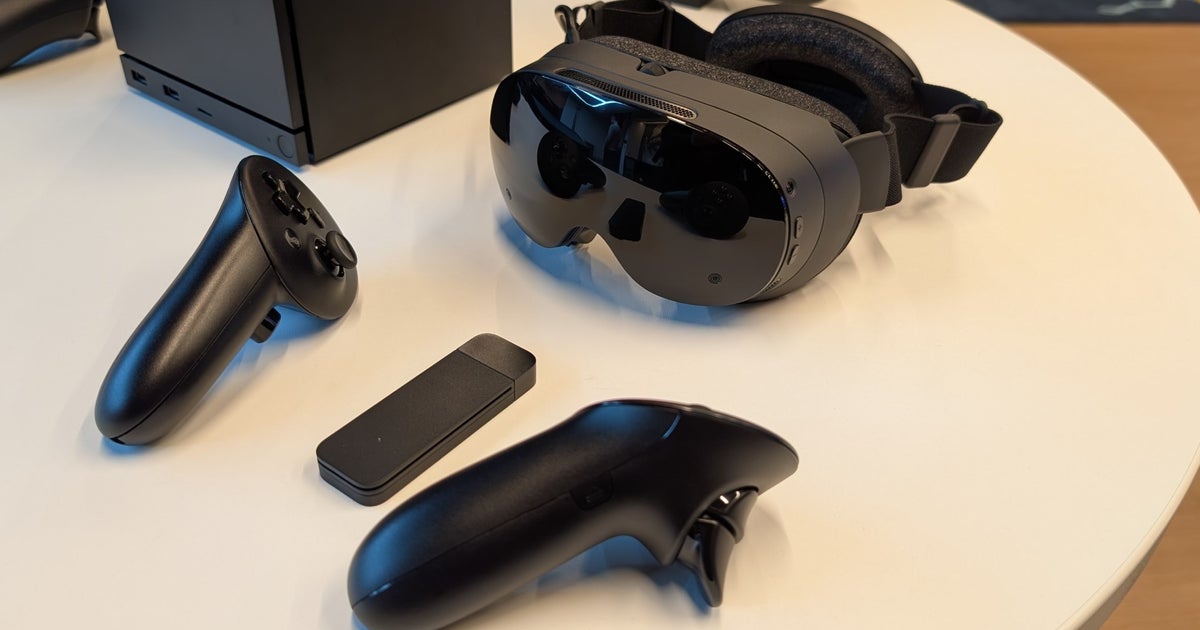
The all-in-one Steam Frame headset is on the way – very soon, if rumours are to be believed – but in short, things don’t look great. Then again, things don’t look great anywherein the games industry, so why should VR, gaming’s most niche market, be any different? To truly understand the state of the VR scene, we need to try to separate the generallybad from the specificallybad. When we do that, it becomes clear that VR broadly isn’t faring any worse than the industry at large, and in some areas at least, is healthier than you might expect.
Let’s start with the hardware itself. As I mentioned, shipments of VR headsets are currently in decline, with a 17% drop in shipments in the first quarter of 2026. That’s a steep drop, though it’s worth bearing in mind the VR headset market hasn’t been especially well fed in the last couple of years.
Between 2019 and 2023, Wikipedia lists twelve VR headsets having launched, including all three Meta Quests. Since 2024, it lists just two headset launches: the Apple Vision Pro, and the Samsung Galaxy XR. This list does ignore some high-end headsets like those manufactured by Pimax. But such devices are a niche within a niche, unlikely to account for a vast number of sales.
With a dearth of new product, it’s understandable that people won’t be buying as many headsets. But the nature of the devices being launched tells another story – one of a general shift away from the mid-range, all-in-one gaming headset. HTC, at one point Meta’s primary competitor in VR’s middle ground, has seemingly abandoned headset development entirely, while recent headsets like the Vision Pro and the Galaxy XR were not designed with gaming foremost in mind.
Instead, VR devices have shifted increasingly to the extremes. At one end, you have a knotty mix of AR/XR goggles and AI-powered Smart Glasses taking the bones of VR tech and applying it to other functions (like recording people without their knowledge or consent). At the other end, you have the premium devices like Pimax’s headsets, eking a profit out of established VR converts and hardcore simulation enthusiasts willing to spend thousands on a new device.
This may just be a temporary situation. New, theoretically mid-range hardware is coming down the pipe. The question is whether it will still be mid-range by the time it arrives, and whether those devices will be sufficient to revert the downward trend of headset sales.
With no meaningful competition to speak of, Meta’s dominance of the VR market has continued unabated. Combined, the Quest 3, Quest 2, and Quest 3S represent more than two thirds of the VR user base on Steam, while Valve’s own Index is used by just 11% of VR players.
Meta’s own VR gaming ecosystem also seems relatively healthy, though we only have Meta’s word for this. In 2023, reports claimed that Meta saw over 6 million monthly active Quest users. According to the company, Quest usage has grown consistently since then, and was at its highest ever as of 2025.
Apparently, sales of games on the Meta’s Horizon Store were “up very slightly” in 2025, which seems out of kilter with the broader games industry’s <a href="https://www.pcgamer.com/gaming-industry/the-videogame-market-is-as-big-as-ever-with-pc-leading-growth-global-games-revenue-surpassed-the-usd200-billion-mark-in-2025/” rel=”nofollow noopener” target=”_blank”>surprisingly impressive performance last year. However, Meta’s sales figures may be affected by the Horizon Store+ subscription service, Meta’s equivalent to Game Pass, which now has over 1 million subscribers to Horizon Store+.
While all of this is positive, it’s important to put this context of Meta’s broader VR market. Only 1% of all Steam users play VR games, which includes Quest users, Valve Index players, and people still running on HTC Vive.
With the Horizon Store, Meta has the advantage of a captive audience, but there is still a question over how viable an enterprise VR gaming is for its biggest fish. Meta said that last year, the number of apps that made more than $1 million in gross revenue on the Horizon store last year was over 100. To be clear, that’s allapps for all time, not new apps released in 2025. Nonetheless, that’s a minimum of $100 million from the Horizon Store, and some games, like the wildly successful Beat Saber, likely made significantly more than $1 million.
In isolation, then, the Meta store seems to be a steady earner. But it’s crucial to factor in the galactic boondoggle that is Meta’s failed pursuit of the Metaverse. Reality Labs has chalked up a staggering $80 billion in operating losses – and at that lower estimate, those one hundred apps would have to continue earning $1 million in revenue for 800 years in order for Reality Labs to break even.
Obviously, Meta have more money coming in than that, but at $402 million in sales this quarter versus more than $4 billion in operating losses, the numbers still don’t add up. As such, Meta finally admitted defeat on the VR side of Horizon Worlds in June, shutting it down as a virtual reality platform (Horizon Worlds continues to exist as a smartphone experience, where it does at least make some money).
Sadly, Horizon Worlds VR wasn’t the only casualty of the Metaverse fiasco. In January, Meta shut down three VR studios, including the creators of Asgard’s Wrath and Resident Evil 4 VR. They also cancelled a sequel to the excellent Batman: Arkham Shadow and ended its support for Quest for Business – aka VR for boring people.
All of this has led to questions about how much of a priority VR is at Meta, especially as they invest heavily in AI (which is also not going well) and Reality Labs switches focus from the Metaverse to smart glasses. Despite this, Meta themselves say they hasn’t lost interest in VR yet, stating that their investment in future VR headsets “remains large”, with new devices currently in development.
For the short to medium term, VR’s future looks relatively stable within Meta’s own ecosystem. Outside of that bubble, however, things are considerably tougher. Alongside the studio closures initiated by Meta, numerous other notable VR developers have struggled this year. Mighty Eyes, developers of the VR Adventure, Wanderer: Fragments of Fate, cancelled a planned sequel and ended support for the current game. Survios, the creators of Alien: Rogue Incursion, laid off most of their development team in April. That same month, the social VR gaming platform Rec Room announced it was closing in June, after the developers admitted they had struggled to make it a profitable business. Rec Room, it should be noted, was one of the most popular VR apps on Steam.
The big problem for PCVR devs is simple visibility. Games released on the Meta store have the advantage of an audience primed for VR games. But on Steam, VR developers are competing with everyother game on the platform, and VR games are at an automatic disadvantage because of their specialist hardware requirements. Even within their own VR category, bespoke VR games must compete with already successful flatscreen games that also support VR, like Phasmophobia, Skyrim, and No Man’s Sky.
The combination of the visibility issue and the much smaller audience is also why tentpole games like Half-Life: Alyx and Asgard’s Wrath 2 are rare. Games of that scope have budgets in the tens and hundreds of millions, and unless you have a device to sell, as Valve and Meta did with both of those games, developers need to maximise the potential audience for it.
Meta themselves said as much in their own state-of-VR article, observing that “The big-budget AAA Hollywood style narrative games are simply too expensive for today’s market.” Hence, such games will either be exclusively flatscreen or feature VR as an option, though every one of these which does succeed makes it even harder for VR exclusive games to break through.
This watering down of VR exclusivity also means that bona-fide killer apps for VR are few and far between. While 2026 has delivered a few moderately interesting titles, like Into the Radius 2, the survival game Bootstrap Island, and Little Nightmares VR, none are likely to draw people back to VR en masse. Similarly, there are a few interesting projects in the works, like Payday: Aces High and Hot Dogs, Horseshoes & Hand Grenades 2. But these games face an enormous struggle to to wrest attention away from the mainstream flatscreen experiences.
What does all this mean, then, for the impending release of Valve’s Steam Frame? Well, an injection of new hardware certainly wouldn’t hurt the VR market, but the extent of its impact is going to be highly dependent on several factors. The first is price. While the original plan was to make the Frame cheaper than the £919 Index, subsequent hardware shortages (precipitated by AI data centres gobbling up every free SSD and stick of RAM) are likely to have a significant impact on the new headset’s price, with reports suggesting it could cost as much as $1,500 (£1,120). That would kick it well out of the territory occupied by the Quest 3, putting it closer to the specialist headsets made by Pimax.
The other factor is: what are you going to play on it? The age of excitement over VR for its own sake has well and truly passed, and if those reported prices are accurate, the Steam Frame is unlikely to appeal to anyone who hasn’t bought into VR already. Which leaves games as the main draw. Again, though, there aren’t really any big, glossy VR exclusives knocking around that are likely to tempt people into dropping a thousand notes on a new headset. Put another way, nobody’s going to buy a Steam Frame to play Gorilla Tag.
No doubt every VR enthusiast (myself included) is hoping that Valve has something else in the tank—an equivalent of Half-Life: Alyx to really show off the Steam Frame’s capabilities. Unfortunately, there’s little to suggest this is the case. When similar questions circulated around the Steam Machine, Valve said they viewed the entire Steam library as its launch exclusive. Plus, the Steam Frame is being marketed not just as a VR headset but as a PC, able to play VR and non-VR games either through streaming or as a standalone device.
As such, I don’t see the Steam Frame changing the shape of the VR market in any meaningful way. And until Valve can build a device that can effectively compete with Meta on price, it will continue to play second fiddle to the Quest on its own platform.
All of this said, VR gaming is not dead. While the Steam Frame is unlikely to radically change the VR landscape, Valve have enough of an audience that the headset will probably be successful on its own terms. Meta, meanwhile, clearly sees enough value in the Quest and Horizon+ for at least one more device iteration.
What shape the future of VR gaming will take is harder to define. For VR to reignite large-scale interest, it needs games that can compete with your premium flatscreen experiences, your Half-Life, your Boneworks, your Asgard’s Wrath. It appears few, if any, developers are willing to take on that level of risk.
Meta believe that the future is in smaller multiplayer fare aimed teenagers, the VR equivalents of games like Peak and R.E.P.O., of which Gorilla Tag is probably one. Those games are definitely more affordable to make, but the hardware also needs to be affordable for that demographic too, which is going to be increasingly difficult to maintain over the next few years.
Personally, I reckon that, short of a landscape-altering event, VR will eventually be subsumed into the broader games industry as an alternative way to play, no different from buying a steering wheel for your racing games or a HOTAS for your flight sims. The Steam Frame’s hybrid nature is emblematic of this in some ways. Rather than being a VR headset, it’s a headset that does VR if you want it to. It’ll be interesting to see how PC players respond to that.
