

‘I’m the original item girl’: Usha Uthup on embracing age, her brassy ‘bedroom voice’ and how Dhurandhar gave her career a new boost
Why the ‘original item girl’ never chased Bollywood benchmarks or reinvention
Dubai: Three minutes. That’s roughly all it took for Usha Uthup to become Usha Uthup.
When the legendary Indian singer first logged onto our zoom video call, there had been a small but crucial miscommunication: she had been told it was an audio interview.
“I thought this was not a video chat,” she said, slightly startled when I asked if she could <a href="https://comicvibe.com/4-of-the-best-portable-battery-packs-you-can-buy-for-nintendo-switch-2/” title=”4 Of The Best Portable Battery Packs You Can Buy For Nintendo Switch 2″>switch on her camera.
The reason was wonderfully simple. “I’m not really well dressed and camera-ready”
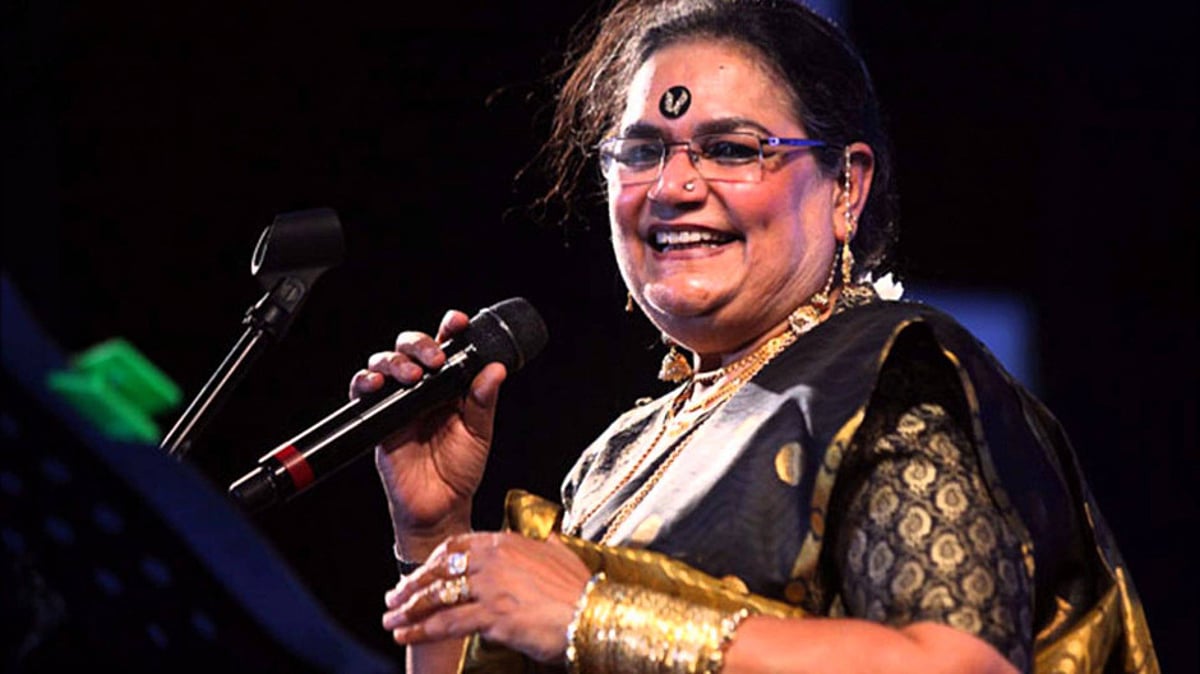
When I assured her we could absolutely stick to audio if she preferred, Usha thought over it swiftly. There was some hurried searching for dangling statement earrings, some good-natured fretting about not being properly dressed and then, within minutes, she was in boss-lady mode with her unmistakable vertical and round Bindi on her forehead, the not-so-heavy silk sari, and her carelessly-tied chignon. She quickly dabbed some maroon lipstick too.
“That’s as good as I can get now,” she declared with a confident smile.
Except, it wasn’t merely a quick fix. In hindsight, those gloriously chaotic few minutes before the interview were perhaps the most Usha Uthup introduction imaginable. There was no entourage engineering a transformation, no elaborate glam intervention and certainly no diva-level fussing.
When the interview formally began, she took one look at herself and delivered a disclaimer that wasn’t really a disclaimer at all.
“I would have liked to be a little better dressed than I am now, but that’s not an apology because what you see is what you get.”
‘I never changed the way I looked’
For a woman who has spent 57 years in an industry addicted to makeovers, Uthup seems wonderfully immune to the whole business of becoming somebody else.
The sari, the flowers, the bangles, the heavy necklaces and, most importantly, that unmistakable deep, brassy voice were never manufactured as part of some carefully plotted personal brand.
“Of course, that’s my USP. I mean, I never changed the way I looked. Sari stayed,” she said.
She traces her love for saris to an ordinary upbringing.
“It’s because I come from a very middle class family, and I mean, I just wore whatever there was in the house, whatever my amma wore or what my sisters wore. I just wore that. That’s all.”
Success just meant she wore more expensive saris. But the woman inside them remained stubbornly familiar.
“I was always well turned out, and that’s what is important.”
For Uthup, fashion is less about making statements than knowing what works for you and sticking with it.
“Fashion is about comfort, being constant and consistent,” she said. “And that’s what I’ve been for 57 years on stage.”
‘Age is definitely age’
At a time when we are constantly being told that age is merely a number, Uthup comes clean.
“Age is not just a number,” she said. “Age is definitely age. There’s no denying that you have more grey hair and wrinkles. But you know what, who cares! I am very happy ageing boldly and loudly.”
That lack of anxiety about ageing perhaps explains why she can share a stage with musicians generations younger than her without trying to compete with them.
Speaking about performing in Dubai’s Coca Cola Arena alongside Benny Dayal and Thaikkudam Bridge in the concert entitled ‘Thaalam Beats this Saturday on August 15th, Uthup seemed more excited than territorial.
She is a fan of theirs, she insisted, and believes relationships between artists matter more than any contrived chemistry.
“I just call it plain love and maintaining relationships.”
The generational differences, if anything, reinforce something she has believed throughout her career.
“Music has no barriers of caste, color, creed, gender, age, sex. No way, there is no barrier.”
And then she offered another reminder of why she has survived so many musical eras.
“The song is much bigger than the singer, and a song is a song is a song. It doesn’t matter who sang it before.”
When ‘Dhurandhar’ introduced Usha Uthup to another generation
Perhaps nowhere is that philosophy more evident than in the extraordinary second life of “Rambha Ho”.
The song, which Uthup sang decades ago, has found an entirely new audience through Dhurandhar. Children who may have had no idea who originally sang it are suddenly playing it on loop.
When I told her that my own children had discovered the track this way, Uthup didn’t sound possessive about a younger generation arriving late to her music.
She sounded grateful.
“Exactly, that’s what I’m saying. I’m so grateful to God and to Dhurandhar and to my audiences for letting me be here, live to tell the tale that, hey look, this is where it started.”
She knows how that might sound.
“I mean that might sound so pompous,” she admitted.
But she isn’t claiming ownership so much as marvelling at her own longevity.
“It’s lovely to know… you’re still around to say that. Look, this is where it started, and I’m so happy about that.”
She compares it, hilariously, to enduring advertising jingles; even invoking her own Vicks and Amul jingles, whose tunes survive generations.
“It’s like that, you know, that you’re still around. Thank God for that, to be able to say, hey, this is how it started.”
And then comes the line that captures the extraordinary circularity of pop culture.
“All the things that y’all are doing now is something I did 57 years ago.”
‘I’m the original item girl’
Uthup isn’t precious about terminology either.
Young filmmakers still approach her because they want that unmistakable husky voice. She recently recorded a Kannada song, she told me, for a young director and music director who specifically wanted her particular vocal texture.
Or, as Uthup puts it rather more colourfully, her “bedroom voice”.
Then she drops another fabulous description of herself.
“They used to call me the item girl. I’m the original item girl.”
Her reasoning is delivered with wicked matter-of-factness.
“All the good girls got Lataji Mangeshkar and Asha Bhosle… and all the bad girls got me, so that’s fine.”
And Uthup certainly got the songs that demanded swagger.
“That’s how ‘Hari Om Hari’ and ‘Rambha Ho’…” she said, before rattling off songs she has sung across Tamil, Telugu and Malayalam.
There is no resentment about the categories she was placed into. If anything, she appears amused by how neatly the very quality that once made her an outsider became her calling card.
“I’ve got a very bass voice,” she said.
When I asked if that was the famous bedroom voice, she laughed.
“That is my bedroom voice, my item girl voice. But that’s how I sound voice.”
That final distinction matters.
Because Uthup never manufactured the voice either.
“This is how I sound, and I’m very happy about it.”
‘It’s about how original you are’
For a singer who entered an industry dominated by conventionally sweeter female playback voices, Uthup could have spent years attempting to sand down her differences.
She did the opposite.
“As I always say, it’s not how good a singer or how bad a singer, but how original you are, and that keeps you going.”
It may be the most important thing she says during our conversation.
Because originality, in Uthup’s world, isn’t a motivational hashtag. It is a 57-year experiment whose results are now sitting in front of her.
“I’m very, very grateful that I was — that I am — so different, and I’ve never copied anybody. Never ever.”
She is equally generous towards the women who followed.
Talking about Sunidhi Chauhan, Uthup is almost gleeful in her admiration.
“Look at her. Look at the way she sings. Look at the body. Look at the entire package. It’s so fantastic.”
When I mention stamina, Uthup swiftly corrects me.
“Stamina I have. Okay, I have so many things, but body I don’t.”
It is impossible not to laugh.
But beneath the joke lies something striking: there is remarkably little bitterness in the way Uthup surveys an industry that didn’t necessarily build its conventional heroine-singer mould around women who looked or sounded like her.
She doesn’t begrudge viral singers their overnight success either.
“I don’t judge people really. If I like a song or I like a singer, I just love them.”
She knows, however, that a studio and a stage demand very different muscles.
“In live, there is no second chance, and there is no way that you can rectify in case you’ve made a mistake.”
Still, she refuses to sit in judgment over singers who become famous through a single viral song.
“It’s okay. I mean, it’s all right. Let everything come up. There’s room for many more.”
Bollywood was never the benchmark
Perhaps one reason Uthup has been able to remain so open is that Bollywood was never the sole measure of her success.
She built herself through nightclubs, restaurants, live stages, multiple Indian languages and audiences who discovered her through word of mouth long before algorithms could turn a singer into an overnight sensation.
She remembers an era with “no television” and certainly no social media.
“Maybe that’s why I’m still around because it was so slow,” she said.
“For me, it was all about just the print media that wrote about me, and also the amazing word of mouth, or as they call it, industry whispers.”
People would talk about “this South Indian girl in a sari” they had heard singing somewhere.
That was virality before virality came with a view count. And Uthup remains proud of having built a career around “live performances, not using Bollywood as a benchmark for success.”
That doesn’t mean she rejects Bollywood.
“I’m very, very happy to do any song that anybody asks me.”
The difference is subtle but important: Bollywood could be part of Usha Uthup’s career. It never needed to validate it.
‘Why would I want to change?’
Our conversation eventually turns to women and the relentless pressure to shrink; physically, metaphorically, professionally.
Uthup acknowledges that she wouldn’t mind losing some weight, but her reasoning has nothing to do with appearance.
“I’d love to lose a little bit more weight because it might just help my knees and things like that, but not otherwise.”
Her audiences, she believes, have grown up with the woman they recognise.
“People have grown up with me and the way I look.”
After concerts, people still approach her amazed that she appears essentially the same woman they encountered decades earlier.
And her response is beautifully uncomplicated.
“Why would I want to change?”
Women, she says, have always been among her greatest supporters.
Then comes a joke only Usha Uthup could deliver with such cheerfulness.
“They know with a body and a face like mine, I’m no danger to their husbands.”
I protest. Surely we don’t need to reduce women to that? But Uthup isn’t easily moved from her point.
She explains it in the context of the world in which she began singing, nightclubs and restaurants largely frequented by men.
Slowly, women and families began coming too.
They saw a South Indian woman in a sari singing Western songs — a visual and sonic combination that refused the usual nightclub stereotype.
“They feel it’s okay. She’s okay. I’m okay.”
And eventually, she says, those spaces “became a place which was for families too.”
Again, Uthup changed the room simply by refusing to change herself.
Dubai, Malayalam and a ‘mini India’
Her relationship with Dubai is similarly built around people rather than glamour.
“Dubai has been wonderful, really, to me.”
Over the years, the city’s multicultural audiences encouraged her to keep expanding her repertoire, including learning Arabic songs.
She understands that a Dubai crowd can contain Malayalis, Tamilians, Telugus, Punjabis, North Indians and many more communities, and she wants her concerts to reflect them.
“So you know it is whole of India, and I think Dubai is mini India.”
She has particularly warm memories of performing with Malayalam cinema legends including Mohanlal and Mammootty, and speaks excitedly about the response to “Empuraan”.
But ask what she loves about Dubai and she doesn’t immediately reach for shopping malls or luxury.
She talks about cab drivers.
“The minute you sit in a cab… I love to speak to the drivers straight away. I ask their names.”
Those conversations remind her that ordinary people frequently have far more in common than the borders drawn between them suggest.
“You could be driven all over by an Indian or a Pakistani driver… we talk the same language, we share the same jokes, we listen to the same FM radio.”
For Uthup, that’s Dubai at its best.
“It’s just a mini, mini world in Dubai and a mini India for sure.”
Still here, still singing
Towards the end of our conversation, I ask what she might sing next.
The woman whose “Rambha Ho” has suddenly been embraced by children decades after its creation tells me she has been receiving requests to sing Adele’s “Skyfall”.
There have been requests for Miley Cyrus’ “Flowers” too.
Of course there have.
Because perhaps the strangest thing about Usha Uthup’s 57-year career is that the woman who looks so gloriously consistent has never stopped moving musically.
The Kanjivarams silk saris, the bindi, and the bass voice stayed. She also refused to resemble anyone else and her songs kept traveling. But Uthup doesn’t pretend age hasn’t happened.
The grey hair and the wrinkles exists. But her parting line:
“Who cares because what you see is always what you get with me.”
Bollywood star Kalpana Iyer on Dubai and Dhurandhar
From radio star to entrepreneur in Dubai

Kritika Kamra on fame, roles and staying grounded

Remembering Asha Bhosle: Grit, glee and grace
Related Topics:
bollywoodPakistanindiaMusic
Get Updates on Topics You Choose

Know your artist: five UAE acts to see this autumn

Backlash over Israel song sees Boy George leave show

Dubai students sing tribute to UAE soldiers
Arijit Singh slams violence against protesting kids
