

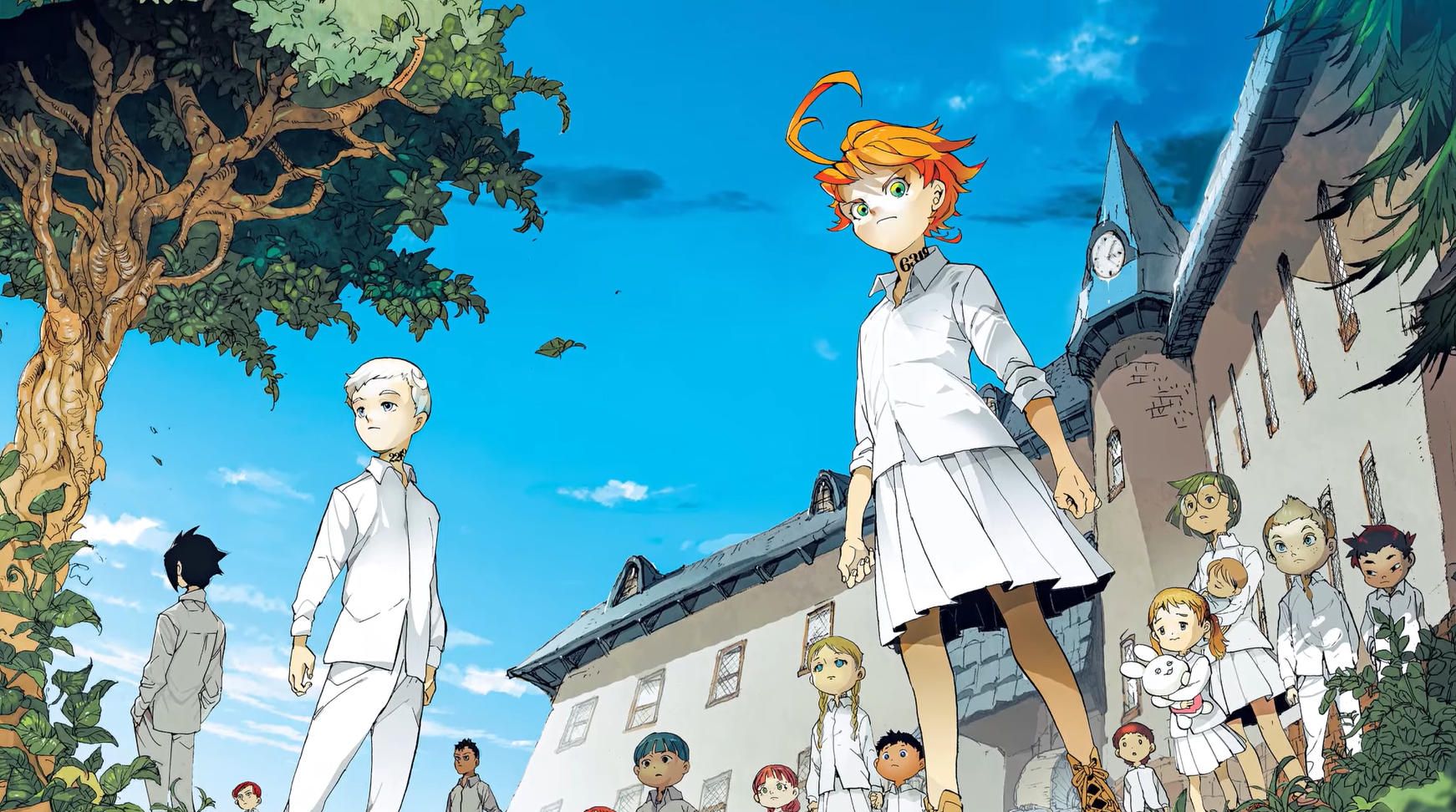
When political scientists study what happens after war ends, they identify a recurring crisis point that peace agreements rarely survive: the implementation gap. The moment a treaty is signed, the incentive structure that produced cooperation starts to erode, factions that weren’t party to the original deal pursue their own interests, and the absence of open conflict reveals every seam the agreement was sewn with. Kaiu Shirai and Posuka Demizu’s new 36-page one-shot for The Promised Neverland — confirmed today as “War vs. Peace” and scheduled for Weekly Shonen Jump Issue 39 on August 24 — arrives at precisely this moment in its fictional universe, five years after Emma renegotiated an interspecies treaty that had held for a thousand years. Whether a manga chapter can answer what peace actually costs is the question the franchise’s original finale never had time to ask.
Today’s combined Weekly Shonen Jump Issue 37/38, which went on sale in Japan on Monday, confirmed the title, page count, and publication date for the anniversary one-shot, as Anime News Network reported. The chapter was first teased in April as one of five projects marking the manga’s 10th anniversary; a title and storyboard preview appeared on August 5, confirming it would be a sequel rather than a side story; and today’s issue delivered the complete publication details.
“War vs. Peace” and the Ending That Wasn’t
The original The Promised Neverland manga ran in Weekly Shonen Jump from August 1, 2016, to June 15, 2020, spanning 181 chapters across 20 volumes. Its premise: in a world where humans and demons share a planet but not a territory, children raised in idyllic orphanages discover they are being bred as livestock for demon consumption. The story follows Emma, Norman, and Ray — the three exceptional children of Grace Field House — as they escape, rally allies, and ultimately dismantle the thousand-year-old treaty called “The Promise” that maintained the farming system. Emma’s renegotiation of The Promise, which closed the series, was intended to establish a world where demons and humans might coexist without predation — a resolution that the manga reached in its final pages at considerable speed.
Kaiu Shirai has confirmed publicly that the COVID-19 pandemic shortened the final arc, restricting content he had planned to include. The rushed ending became the series’ most discussed feature: readers got the destination but not the road. The one-shot’s title, “War vs. Peace,” suggests Shirai intends to finally walk that road. Preview pages released earlier in August confirmed the setting will be the year 2050 — five years after the manga’s 2045 conclusion — showing a world in which humans and demons appear to be working and living alongside each other, per Outlook Respawn’s reporting. Those previews showed Gilda searching for Ayshe, the taciturn demon-raised girl who fights alongside the Grace Field children in the manga’s later arcs and who was, notably, cut entirely from the anime’s second season.
The one-shot is the most significant new chapter in the franchise’s main timeline since a handful of bonus chapters published 2020-2021, and it is the first issued as part of a major formal anniversary campaign.
What Game Theory Predicts About Emma’s World
The political logic of The Promised Neverland has always been more rigorous than its genre requires. The original Promise was not simply a ceasefire — it was what game theorists would call a Stag Hunt resolution to an otherwise intractable conflict. Unlike a Prisoner’s Dilemma (where mutual defection is the rational equilibrium), a Stag Hunt describes a situation where both parties genuinely prefer cooperation but cannot commit to it without a trusted third party guaranteeing the other side won’t defect. The Ratri clan served as exactly that guarantor for a thousand years, ensuring the treaty held by managing both the human side’s ignorance of their condition and the demon side’s access to farmed livestock.
When Emma exposed and dismantled the Ratri clan’s role, she removed the institutional trust anchor — precisely what Robert Axelrod’s foundational 1984 research on cooperative game theory predicts as the most dangerous moment in any cooperative arrangement. Without a guarantor, cooperation in iterated games depends on direct trust between the parties and on the absence of actors who weren’t included in the original agreement. The year-2050 world “War vs. Peace” will enter is, in game-theoretic terms, not a solved problem but a freshly unsupported equilibrium — one that has survived five years but has no institutional mechanism guaranteeing it will survive five more.
This is not background. It is the structural question the title announces. “War vs. Peace” as a binary suggests that the post-Promise world hasn’t resolved the original conflict so much as postponed its next iteration. Game theory literature on the collapse of cooperation in evolving games — including Stewart and Plotkin’s evolutionary cooperation research at the University of Pennsylvania — predicts that cooperative equilibria are most vulnerable precisely when the conditions that produced them change, and that third parties who weren’t party to the original agreement tend to be the most significant source of defection. The one-shot’s preview pages suggest Ayshe, Gilda, and other characters from the manga’s later arcs will appear — and these are exactly the kinds of second-tier actors whose relationship to the new order the original manga left unresolved.
The Biology the Series Built Its World Around
The political stakes of “War vs. Peace” are inseparable from The Promised Neverland‘s underlying biology, which raises questions that real science takes seriously at a much smaller scale. Demon cognition and personhood in the fiction depend on what they consume: eating humans grants demons near-human intelligence, complex social reasoning, and stable physical form; prolonged deprivation reverses these gains, reducing them to feral, mindless creatures. This is the manga’s most scientifically interesting idea, because it maps onto real mechanisms in biology even though it vastly exaggerates their speed and scale.
Horizontal gene transfer — the process by which organisms acquire genetic material from outside the normal parent-offspring relationship — is well-documented in prokaryotes and increasingly observed in eukaryotes. Nematodes have acquired bacterial cellulase genes; some arthropods show evidence of predator-derived genetic sequences. The demon mechanism as written is a dramatic extrapolation of a related principle: dietary epigenetic reprogramming, in which consumed compounds act as transcription-factor modulators that activate or silence pre-existing gene sequences. The demon genome, in this reading, is a layered meta-genome that reads its biochemical environment and expresses accordingly — the same basic logic the hologenome theory of evolution uses to describe how host organisms and their microbiota function as a single unit of selection.
What this means for the post-Promise world is not trivial. A peace agreement between humans and demons is not analogous to a peace agreement between two human populations, because the biological dependency that drove the conflict doesn’t disappear when the farming system does. Demons who abstained from eating farmed humans — like the character Sonju, who refused on religious grounds — represent the possibility of a demon who maintained cognitive stability without human livestock. But the fiction raises, and the one-shot will presumably have to engage with, the question of what happens to demon populations whose access to their traditional food source has been removed but whose biology hasn’t changed. The science of dietary dependency, withdrawal, and population-level behavioral change is real medicine; the fictional version is a mythological amplification of it.
What a Divisive Ending Means for a Sequel
The Promised Neverland‘s original anime adaptation offers a useful frame for understanding what Shirai is returning to and why the fandom’s response to today’s announcement has been notably complex. The anime’s first season, produced by CloverWorks and broadcast in 2019, was one of the most acclaimed genre series of the decade, earning 100% on Rotten Tomatoes across reviewed episodes and “Best Fantasy” at the 2020 Crunchyroll Anime Awards. The second season, which aired January through March 2021, became a case study in adaptation failure: it omitted entire arcs (including the Goldy Pond storyline, which introduced Ayshe), compressed the manga’s most complex political chapters into a handful of episodes, and ended with a finale that Anime News Network critic Jairus Taylor called “a total disaster” that “faceplanted pretty hard.” Writers removed their names from the final episodes after the backlash.
The result is an unusual split in the franchise’s audience. Anime-only viewers experienced a story that ended feeling incomplete and rushed. Manga readers experienced a story that ended feeling incomplete and rushed for different reasons — COVID cut the final arc short — but with substantially more narrative investment. “War vs. Peace” is not resolving the anime — Shirai has made clear this is a manga one-shot, and no anime adaptation has been announced — but it is returning to the version of the story that the manga readers felt was truncated. The 36-page count means this will be a focused story, not a comprehensive restoration. Thirty-six pages is enough to establish tone, show a limited set of characters in the year-2050 world, and make a specific statement about what peace between humans and demons looks like in practice. It is not enough to answer every open thread.
What it can do — and what the title suggests it intends to do — is demonstrate whether Shirai believes the world he built is capable of sustaining peace, or whether the answer is that it is not, that the biological and political pressures that produced a thousand years of exploitation simply reorganize themselves under new conditions. That is a genuinely philosophical question, and it is the one the franchise’s entire architecture was built to ask.
Where to Read, and What to Expect
“War vs. Peace” will publish in Weekly Shonen Jump Issue 39, on sale in Japan on Sunday, August 24, 2026. As of today, no English-language release date or simultaneous international publication window has been confirmed by Shueisha, Viz Media, or the Shueisha MangaPlus digital service, though MangaPlus has historically carried The Promised Neverland chapters simultaneously with Japanese release for international readers. English-language availability should be confirmed closer to August 24.
The anniversary campaign also includes a stage musical adaptation running in Tokyo this winter, a full-color digital edition of the complete manga, and Shueisha’s ongoing offer of the first 10 volumes free to read on Shonen Jump+ and the Zebrack platform through August 31, 2026. The manga accumulated more than 42 million copies in worldwide circulation by August 2023, and the franchise represents one of Weekly Shonen Jump’s most commercially significant concluded series.
The one-shot is not a new series and is not, at this stage, a confirmed bridge to one. It is a 36-page answer to a question the original story opened and left unresolved. Whether that answer satisfies — whether post-Promise coexistence holds, fractures, or collapses back into something the title “War vs. Peace” implies is still being decided — is what August 24 will reveal.
Frequently Asked Questions
When does the Promised Neverland one-shot “War vs. Peace” come out?
“War vs. Peace” will appear in Weekly Shonen Jump Issue 39, which goes on sale in Japan on Sunday, August 24, 2026. As of August 10, no simultaneous English-language release has been officially confirmed, but Shueisha’s MangaPlus platform has historically carried the series for international readers alongside the Japanese release. Check MangaPlus and Viz Media’s Shonen Jump platform around August 24 for English availability.
Will “War vs. Peace” lead to a full sequel series for Promised Neverland?
No sequel series has been announced. “War vs. Peace” is a standalone 36-page one-shot commissioned as part of the manga’s 10th anniversary campaign, which also includes a stage musical, a full-color digital edition, and other merchandise initiatives. Shirai has not publicly indicated plans for a new serialization. Given how the manga’s post-2020 output has been structured — focused bonus chapters rather than ongoing storylines — the one-shot appears to be a contained statement rather than a series launch. That said, fan response to major anniversary one-shots has historically influenced publishers’ decisions about further development.
What is the post-Promise world like, based on what’s been revealed?
Preview pages released by Shueisha on August 5 showed a setting in the year 2050 — five years after the manga’s 2045 conclusion — in which humans and demons appear to be coexisting peacefully. Characters from the manga’s later arcs, including Gilda and Ayshe, appear in the previews, suggesting the one-shot will follow the Grace Field House survivors rather than introduce an entirely new cast. Beyond those preview glimpses, the specific events, conflicts, and themes of the chapter remain unknown until August 24.
Why did the Promised Neverland manga end the way it did?
Kaiu Shirai has confirmed that the COVID-19 pandemic shortened the final arc, restricting content he had planned to include. The original story was intended to run longer; the final chapters were compressed due to production constraints, which is why the resolution felt abrupt to many readers. The one-shot appears to be, in part, Shirai’s opportunity to revisit the post-Promise world that the original ending could only gesture toward.
ⓒ 2026 TECHTIMES.com All rights reserved. Do not reproduce without permission.
