

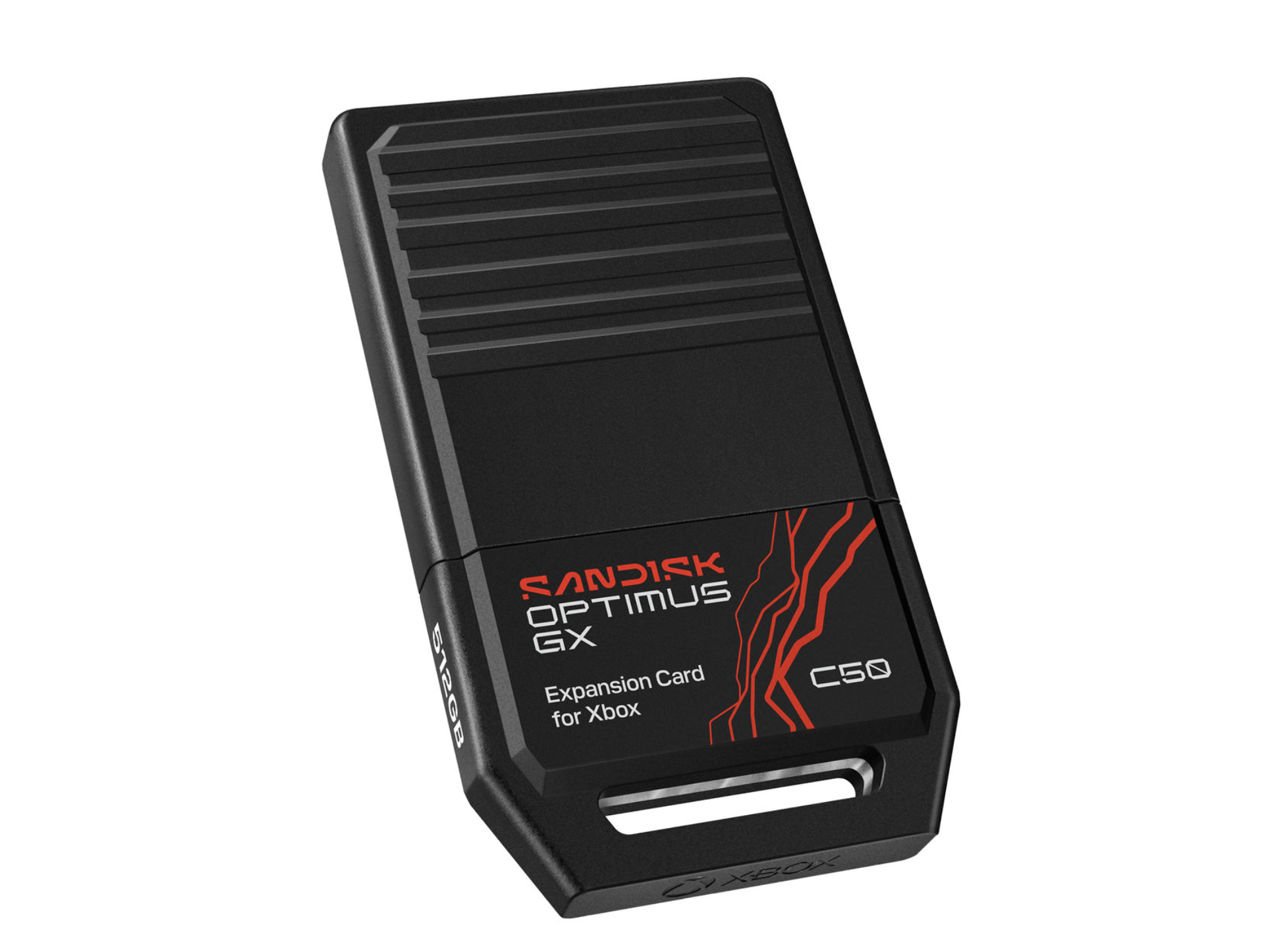
SanDisk has unveiled the Optimus GX C50 Storage Expansion Card for Xbox Series X|S, making it the third manufacturer to earn Microsoft’s certification for the console’s proprietary expansion slot. The cards are available in three capacities — 512GB, 1TB, and 2TB — and are expected to reach retail in late August 2026. The announcement was covered today by Pure Xbox and GamesRadar, arriving weeks after the Xbox price rose to $799.99 on August 1 and just under three months before Grand Theft Auto 6 lands on November 19 at the Xbox store product page with an estimated 200GB install size.
For the roughly 28 million Xbox Series X|S owners who have spent the last six years juggling storage on a console with no open NVMe upgrade path, the Optimus GX C50 arrives with introductory pricing that makes a genuine case for itself. The 1TB model is listed at $199.99 on SanDisk’s own website — $175 below the $374.99 currently showing for the WD_BLACK C50 at Best Buy’s current listing. Whether that price holds is a different question.
What Is the Optimus GX C50?
The Optimus GX C50 is an officially licensed expansion card that plugs into the dedicated slot on the back of the Xbox Series X or Series S — a slot that looks and functions nothing like the M.2 port on a PS5. Where Sony owners can pop open the side panel and insert any compatible Gen 4 NVMe drive, Xbox owners must buy a card certified by Microsoft and manufactured under a licensing agreement. Seagate held that exclusivity from the platform’s November 2020 launch until Western Digital entered in 2023 with the WD_BLACK C50. SanDisk’s arrival marks the third certified manufacturer.
All three cards deliver the same thing: a performance floor set by Xbox Velocity Architecture, Microsoft’s proprietary storage subsystem that requires any expansion card to sustain 2.4 GB/s of raw I/O throughput with guaranteed consistency across the full range of operating conditions. The reason the Xbox imposes this threshold is technical: Xbox Velocity Architecture’s hardware decompression block routes asset reads directly from the expansion card’s NVMe controller to a dedicated decompression chip on the console’s SoC, <a href="https://learn.microsoft.com/en-us/gaming/gdk/_content/gc/system/overviews/directstorage/directstorage-overview” rel=”nofollow noopener” target=”_blank”>bypassing the CPU entirely. That pipeline can handle up to 50,000 I/O requests per second using less than 10 percent of a single CPU core — which is what allows an optimized title to stream textures, level geometry, and audio assets continuously without the CPU stutter that plagued the previous console generation. For that pipeline to work identically whether a game is running from the internal drive or an expansion card, the card must meet the same sustained-throughput guarantee. Microsoft controls that specification, which is why only certified manufacturers can sell compatible cards.
The physical format is a modified CFexpress Type B connector, the same standard used by professional cinema cameras from Canon, Nikon, and Panasonic — but with the pins rearranged. Reverse-engineering by modders confirmed that the slot runs PCIe 4.0 x2, and that the pin rearrangement is a deliberate design choice that prevents standard CFexpress cards from working, creating the licensing gate. The result is that every licensed Xbox expansion card uses functionally identical underlying technology, which is why performance testing consistently shows no measurable difference between a Seagate card, a WD_BLACK card, or any future SanDisk card.
Pricing: Introductory, With an Asterisk
SanDisk’s introductory launch prices are as follows:
- 512GB: $109.99
- 1TB: $199.99
- 2TB: $339.99
Those are the prices on SanDisk’s own website, where the “standard” retail prices appear crossed out above them: $137.99, $249.99, and $424.99 respectively. The crossed-out figures are SanDisk’s own stated regular prices — a strong signal that the launch figures are promotional and may rise after the initial sale period ends. GamesRadar’s reviewer noted the same concern, writing that the launch figures look like introductory prices.
The picture gets more complicated when you look at retail. Best Buy is currently listing the 1TB Optimus GX C50 at $265.99 — $66 more than SanDisk’s own website. The Best Buy SanDisk C50 listing suggests that SanDisk’s direct site pricing is the promotional entry point, while third-party retailers are already pricing closer to where the card will settle once the launch offer expires. Buyers who want the $199.99 price should purchase directly from SanDisk.
For comparison, the WD_BLACK C50 1TB — which is technically a predecessor product from the same corporate family — is currently selling for $374.99 at Best Buy. Even at Best Buy’s higher SanDisk price of $265.99, the Optimus GX C50 1TB remains $109 cheaper than the WD_BLACK 1TB at the same retailer.
WD_BLACK by Another Name
The Optimus GX C50 is not, strictly speaking, a product from a new entrant. SanDisk was part of Western Digital from 2016 until February 2025, when the flash memory business was spun out as an independent public company per the SanDisk corporate separation agreement. At CES 2026, the newly independent SanDisk announced the Optimus brand as the successor to the WD_BLACK and WD Blue lineups — retiring those names in favor of a three-tier structure: Optimus (entry), Optimus GX (gaming), and Optimus GX Pro (professional). The WD_BLACK C50 Xbox expansion card maps directly to the Optimus GX tier; the C50 suffix carries over intact.
What this means practically: the Optimus GX C50’s underlying technology, manufacturing processes, and certification with Microsoft were established by the same engineering organization that built the WD_BLACK C50. The “third manufacturer” story is accurate in a corporate legal sense — SanDisk and Western Digital are now separate public companies — but the technology and institutional knowledge behind the card are continuous with the WD_BLACK line. Buyers who trust the WD_BLACK C50’s track record are buying from the same production lineage.
The more significant question is what the rebrand signals about long-term stock availability. The WD_BLACK C50 and Seagate expansion card have both gone in and out of stock repeatedly in 2026. Adding a third SKU from the same family as WD_BLACK does not automatically double the supply of licensed expansion cards — it adds a label. Whether SanDisk is manufacturing the Optimus GX C50 as an additional production run or as a replacement for declining WD_BLACK inventory remains unconfirmed.
Why Expansion Cards Matter More Now
The storage calculus for Xbox owners shifted significantly on August 1, when Xbox Series X prices rose to $799.99 for the 1TB disc model and $499.99 for the 512GB Series S. The 2TB Galaxy Black Special Edition was discontinued. For owners who cannot or will not buy a new console, the expansion card slot — which can be paired with any licensed card — remains the only way to extend storage while preserving the full Xbox Velocity Architecture performance guarantee for new-generation titles.
The math argues for going large. An Xbox Series X has approximately 802GB of usable internal storage. With Starfield consuming around 140GB, Forza Motorsport around 100GB, and GTA 6 carrying an estimated 200GB install size, three flagship titles alone consume 440GB — more than half of a 1TB expansion card. The 2TB Optimus GX C50 at SanDisk’s introductory $339.99 price stores roughly twice what the 1TB card does, at a cost that is less than half what a replacement Xbox Series X currently costs.
The broader NAND flash market makes the timing notable. Since late 2025, wholesale NAND and DRAM prices have more than doubled as AI data center demand redirected semiconductor fab capacity toward high-bandwidth memory for AI accelerators. Microsoft itself stated that its storage costs risen 2.5 times since late 2025, with further increases expected through 2027. Against that backdrop, a new expansion card entering with pricing below the existing retail competition is a genuine counter-market signal — whether it reflects SanDisk absorbing cost to build market share, or a one-time promotional window before prices normalize.
Bundled Perks and Availability
Each Optimus GX C50 includes two bundle offers: a one-month trial of Xbox Game Pass Ultimate (for new subscribers only, redeemable at Microsoft.com/redeem by December 15, 2027) and a one-month trial of Discord Nitro. Neither offer is a substitute for the card’s core storage value, but both represent modest near-term incentive for buyers who have not yet subscribed to either service.
As of today, SanDisk’s product pages show a “Notify Me” button rather than a confirmed release date. Best Buy has already listed all three capacities, and multiple gaming hardware outlets project availability in late August 2026. No firm ship date has been confirmed by SanDisk.
The 5-year limited warranty matches the WD_BLACK C50’s coverage and exceeds the standard 3-year warranty on most Seagate expansion card models — a practical advantage for a component that will be repeatedly inserted and removed and that lives in a console environment with limited airflow.
Should You Buy at Launch?
The honest answer depends on which price you expect to pay. At SanDisk’s direct-site introductory prices, the Optimus GX C50 is the most affordable new licensed expansion card on the market today — particularly the 1TB at $199.99. At Best Buy’s current $265.99, it is still competitive but no longer dramatically so. If SanDisk’s standard prices ($249.99 for 1TB) are where the card settles after the promotional period, the advantage narrows further.
The 5-year warranty, the proven CFexpress Type-B architecture, the timing ahead of GTA 6’s launch window, and the absence of any competing expansion card launch on the horizon all support moving quickly. The one risk is overpaying through a third-party retailer when SanDisk’s own site offers a substantially lower price. For buyers who plan to purchase, going direct is the cleaner path as long as the introductory prices are still in effect.
Frequently Asked Questions
Is the SanDisk Optimus GX C50 compatible with both Xbox Series X and Xbox Series S?
Yes. The card is officially licensed for both the Xbox Series X and the Xbox Series S, using the same proprietary expansion slot on the back of each console. All licensed expansion cards — from Seagate, WD_BLACK, and now SanDisk — deliver the same Xbox Velocity Architecture performance on both consoles.
Why can’t Xbox Series X|S owners use a standard NVMe SSD or a PS5-style upgrade instead?
Xbox’s storage expansion slot uses a modified CFexpress connector with PCIe 4.0 x2 — a standard form factor, but with the pins rearranged so that off-the-shelf NVMe drives and standard CFexpress cards cannot physically connect. The proprietary format allows Microsoft to control which manufacturers can produce compatible accessories and to enforce a guaranteed minimum sustained throughput of 2.4 GB/s, which is required for the console’s hardware decompression pipeline to work correctly. Unlike the PS5, which has an open M.2 slot that accepts any compatible Gen 4 NVMe drive with a heatsink, Xbox owners are limited to licensed expansion cards.
Is SanDisk a genuinely new manufacturer, or is this related to WD_BLACK?
SanDisk and Western Digital are now separate public companies, but their flash memory businesses shared the same engineering organization until February 2025, when the spin-off was completed. At CES 2026, the independent SanDisk retired the WD_BLACK brand in favor of the Optimus GX naming tier. The Optimus GX C50 is the direct successor to the WD_BLACK C50 in all but name — same form factor, same PCIe 4.0 x2 interface, same five-year warranty, per the SanDisk CES 2026 announcement. Buyers should treat it as a rebranded continuation of the WD_BLACK line rather than an entirely new entrant.
Will the introductory prices on the SanDisk Optimus GX C50 last?
Not necessarily. SanDisk’s own product pages show standard retail prices — $137.99 (512GB), $249.99 (1TB), $424.99 (2TB) — crossed out above the launch figures, which is a standard promotional discount presentation signaling that the introductory rates are temporary. The Best Buy SanDisk C50 listing already shows the 1TB at $265.99, which is $66 above SanDisk’s own launch price and already closer to the standard rate. Buyers who want the introductory pricing should purchase directly from sandisk.com while the promotional window is open.
ⓒ 2026 TECHTIMES.com All rights reserved. Do not reproduce without permission.
