

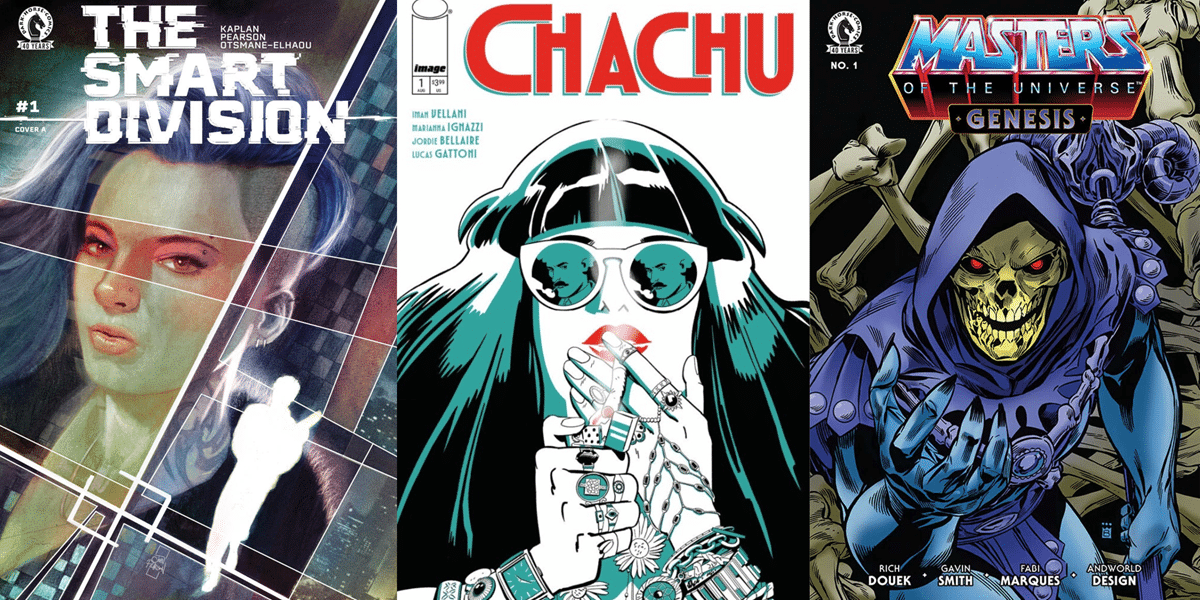

This week’s Wednesday Comics Reviews tackles Chachu #1from writer Iman Vellani, a new Masters of the Universecomic, plus capsule reviews of Smart Divisionand Fort Psycho! Plus, the Prog Report!

Chachu #1
Writer: Iman Vellani
Artist: Marianna Ignazzi
Colors: Jordie Bellaire
Letters: Lucas Gattoni
Publisher: Image Comics/Tiny Onion
Stunt casting celebrities for comic book writing doesn’t draw me in. It doesn’t cast me out of picking up an issue if the concept intrigues, but for the most part, I stick with those wanting to script comic books for a living over creative folks who have made a name in another entertainment area and then venture into comics writing. There are exceptions, most notably authors who ply their talents to graphic stories (Far SectorbyN.K. Jemisin) and comic fans who have done well and simply want to create for others what they have enjoyed (like theCount Crowleyseries by actorDavid Dastmalchian).
Of all non-comics professionals writing comics projects of the last decade, those two examples are the only ones I’ve read multiple times. I tell you this as clarification on where my review ofIman Vellani’sfirst issue ofChachuis coming from. And truth is,Vellanihas joined the ranks of comics writers I’ll seek out in future with this solo series.
Because as neo noir entertainment goes,Chachudelivers. In the premiere, we meet 19-year-old Leila, a Pakistani Canadian young woman starting college in L.A., 1979. She uses the opportunity to connect with her paternal uncle, her Chachu, who’s disowned by the rest of her family after he ran off to California and became a private investigator. Now semi-retired and married to a hot-property Hollywood celeb, Cleo Chandler, Chachu is one of the few remaining links Leila has in discovering more about her father. He died before she was born, but the brothers were close and she’s searching for connection to that side of her family, the side her own closest relatives don’t discuss.
Leila’s timing could be better. She arrives in the midst of a dispute between Chachu and Cleo, from which Cleo drives away after colliding with her niece-in-law’s car. Uncle and niece meet for the first time, and what follows is a Boulevardier cocktail of Hollywood politics, missing persons, and robbery. Or a publicity stunt, jury’s still out. Stir with two gumshoes, one amateur and the other hardboiled, and you have an introductory issue of worthy pulp fiction.
Vellanicommunicates more than she tellswith what remains unspoken. With what’s perfectly inferred, ready for framing. Her subtext is masterful. And the narrative goodness doesn’t end there.
The first impressions drawn by Leila taking stock of her Chachu is one of the best descriptive passages I’ve read in ages. Later, Leila’s rundown of Chachu’s situation illustrates a perception and attention to detail which must run in the family, given her uncle’s P.I. past. A past quickly catching up with both of them before the issue’s done. The multi-panel monologue is clever as it is funny and gets just the right jaded response from her more experienced, more world-weary relative. By the closing panel, we have great chemistry hooks established between Leila and Chachu and an even greater desire to learn more about both.
The narrative is smooth as polished hardwood bar counter until the final act. There, Cleo Chandler falls into a moment of peril with a decidedly staged outcome as it’s presented. Compared to the overall tone of the issue otherwise, it lands a bit over the top. Yet, it’s La-La Land in the late ‘70s. Chances are, as the story continues, it will match and mesh with the rest of the title’s mood.
ArtistMarianna Ignazzicaptures the joy of a girl on her own in the glitz capital of the world, and in a nostalgically enchanting era. But also captured are the seamier elements as they begin surfacing beneath the glamour. And the escalation between both ramps up satisfyingly as illustrated byIgnazzi.
The aesthetic is energized byJordie Bellaire’sspot-on color choices. I want to see at least one Harvest Gold kitchen appliance ensemble before this miniseries concludes. In this art team’s hands, it would be a graphic story slice of my childhood home. When readers see their amazing splash page collab, you’ll understand how well they render a dreamscape hewn from sunglasses, smokes, convertibles, and hot California highways.
Letters byLucas Gattonishare a memorable wheels-go-round-and-round moment during the mentioned car crash between Leila and Cleo. And his font choices for the era ring true throughout, from sound effects to scandal sheets to casinos.
The opening chapter forChachu’sfive-issue run promises a 1970’s neo noir road trip as a quest for family, for connection, and for self-discovery across Hollywood’s backlots and hills. Future issues hint at travel leading to the Las Vegas strip and all the neon this era has to offer. The art team here has me dialed in with anticipation. It isn’t often that a new book lives up to its promo blurb, but this is one of those times. Given how winninglyVellani,Ignazzi,Bellaire, andGattonihave made their character introductions for an adventure on par withKiss Kiss, Bang Bang, I’m all in.
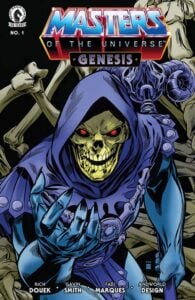
Masters of the Universe: Genesis #1
Writer:Rich Douek
Artist:Gavin Smith
Colorist:Fabi Marques
Letterer:Andworld Design
Publisher:Dark Horse Comics
As the name of the series implies,Masters of the Universe: Genesis #1is the debut issue for what is in effectMasters of the UniverseYear One. WriterRich Douekcenters the series on Skeletor’s rise to power on Eternia as he begins to subjugate the Mer-people and Beast men under his rule in an attempt to seize control of the planet. Douek spends the lion’s share of the issue on Skeletor’s past and that is done well and to a great effect as it retells elements of the 1983He-Manseries but with 1) the gift of hindsight and massaging all of the retcon wrinkles into a cohesive narrative and 2) helping integrate the origin into the new narrative of theDark HorseMasters of the Universecontinuity. I won’t lie, while I am largely familiar withHe-man, my knowledge lies more with the 2000’s era reboot of the franchise and less around the original 1980’s rendition. With that in mind, I appreciated this issue as a retelling of the franchise lore.
When it comes to characterization, Skeletor is the only one that is fleshed out. Mer-Man and Beast Man are largely one-dimensional and serve to move the Skeletor centered plot. That said, Douek’s Skeletor is really well done.One notable scene that stuck out for me was when Skeletor is referred to the leader of the Mer-people as just Mer-Man. This obviously bothers the leader and when Squidish Rex (Mer-Man’s real name, by the way) tries to correct him, Skeletor is just completely dismissive of Squidish. It’s small moments like that and Skeletor’s grandiose retelling of his exile from Etheria that give you a real sense of the character’s unreliability and disregard for others. The lettering byAndworld Designdoes this great job of capturing Skeletor’s grating voice with craggy speech balloons that gives a nice visual cue to the reader that this dude sounds like a freak.
The art byGavin Smithis solid. There is a focus on high fidelity to the character model’s and that is expected with a licensed comic of this nature. There is a bit of a sketchy quality to the line work that gives it a bit of a penciled look evocative ofFreddie Williams IIbut Smith is still distinctly is in his own style. This sketchy line-work gives this book an quasi-gritty texture that makes it feel a bit pulpy alaConanand other sword and sorcery comics. Unfortunately, I think it creates a much busier look to the pages and in turn makes some of the panels a bit harder to read as there is a strong emphasis on rendering on all levels of the composition, not just what is the intended focus.
The coloring byFabi Marquesis mostly fine but the color palette, while befitting of a “evil forces” type story, doesn’t complement the line work and just further complicates it. There are a couple moments where there is a statue of Hordak and Skeletor that I could not tell was a statue at first and it threw off the narrative flow of the issue.
Overall, I likedMasters of the Universe – Genesis #1. While I am not the most devout fan of theMasters of the Universe, I do appreciate the franchise and felt this issue does a solid job overall. The art is a bit overworked at times and it makes it harder to read but it isn’t completely detrimental to the comic. I just wish it could have been a bit more clearer at times. Worth checking out if you are interested in MOTU.
Rapid Reviews
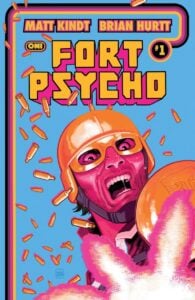
Fort Psycho #1 (Oni Press): Fort Psycho #1is a big swing of a comic right from its start. It compresses ideas around giant terrorism attacks, global response, and, ultimately, public reaction to systemic eye-for-an-eye, it takes a bad man to stop worse men, violence … all in its opening, before getting to what its bigger narrative is about. And I dug it. Key to this kind of comic — the sort that mixes borderline superhero spy soldiers with big global developments — is, in my opinion, the art, and writer Matt Kindthas a perfect set of collaborators for this book in artist Brian Hurtt,colorist Bill Crabtree,and letterer Becca Carey. It all adds up to a fantastic first issue that straddles different genres of comics in surprising ways, starting as a big super soldier blowout before transitioning into a smaller, super soldier mystery story. —Zack Quaintance
The Smart Division #1 (Dark Horse): The Smart Divisionhas been on my radar since it was announced, reuniting as it does the creative team from Mindset, with writer Zack Kaplan,artist John J. Pearson,and letterer Hassan Otsmane-Elhaou.And while this first issue didn’t grab me as quickly as Mindset #1did way back when, it’s still a strong read that left me intrigued with what’s to come, perhaps a bit more character driven than I was expecting from a book that seems bent on combining politics, tech, and maybe even conspiracy in this way. Also, as a former resident of Washington, D.C., I really appreciated the attention to detail Pearson brought to the city, really nailing its sight lines and other small touches needed for the book to feel immersive and real. —Zack Quaintance
The Prog Report
-
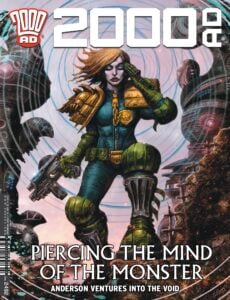
Screenshot 2000AD #2492 (Rebellion): This week’s issue is a lot like the last few issues, in that it feels most consumed by The Oubliette storyline, which features prominently in at least two of the strips (it could ultimately be revealed to be part of more), and is also supported by recent storytelling in issues of The Megazine. This is a strong story, to be sure, but given the amount of space its taking up (and how long its stretching on), I’m starting to feel antsy, wondering when we’re going to get some momentum concentrated around an ending. But that could be a mething. The main Oubliettestory, I’ll remind you, is from writer Ken Niemand,artist Dan Cornwell,colorist Chris Blythe,and letterer Annie Parkhouse. This week’s cover (above) is by Clint Langley. As always, you can pick up a digital copy of The Prog here. And it is also now available weekly in US comic shops! —Zack Quaintance
Column edited by Zack Quaintance
Read past entries in the weekly Wednesday Comics reviews series or check-out our other reviews here!
