

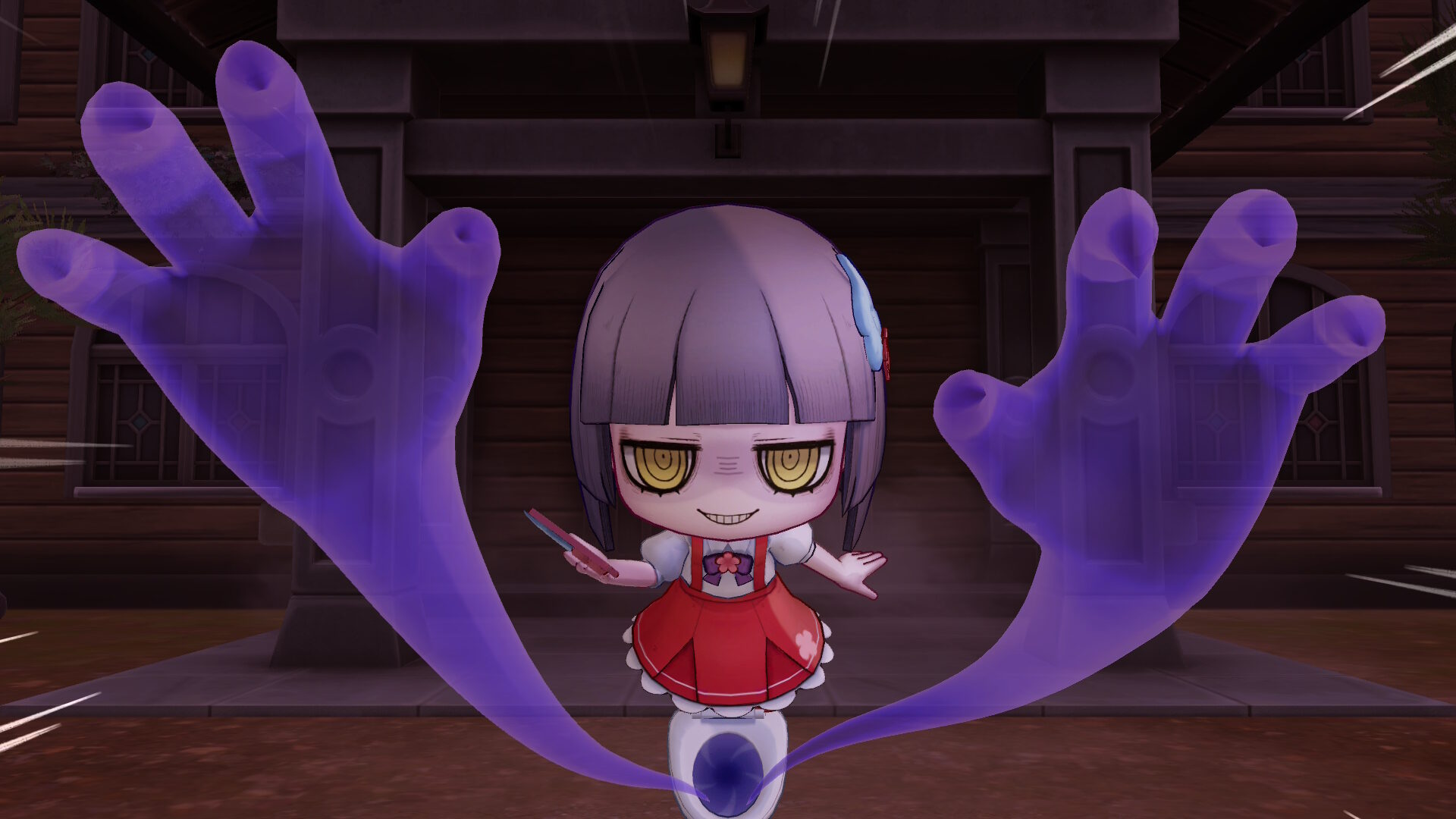
I was excited to take a look at OBAKEIDORO 2: Chase and Seek because the original OBAKEIDORO was one of those games I had always wanted to play, but never really got around to. I was drawn in by its juxtaposition of chibi aesthetic and horror, similar to Yomawari: Night Alone,but knew little else about it—lost in the shuffle of constant games for review and leisure.
I’m glad I finally got to experience OBAKEIDORO 2: Chase and Seek,since not only is it a fun and adorable little asymmetric multiplayer game, but I also learned the English name for the original was Bail or Jail and I think that title just rocks. While it’s not a particularly complex game, there is a lot of fun to be had with it.
Much like its predecessor, OBAKEIDORO 2 Chase and Seek is true to its name—a simple game of hide and seek between Humans and monsters. At its core, it’s an asymmetric multiplayer game where one player controls a monster and needs to capture three Human players within the span of three minutes. It’s essentially an adorable Dead by Daylight.
And for a straightforward kind of experience, it works pretty well. It’s a kind of “fun-in-short-bursts” game of cat and mouse where each of the five available Humans (players start with two but the other three can be unlocked) have to run and hide from the monster player and have a simple but effective suite of options to do so. Humans can crouch behind objects or hide in tall grass and shrubs—so long as they’re out of eye-sight, then they’re more or less invisible.
Should they be noticed by the Monster, they can utilize a short burst from their lantern to stun them, or individual character abilities—Hajime can run faster when near a ghost while Kuro can see the Monster location if there’s a guard by the jail. Monsters are also given a host of options for capturing Humans, getting both a musical cue when they’re nearby, as well as unique abilities and special attacks depending on each Monster.
On top of this, players can earn stamps by completing certain objectives. These stamps grant small bonuses, unlock new lanterns for Humans and add new characters for both sides, providing an incentive to play multiple rounds and complete smaller in-game challenges. Although OBAKEIDORO 2: Chase and Seek is best played online with other people, it offers a surprising number of offline options.
This is a double-edged sword. Although offline play benefits those who want to play on the go or with a group of friends, it also reveals the many ways the game is not designed for solo or couch play. In solo mode, the opposing AI has a strange problem: it is both too smart and too dumb. Oh ho, I cannot wait to explain this one.
“In the audio/visual department OBAKEIDORO 2: Chase and Seek has a really distinct sense of style that genuinely comes off like a spooky Professor Layton.”
When playing as Humans, it can be laughably easy to stay out of sight of a Monster and just hide away for the three minutes, keeping an eye on your allies and only helping out when the coast is clear. However, it’s practically impossible to escape from a Monster once they’ve spotted you since their tracking is so good, you’ll almost never shake them. They usually always grab you without fail, so the best way to win is just to stay as far away from a Monster for as long as you can.
The same goes while playing as Monsters. While it can be laughably easy to catch Humans with special abilities, the standard catch isn’t as reliant and despite small advantages like jail locks moving with each subsequent breakout, the AI humans almost always know exactly where to find them. Conversely, whenever you capture a Human, its allies always bee-line it for a switch, so it’s pretty easy to catch them since they don’t really try to strategize or coordinate.
Hilariously, OBAKEIDORO 2: Chase and Seek includes split-screen multiplayer, which is a recipe for disaster in any stealth-based game. In a game where winning depends on both knowing and not knowing your opponent’s position, players are essentially being asked to use the honour system while hiding and seeking. In this day and age, good luck with that. Still, its inclusion is a welcome option.
In the audio-visual department, OBAKEIDORO 2: Chase and Seek has a distinct style that feels like a spooky Professor Layton game. It has an over-the-top flair for the dramatic, from the game’s menu taking place in a literal theatre to the way players are captured and freed. Despite their chibi forms, the characters have a Burtonesque aesthetic, with sunken eyes and thin lines adding detail to their faces and models.
Adding to this, the music has a distinctly European flair similar to that of the Professor Layton games. It ranges from slow and moody to upbeat and energetic, backed by a generous use of accordion that is rare in games. All of it is wrapped in a playfully spooky atmosphere that evokes the feeling of children playing on Halloween.
Despite some flaws, OBAKEIDORO 2: Chase and Seek is fun for what it is. It may not become a permanent addition to anyone’s online multiplayer rotation, but it is an enjoyable game to return to once in a while and feels particularly well suited to a Nintendo platform. At the very least, it would be a great game to revisit when Halloween season arrives.
