

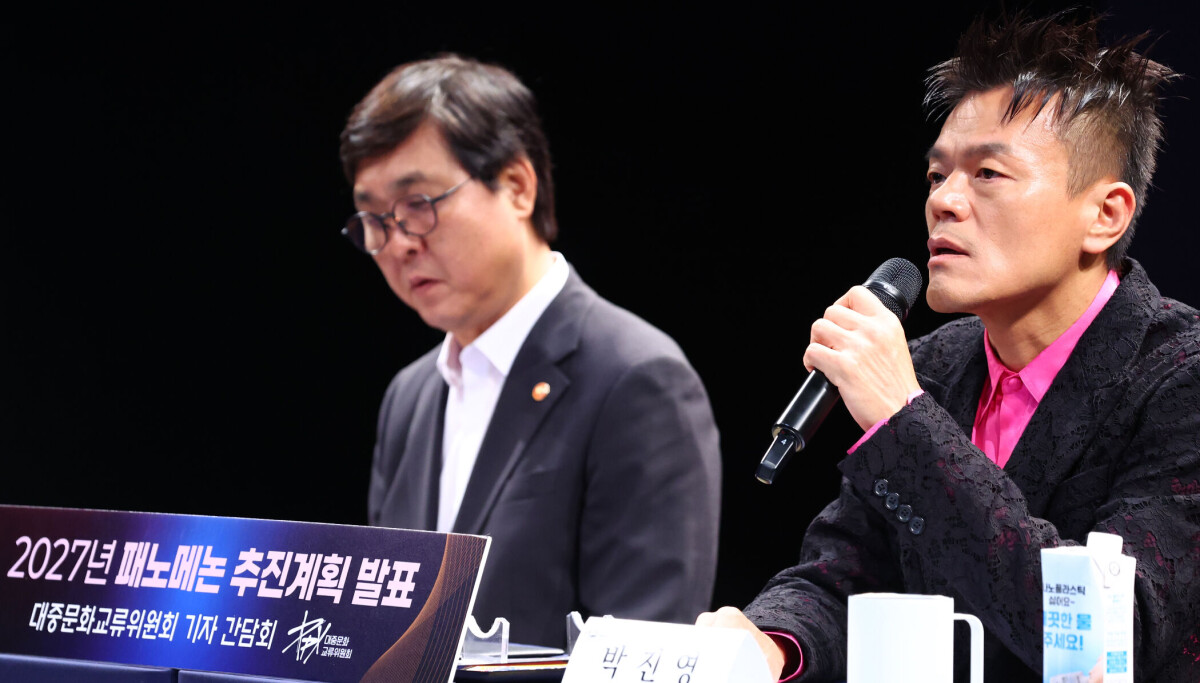
The government-backed Fanomenon project, billed as K-pop’s own version of Coachella, will begin with an ambitious 11-day program of awards ceremonies, concerts and exhibitions projected to generate as much as 1 trillion won ($680 million).
The inaugural event, a rare collaboration among Korea’s four largest K-pop agencies, will run from Dec. 2 to 12 next year. Its main performances will take place at the upcoming Seoul Arena in Chang-dong, northern Seoul, which is designed to accommodate about 20,000 concertgoers. The project is then set to expand into a full-fledged international festival in 2028.
Related Article
-
K-pop’s four main agencies in talks to create Korean version of Coachella
-
Ministry redefines ‘K-culture,’ adds 100 trillion won to sector’s target market size
-
Is the Grammys’ new Asian pop category a red carpet or velvet rope for BTS?
The catch? It will be the fandoms, not the artists, taking home the awards.
The Presidential Committee on Popular Culture Exchange unveiled the plans Monday, when its co-chairs — JYP Entertainment founder Park Jin-young and Culture Minister Chae Hwi-young — held a press conference on the project’s progress at the National Museum of Modern and Contemporary Art, Korea, in central Seoul.
“We have a single goal: to seize the opportunity presented to K-culture and make it last as long as possible,” Park said during his presentation. “I was certain that this would not only benefit K-culture but also give young people around the world an opportunity to connect through pop culture.”
What is Fanomenon?
The project, whose name combines “fan” and “phenomenon,” was first proposed by Park when the committee was launched in October last year. At the time, he described it as “a new festival that may surpass the Coachella Valley Music and Arts Festival.”
The first installment in December 2027, however, will take on the combined form of an awards show, concert series and exhibition rather than a conventional festival.
Describing K-pop as a fandom-driven industry, Park said Fanomenon would provide a platform to help sustain the genre’s global momentum and reinforce Korea’s leadership in the industry.
The program will open with a special event on Thursday, Dec. 2, 2027. Three-day concert runs will follow from Dec. 3 to 5 and again from Dec. 10 to 12, accompanied by four days of awards ceremonies across the two weekends. Tickets will be sold for the concerts and award ceremonies.
The main events will be staged at Seoul Arena, now under construction and scheduled for completion in May next year. With a capacity of approximately 20,000, it is expected to become Korea’s largest K-pop concert venue.
A separate concert will be held simultaneously at Kintex in Ilsan, Gyeonggi, alongside a 10-day exhibition bringing together companies from K-culture-related industries.
How is it different from other shows?
First, Fanomenon is a rare joint initiative involving all four of Korea’s biggest K-pop agencies — HYBE, JYP Entertainment, SM Entertainment and YG Entertainment — which have established a joint venture for the project.
“The four major agencies have launched a joint venture to work together as one team,” Park said. “With the government’s cooperation and everyone working toward a shared goal for the public interest, the project has gained powerful momentum.”
Park also stressed that artists from smaller agencies would receive significant exposure during the event as well, saying its goal was to lift the industry as a whole.
Second, the awards will go not to artists but to their fandoms, though the artists will be handed the trophy for their fans.
Under the current tentative plan, awards will be presented to the 10 most “devoted” fandoms, selected through a detailed, strictly data-based metric now under development. The most dedicated of the 10 will then be crowned the “Fandemonium,” a name that has already been trademarked
Although the lineup has yet to be announced, artists from Korea and overseas are responding positively to invitations to appear at the awards show, according to the committee.
The committee projects that the event will attract 520,000 attendees, including 200,000 visitors from overseas, and generate an economic impact of up to 1 trillion won.
The estimates were derived partly from attendance and economic-impact figures from BTS’s Gwanghwamun comeback performance on March 21, which drew approximately 104,000 visitors to the area.
How is it ‘K-pop’s Coachella’?
After the initial launch of the awards show, Fanomenon will expand into a full festival format closer to Park’s original description of a K-pop equivalent to Coachella. The first overseas edition is scheduled to take place in Los Angeles in May 2028, with plans to bring the festival to other major cities worldwide.
Toward the end of the press conference, Park urged the public to approach the project with optimism rather than skepticism. He recalled how his early attempts to enter the U.S. market had been ridiculed as unrealistic, as well as the difficulties he shared with his close friend, HYBE founder Bang Si-hyuk, during their early ventures in the country.
“When I watch Stray Kids or Twice perform, I become emotional because the vision Si-hyuk and I had in 2003 and 2004 has come true,” Park said. “If we considered only the money, it might be more profitable in the short term for each agency to do its own thing. But the thought of this event becoming an established global festival, with fandoms around the world focused on the awards at the end of every year — it makes your heart swell.”
Responding to accusations that the initiative appears to represent government’s forced intervention to engineer K-pop’s success, Chae said the government did not have the power to propel the genre to its current level of global prominence.
“The government’s role is to ask industry figures such as Park what they need and then provide support,” Chae said. “The Fanomenon project also falls within that objective.”
The committee has outlined three major initiatives: launching the Fanomenon awards show in December 2027, holding the first Fanomenon festival in Los Angeles in May 2028 and establishing K-culture centers around the world that would include concert venues and industry exhibition spaces.
