

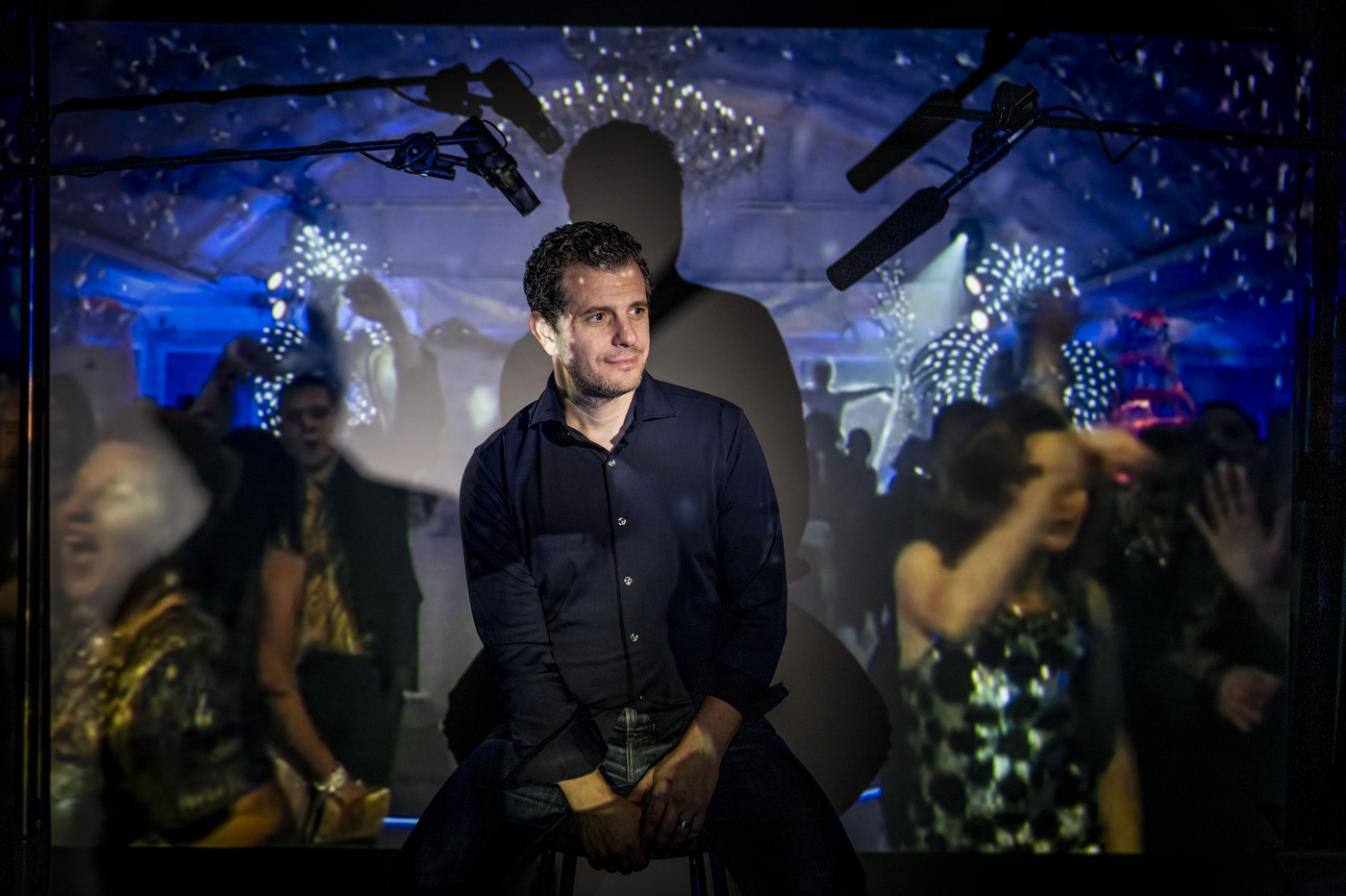
Jason Harris has worked on over 1,000 films and TV shows, but you may not have heard of him. He likes it that way.
Harris is part of a small, tight-knit group of actors in Hollywood responsible for providing the largely invisible yet vital background audio that fills every scene of a production. Whether they are the murmured voice of a character in the back of an office or the shouts of a police officer about to break down a door, actors in these loop groups, so-called because they create repeating background chatter, or loop audio, to fill out a scene, make every scene feel more alive. Their job is not to grab the spotlight but to avoid it.
“It’s a unique and odd skill,” said Harris, founder of loop group studio the Looping Division, which has worked on movies like “Dune” and TV shows like “The Americans,” “Yellowjackets” and “Murderbot.” “You’re a factory worker in a way. You’re literally trying to piece together, with a few people, every single thing that a show might need. … You’re trying to help the energy of the show.”
But now actors like Harris, who make a living through loop groups, face an existential threat: AI. And the threat is at Hollywood’s door.
For instance, AI actress Tilly Norwood is about to lead her first feature film in what could be a landmark test of whether audiences have a taste for AI performers. Animators are anxious about whether to adopt AI or resist a technology that could be coming for their jobs.
Loop group actors, whose work is entirely behind the scenes and designed to be almost invisible, are even easier targets for a technology that has already been used to create voice doppelgangers of famous actors like Bryan Cranston.
Harris doubts looping will disappear altogether. But he is nervous that AI could wreak havoc on an important part of the industry that has given less prominent working actors a way to make a living.
“Do I think loop group will be around in five years? I do because in this industry and in this country things don’t flip completely,” Harris said. “Will it get to a point where looping is not a living? It might.”
Acting outside the spotlight
To the uninitiated, loop groups might seem like a tertiary part of filmmaking. But their work appears in almost every scene and requires a certain craft.
While principal actors speak dialogue that is always recorded on the set of a movie or TV show, extras and background players are often just mouthing words so that microphones don’t pick up background noise on set. Later, during post-production, loop group actors are hired to come in and record audio that will fill in that ambient noise.
Since they are essentially constructing that background soundscape from scratch, loop group work takes many forms. It could involve watching an actor in the background and coming up with a line that fits their lip movements or making the grunts and groans –– the “efforts” –– of combatants in a fight scene.
Given all that loop actors could do, they also have to do plenty of research. In a loop group session, you might be called on to provide the voice for a SWAT team member busting down a door, the commentator of a hockey game heard in the background of a bar or a police dispatcher on the radio in a police car. In every case, actors need to understand the right jargon and vocabulary, even details like the police codes for specific cities, Harris explained.
In other words, “all the little things that would really be pushed to make the scene more believable,” Harris said.
Loop groups also have clever ways of capturing audio in a way that reflects the reality of a scene.
For instance, what’s known as a “free and clear” involves positioning actors throughout the room and having them say their lines to create a sense of distance or directionality. There is also a pass-by, where actors walk past the mic to simulate a background character who is moving. Editors, mixers and recordists might even have actors record their lines in a hallway or move in a specific way to get a specific kind of sound effect.
“There’s a thing called the donut where [actors] walk in a circle in front of the mic and as they pass by the microphone, they say something. They try to do it free and clear of the person coming behind them and in front of them,” said Ann Hadsell, a sound editor and sound mixer with more than 30 years of experience and dozens of credits on Hollywood films that include “Jurassic Park,” “Titanic” “The Notebook” and “Apollo 13.” “It can get very, very creative.”
In a typical session, a group of actors will be in a studio with the director and sound editor as the movie or TV show plays on a screen with cues of where audio needs to be added. Actors will be counted in and then come up with lines that could fit that specific moment.
“Most recently I did that [Daren] Aronofsky film ‘Caught Stealing,’ and there’s a huge scene where actors Liev Schreiber and Vincent D’Onofrio come in and shoot up a wedding,” said Dennis Staroselsky, an assistant teaching professor of theater at Northeastern University and an actor who has done work in the loop group studio. “We had to do the sounds of the people partying at the wedding and also their reaction to the gunshots.”
But regardless of how interesting the scene might be, “you cannot be interesting” and risk distracting from the main action of a scene, Staroselsky added.
It’s for this reason that even veteran actors might struggle with looping, which is sometimes called “walla” as a reference to the ambient murmuring sound of a crowd.
This was the case for Staroselsky, a trained improviser, during his first loop group job, on the Ben Affleck directed Boston crime drama “The Town.”
“There was a shot of a cop in the beginning who’s just talking to somebody, and I go up there and I go, ‘I don’t know, it must’ve been the French cruller,’” Staroselsky said. “I get, ‘Stop, cut. … That’s going to grab attention.’”
It required a recalibration of all the acting skills he had honed over the years until he found a solution that did work for the scene, he said. By design, it wasn’t quite as memorable as Staroselsky’s original choices. He doesn’t remember what voice line they ended up going with, although he recalled it was “something completely mundane like, ‘Yeah, I’m doing okay.’”
“The point was something that wouldn’t stick out at all,” he said.
Risk and reward
There are only a handful of dedicated loop group agencies in Los Angeles and New York City, so they are constantly fighting tooth and nail to book jobs on movies and TV shows. It’s an insular world where who you know doesn’t even guarantee you a job sometimes, Staroselsky said. There’s a reason it’s sometimes called the mafia of the voice acting world, he added.
The competitive culture around loop groups is made more intense by how lucrative the work is.
Actors will get paid a co-star rate, the minimum pay for a supporting performer in a small role, which is $1,283 for a day in the studio, Staroselsky explained. On top of that, they also get residuals from any movie or TV show that is broadcast again, streamed or released on physical media. For some actors, looping is their primary
“I did not realize how hungry people were and how personal and aggressive competition could be,” Harris said. “When you do a series, especially, you’re not competing for one job. You might be competing for five years of employment or more.”
Loop groups in the AI age
The small world of loop groups is also why concerns around AI replacing these jobs are amplified, actors explained.
“There’s a lot of distrust with some of the platforms,” said Rupal Patel, a professor of communication sciences and disorders at Northeastern who co-founded the platform VocaliD that creates custom synthetic voices for clients, including voice actors. “If I make my synthetic voice, how will they use it and will I ever get paid for the jobs I want to do? Will they just replace me and displace my work?”
Synthetic voices can already be created using AI tools and only a few minutes of recorded audio, and the technology is only getting more adept at reproducing the human voice with some level of verisimilitude.
“If you’re thinking about low hanging fruit, [loop groups] are on the low hanging fruit side,” Patel said.
Staroselsky is less worried about unauthorized digital replicas of his voice and more concerned about working actors who will willingly give up their voice rights for a paycheck. Even with some protections in place, studios can get an actor’s consent to make a digital replica of their voice, and it comes with an incentive for actors. Staroselsky is currently developing a film that explores this very scenario.
“You have the choice to opt in and sell your voice and likeness in perpetuity for a certain amount of money,” Staroselsky said. “In L.A. there is a sentiment of writers and artists who are helping AI because ‘Well, it’s going to happen anyway. It might as well be me so I can make some money.’ It’s understandable.”
At least for now, there are some protections in place, although they don’t extend specifically to loop group actors.
Spurred on by incidents like actor Bryan Cranston’s likeness being recreated without his permission in OpenAI’s now defunct text-to-video AI tool Sora, many agencies have adopted an opt-in policy for actors, only allowing actors’ likenesses to be used with their permission.
The Screen Actors Guild – American Federation of Television and Radio Artists (SAG-AFTRA), a union representing about 160,000 professionals in media and entertainment, also ratified a new contract in 2024 to protect some voice actors. Much like its live-action equivalent in 2023, the contract prevented actors’ voices from being used or recreated without their permission. It also mandated that voice actors on animated TV shows must be human.
But such language is not part of the live-action agreement with TV and film studios, so it does not extend to loop group actors. The deal also does not outright forbid studios from creating generic AI synthetic voices not based on a specific actor.
While loop groups might seem like a prime target for digital displacement, Harris said the understated nature of the work actually might make it more difficult to replicate, at least for now. Until the day comes that loop groups are generated more by digital tools than human chatter, Harris is confident there’s still a need for his voice, as far in the background as it might be.
“When you have to do a group of eight people like street kids or cops hanging out in the police station, boy, AI turns it into kind of a mess,” Harris said. “Your line might be something half mumbled and subtle that gives [a scene] life, and if you put an AI in there, it might not quite be that way.”
