

Back in the good, old gaming days, we used to blow on the contacts of cartridges to get our games going. Now, that experience is making a comeback… thanks to FPGAs! These behave differently from emulators, as FPGAs are configurable to imitate a gaming console’s hardware.
The magic is that they do whatever those platforms can, which includes processing graphics, handling audio, and controller communication. As a result, modern retro games are making a return to our lives and running those beloved classic games. Here are seven of the most recent FPGA-based video game systems.
Analogue Super NT+
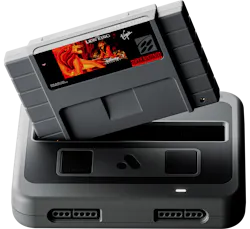
Announced October 16, 2026, the Analogue Super NT+(Fig. 1) is a replication of the SNES and Super Famicom. It runs on an Altera Cyclone V FPGA. Instead of using software emulation, the consoles’ functionality is integrated in programmable hardware.
Users can play over 2,200 game cartridges on this system, which delivers HDMI output at resolutions as high as 1080p. Bluetooth and 2.4-GHz wireless controller connectivity are also included. Analog DAC support is achieved through a USB-C power input and USB-A. The console expects to ship in December 2026.
Analogue Mega Sg+
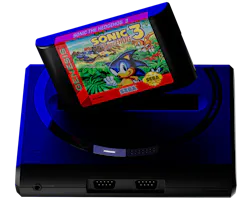
Sega fanatics can replay their favorite classics, too! The Analogue Mega Sg+(Fig. 2), a recreation of Sega’s 8- and 16-bit hardware, runs on the Altera Cyclone V FPGA. It includes the Genesis, Mega Drive, and Master System.
There’s no limit to how much fun players will have with over 2,180 Sega games supported. It even works with HDMI output at 1080p resolution, along with 48-kHz, 16-bit stereo audio. Mega Sg+ also has Bluetooth, 2.4-GHz wireless controller connectivity, USB-C power, and Sega CD hardware support. Those interested won’t have to wait long, either, as it ships in December 2026.
FunnyPlaying FPGB Mini
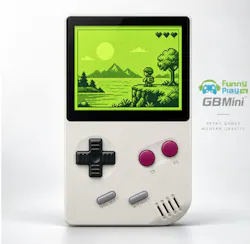
A Game Boy/Game Boy Color recreation has been released in September! Called the FunnyPlaying FPGB Mini(Fig. 3), this handheld console uses a Gowin GW5A5-EV25 FPGA. The system, which works with 32-pin Game Boy and Game Boy Color cartridges, has a 2.98-in. IPS display with an 800 × 720 resolution. It also comes with a 1,800-mAh rechargeable battery, microSD expansion, and a real-time clock.
Want to play with others? There’s a USB-C connection for multiplayer gaming
ModRetro M64
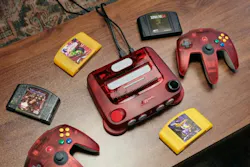
Love the Nintendo 64? The ModRetro M64(Fig. 4) has come into play, giving us that much-needed nostalgia ride. Released in July this year, the system uses an AMD Artix Ultrascale+ FPGA manufactured with a 16-nm process. It supports Nintendo 64 cartridges and provides HDMI output at resolutions as high as 4K at 60 fps.
Local multiplayer is also supported, too. Users can get firmware updates through Wi-Fi, and customization options include CRT filters and overclocking modes
Retro Remake SuperStation One
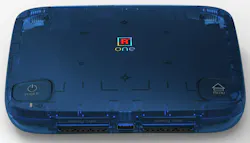
Retro Remake came up with a unique multi-console — the SuperStation One(Fig. 5)! Released in December 2025 – January 2026, it’s an ultra-recreation of the PlayStation One. The company built this system around Intel’s Cyclone V SX SoC FPGA, which integrates a dual-core Arm Cortex-A9 processor. The system also features 128-MB SDRAM and a 24-bit ADV7125 video DAC.
Thanks to its MiSTer FPGA cores, the SuperStation One works for other gaming platforms like the Nintendo 64 and Sega Saturn. Along with VGA, the system has HDMI output (up to 1536p) and composite and component video connections. SNAC interfaces support PlayStation controllers and memory cards. Players can add a SuperDock to support an optical disk drive and an M.2 SSD.
Analogue 3D
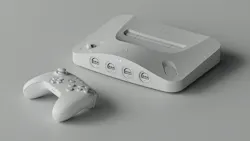
We have another Nintendo 64 recreation that was released on November 18, 2025. This one is different as it runs on the Intel Cyclone 10 GX FPGA. As expected, the Analogue 3D(Fig. 6) supports N64 cartridges and controllers, with region-free compatibility for NTSC and PAL games.
The HDMI output reaches 4K, and the Original Display Modes reproduce the CRT appearance and professional video monitors, like scanlines, phosphor effects, and shadow masks. Players will notice smooth gameplay, achieved with the help of variable refresh rate. Controller ports (4x), built-in Expansion Pak and Controller Pak, Bluetooth, dual-band Wi-Fi, and a 16-GB SD card are included.
Sipeed Tang Retro Console
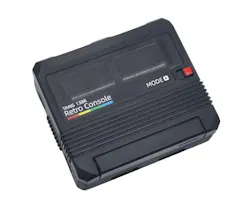
Released in April – May 2025, the Sipeed Tang Retro(Fig. 7) is another multi-gaming console. This recreates the NES, Super Nintendo, Game Boy Advance, Sega Genesis, and Sega Master System. It uses the Gowin GW5AST 60K/138K FPGA that works with multiple hardware gaming cores. Players can even switch between cores
An external storage loads the BIOS files, emulator cores, and games using USB OTG. Meanwhile, the Sipeed Tang Retro console features HDMI for video output and 2x USB-A ports for the controllers. This works as an FPGA debugging and development tool, too.

1 Comment
Pingback: Zeta Gundam's Anime-Accurate Gundam Mk-II Officially Returns for New Re - Comic Vibe