

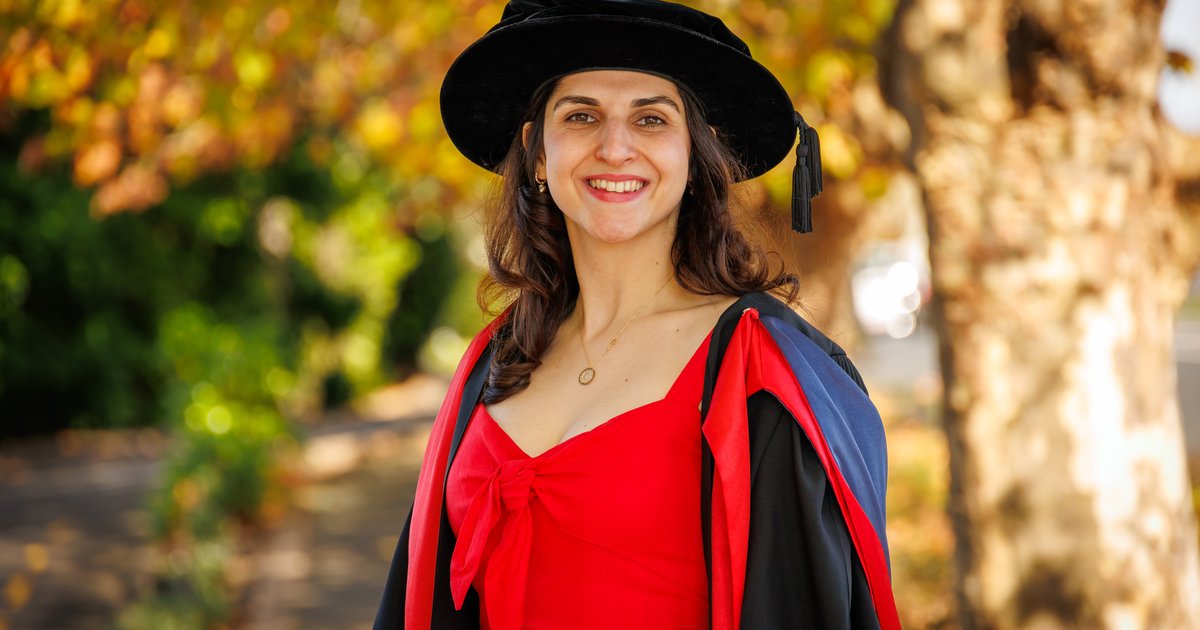
Originally from Turkey, Dr Erensoy moved to Aotearoa New Zealand six years ago. Her tertiary journey began with a degree in city and regional planning, where her interest in designing spaces evolved into a fascination with the people who use them.
“It was during my city planning studies that I realised even the best-designed products or environments only succeed if they genuinely work for the people using them,” she says.
She went on to complete a Master in Management Information Systems, where she recognised VR was becoming increasingly accessible and saw an opportunity to explore a new kind of customer experience.
“Rather than looking only at the technology itself, I was curious about the entire customer journey – how people think, feel and behave from the moment they enter a virtual store until after they’ve completed a purchase. My PhD combined technology, psychology, design and business, with the goal of identifying what makes these experiences enjoyable, useful and centred around human needs,” Dr Erensoy explains.
Retail provided the ideal setting to explore these questions.
“It’s a fascinating environment for studying human behaviour, and VR offers the chance to completely rethink how shopping could work. It allows businesses to design entirely new experiences that wouldn’t be possible in the real world, and I wanted to understand how those possibilities influence people’s emotions, decisions and overall experiences.”
As immersive technologies continue to develop, organisations are increasingly exploring how they can enhance customer experiences. Combining elements of both physical and online shopping, Dr Erensoy says VR also offers something entirely different.
“Unlike traditional online shopping, customers can move through a three-dimensional environment and interact with products in a much more immersive way. At the same time, it offers flexibility that physical stores often can’t, such as imaginative spaces or personalised experiences. Rather than replacing physical stores, I see VR as another way businesses can connect with customers in meaningful ways.”
To investigate these experiences, Dr Erensoy reviewed existing research, interviewed international experts in VR and customer experience, and conducted immersive shopping experiments where participants completed tasks inside a virtual store. She then interviewed the participants to understand how they felt throughout the experience and which moments had the greatest impact.
One of her biggest findings was that memorable customer experiences are shaped by many small interactions rather than a single standout feature.
“I was surprised by how strongly emotions influenced the experience. Feelings such as curiosity, enjoyment and confidence often determined whether participants perceived the experience positively, sometimes even more than technology itself.”
She found that successful virtual experiences depend on thoughtful, human-centred design.
“The most engaging virtual environments are those that feel intuitive, reduce effort, support customers’ goals and create positive emotions along the way. When people feel comfortable, confident and in control, the technology almost disappears into the background. Human-centred design is about designing around people’s needs rather than simply showcasing what’s technically possible.”
Dr Erensoy hopes her research will provide practical guidance for organisations designing future customer experiences and encourage them to consider customer needs from the earliest stages of technology design.
“The organisations that succeed will be those that keep people, not technology, at the centre of innovation. Technology will keep changing, but the best innovations begin with understanding people.”
Dr Erensoy says undertaking her PhD at Te Kunenga ki Pūrehuroa Massey University was an incredibly rewarding journey.
“Massey has a strong reputation for applied research and encourages students to tackle real-world problems, which really appealed to me. I was fortunate to work with incredibly supportive supervisors who challenged my thinking while giving me the freedom to explore my own research ideas. I always felt encouraged to collaborate across disciplines and develop research that could have practical value beyond academia.”
She says completing a PhD is never an individual achievement.
“I’m grateful to my supervisors, Associate Professor Anuradha Mathrani, Dr Alexander Schnack, Dr Nilufar Baghaei and Professor Jonathan Elms, for their guidance, encouragement and belief in me throughout my journey. I’d also like to thank my family, my partner and my friends for their constant support, as well as everyone who participated in my research and generously shared their time and experiences. Finally, I’m grateful to Massey University for providing an environment where curiosity, collaboration and applied research are genuinely encouraged.”
Since completing her doctorate, Dr Erensoy has moved to Wellington, where she now works as a Client Insights Specialist, helping organisations better understand their customers and make evidence-based decisions.
“I’m excited to continue working at the intersection of research, technology and customer experience while staying connected to academia through future collaborations.”
