
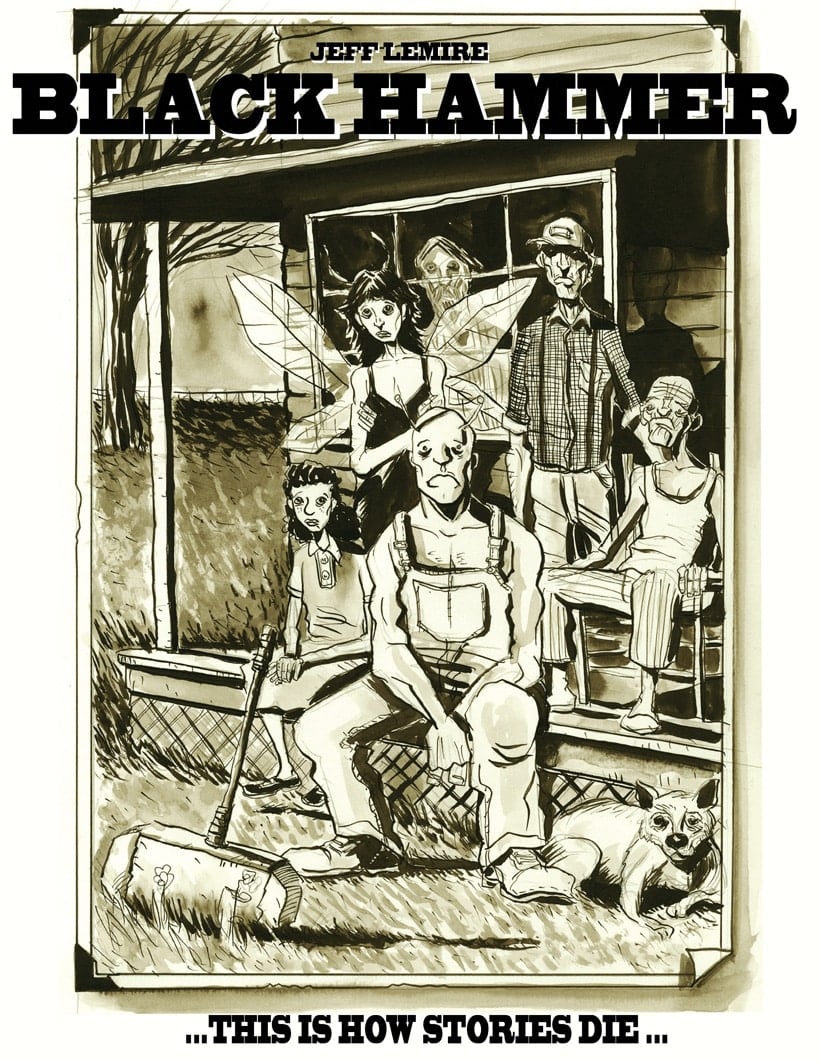
Ten years ago, Jeff Lemire, Dean Ormston, and Dark Horse Comics welcomed us into the world of Black Hammer.
Of course, back then it wasn’t a world yet, just a single series about six heroes from the golden, silver, and bronze ages, stranded on a mysterious farm (and the reporter trying to find them). Fast forward to today and the series has not only moved well past its original run, but expanded into various spinoff titles. It concluded Phase One in 2019, then Phase Two in 2024, and with the latest miniseries, Black Hammer: Spiral City, kicked off Phase Three.
To celebrate a decade of Black Hammer, we spoke to writer Jeff Lemire about the series, its most recent developments, and looking back on the journey up to this point.
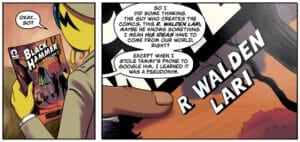
MARK TWEEDALE: I often see pieces talking about Black Hammer as being about Golden Age or Silver Age superheroes, but I think it’s more than that. Black Hammer isn’t really about superheroes; it’s about superhero stories. It’s why we have Limbo Land, why we have Colonel Weird and Inspector Insector crawling out of “the Creator’s” ear, why we have a world that exists outside of the Para-verse, why we have a world where Black Hammer is written by R. Walden Lari, and why we have Spiral City (the most recent arc of Black Hammer with Teddy Kristiansen) told through the lens of a storybook narrative. What is it about Black Hammer that makes you not just want to tell stories, but explore how stories are told?
JEFF LEMIRE: I think that comes from a few places. First off, the entire concept of Black Hammer came to me at a younger age, when I never in a million years thought I’d have the opportunity to tell “real” superhero stories for Marvel or DC in mainstream comics. I was an indie cartoonist who also happened to love superhero comics and I saw Black Hammer as a chance to tell “my version” of superhero stories. Or to tell superhero stories through an indie comics lens. So, right from the inception, I was sort of coming at it from a place of commenting on the genre. In other words, it wasn’t just a love letter to superhero stories, but a love letter to the history of superhero comics, and the comics industry, as well. So, I think those more “meta” aspects that emerged were really part of its initial DNA.
Having said all that, I do think I’ve taken these meta elements as far as I can with Black Hammer. After Black Hammer: The End, it was time to move on from that and to try and approach things from a different place. So, in Spiral City and in the new series I’m writing, we still have elements like the “storybook” section in Spiral City, but I think that I’m finished using the more overt meta stuff as characters and plot points. That feels done now. And, Black Hammer was, and is, really at its best when it’s anchored in the characters and driven emotionally. So that will be my focus moving forward. The world has been built. Now I can just try and tell more good stories in it.
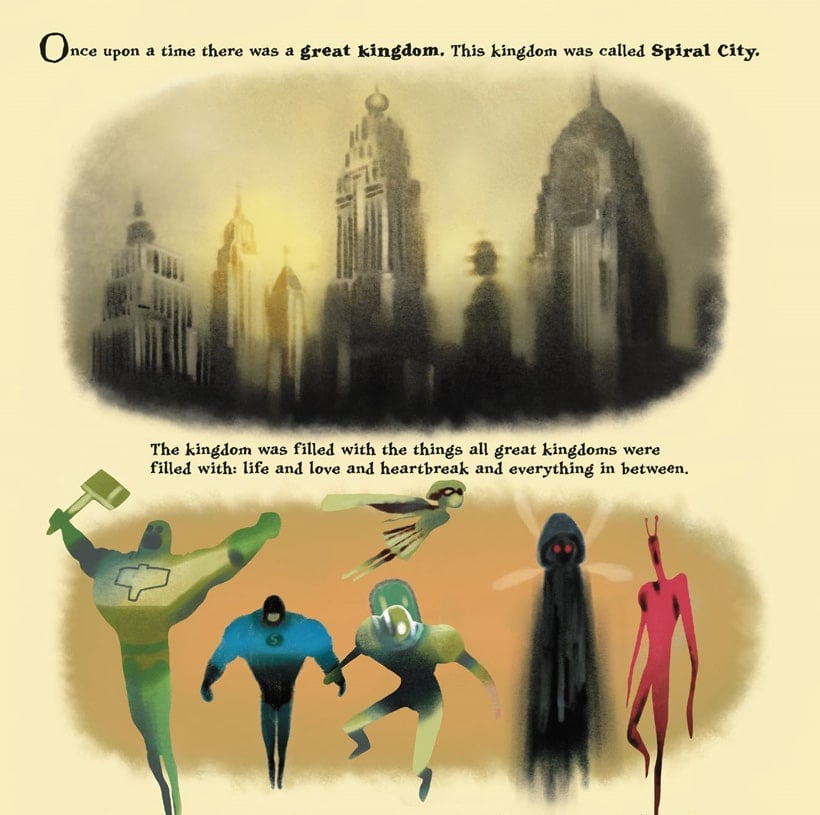
TWEEDALE: Spiral City is an excellent example of how flexible the series is, with supporting characters and new characters stepping into main roles. Inspector Insector finds his place in the main continuity after escaping Limbo Land and Jose Torres (Concretestador) rediscovers who he is outside of his previous job at Spiral Asylum. And the rest of the main cast, Hell’s Belle and Malcolm Gold, are new characters. Sure, Lucy Weber appears, but as part of the news broadcasts in Spiral City, a background element to the main narrative. It’s a massive change from the Para-verse storyline from Reborn and The End, and I loved it. What attracted you to this story with these particular characters?
LEMIRE: You kind of pinpointed it already. After The End things go SO cosmic and big that there was nowhere left to go except to shrink things back down to a much more grounded street-level story. If The End was our Crisis then Spiral City was our attempt to get back down on the streets and examine the aftermath using less known and new characters.
TWEEDALE: As you said, you’re moving away from the meta element, but it’s still a part of the series’ DNA. In this case, Inspector Insector was the storybook narrator, which makes so much sense because in all his prior appearances he’s had a noir detective-style interior dialogue. Displaced, that interior voice changes and recasts him from hero detective to fool. And it was fascinating to explore how an idea can be anything, but living up to that in reality is entirely different. In Limbo Land, he could say he was the greatest detective, but on the streets of Spiral City, he actually has to be the greatest detective and he falls woefully short. At one point he thinks he’s solved the mystery and all he’s going on is circumstantial evidence and a hunch. This was a wonderful way to explore the gap creators face with every work of art between concept and execution.
LEMIRE: You nailed it. In Limbo Land he was a “high concept” or an idea. In reality things are much more layered, nuanced and difficult. And we see his transformation from idea to a real “person” in that series. And the fact that we do that with a walking talking humanoid insect is all part of the joy of comics.
TWEEDALE: Hell’s Belle ended up being my favourite in this tale. I enjoy seeing people with superpowers using their abilities to find careers outside of superheroics. Belle’s world kind of falls down around her in this arc and everything is worse now, but I feel like she now has an opportunity to explore a life that’s more authentic to who she is. Hopefully this isn’t the last we’ve seen of her.
LEMIRE: I love that character too. I’m glad you responded to her. I think you’re right, there is definitely more story for her. Again, all the artifice of the “pop star” was ripped away and, like Insector, she is now free to discover a more authentic self.
TWEEDALE: Given that so much of the original run of Black Hammer was exploring who the characters were when they weren’t heroes, I have to wonder if uncoupling “super” and “heroes” is something you’re drawn to exploring?
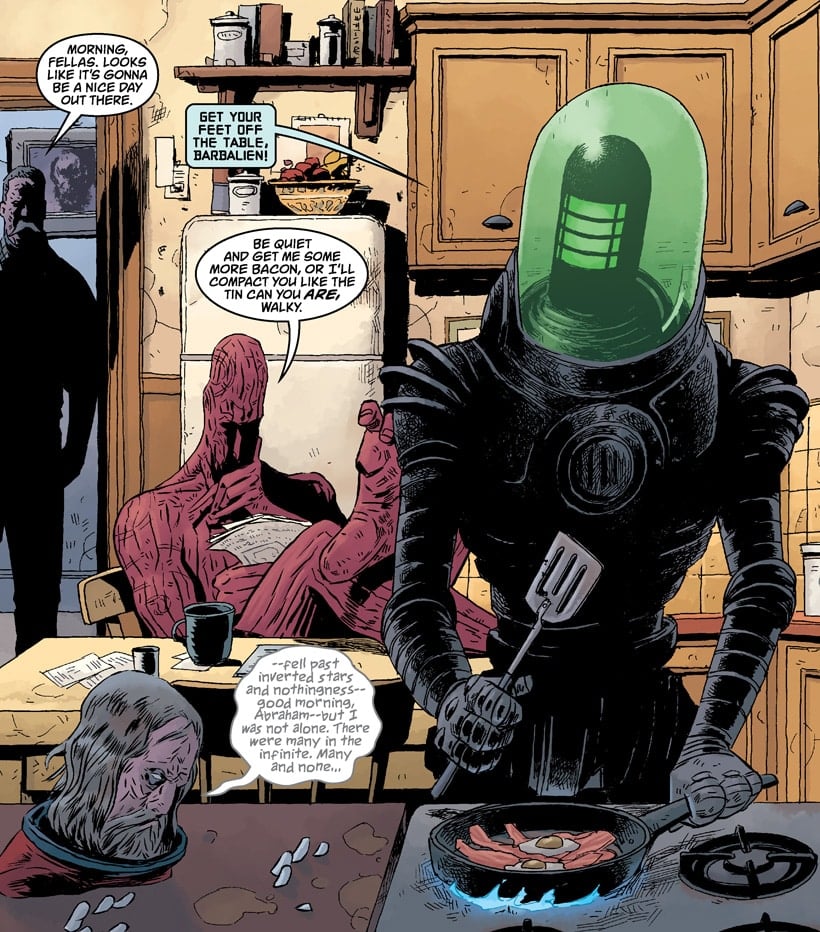
LEMIRE: It definitely is. As I started working on the original Black Hammer series I quickly realized that the main theme of the story was identity. What are these heroes when you strip them of their “super” identities and their artificial “secret” identities and they have to figure out who they really are? That not only informed the original series, but continued to drive many of the stories.
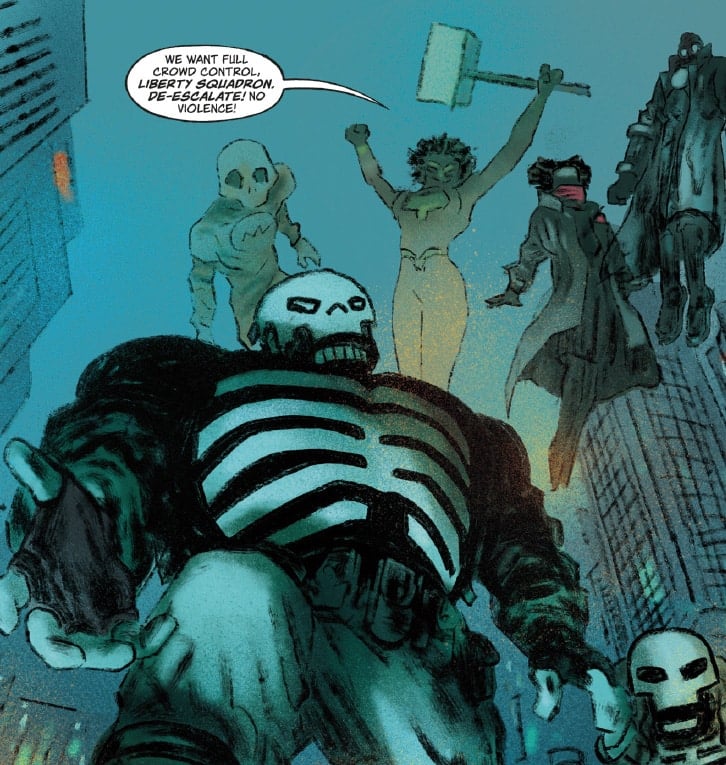
TWEEDALE: Forgive me for getting into the weeds for a moment, but Skulldigger’s return at the end of Spiral City came as a welcome surprise. He’s a great character, and I was sorry to see him sacrifice himself in The End (albeit as “Spacedigger”). We saw Golden Guinevere take on the mantle of Skeleton Girl, but at the end of that story she was alone. Are you planning a story to explore his return or if this Skulldigger is a Para-verse variant?
LEMIRE: There is a story there, and I know who that Skulldigger is, but I need to find the right time to tell that story. He’s not a variant version… He’s… well, I can’t spoil that.
TWEEDALE: Ah! Now you just have me more curious.
Last year, you were gearing up for the next arc of Black Hammer and you polled your newsletter readers what they’d like to see next: a continuation of Spiral City, a new solo character series, or a new group story. (I’d like all of them, obviously.) But this speaks to how many directions you’re open to. The World of Black Hammer spinoff titles are together bigger than mainline Black Hammer, and they include some of the best stories. (The back-to-back run of Skulldigger + Skeleton Boy, Colonel Weird: Cosmagog, and Barbalien: Red Planet is simply fantastic.) For me, the key to that is the artists you collaborate with. I see Letizia Cadonici’s Free Comic Day short story and immediately I’m imagining a whole story from her. Or a Willow D. Whisper story with Dani. With these spinoffs, how often does the choice of artist drive the way you develop the story and vice versa?
LEMIRE: The artist choice is a huge part of it. You can shape the story around the mood, style, and strengths of the artist and it brings so much personality to it. Though, I often, or always, have the story first and then look for the right artist to do it. So, I start with an idea or vision for a story, look for an artist that feels like a fit with that mood or vision. But, as you actually get into scripting and seeing art come back, it evolves and you start to react to what you’re seeing and that’s when it becomes a collaboration, and something new, and almost always something better than what I originally had in my head.
That’s certainly been the case with the new Black Hammer series. It is a totally new cast and I had an idea of what the characters would look like, but when my collaborator started sending me designs it just took on a whole new life of its own and became something special.
TWEEDALE: That new series will be coming next year. We’ll learn more from San Diego Comicon at the anniversary panel on Thursday. Also, Dean Ormston is currently working on a mysterious Madame Dragonfly project. You’re unable to discuss those just yet, so let’s turn our sights backwards. Since Black Hammer debuted in July 2016, what have been the biggest surprises for you? And what character moments are among your favourites?
LEMIRE: The biggest surprise has to be how big the universe became and how much the success of Black Hammer allowed me to expand and explore. That was never the plan and it all just happened in a surprising and wonderful way. I never could have dreamed there would be as many stories, characters, and collaborators as there are now in the Black Hammer Universe.
Favorite moments, so hard to pick one or two. I love the ending to Doctor Andromeda. I love how Skulldigger + Skeleton Boy came out. Anything with Colonel Weird is a joy to write. Teddy’s Spiral City was a joy to write and see come to life. I mean, I love all of it.