

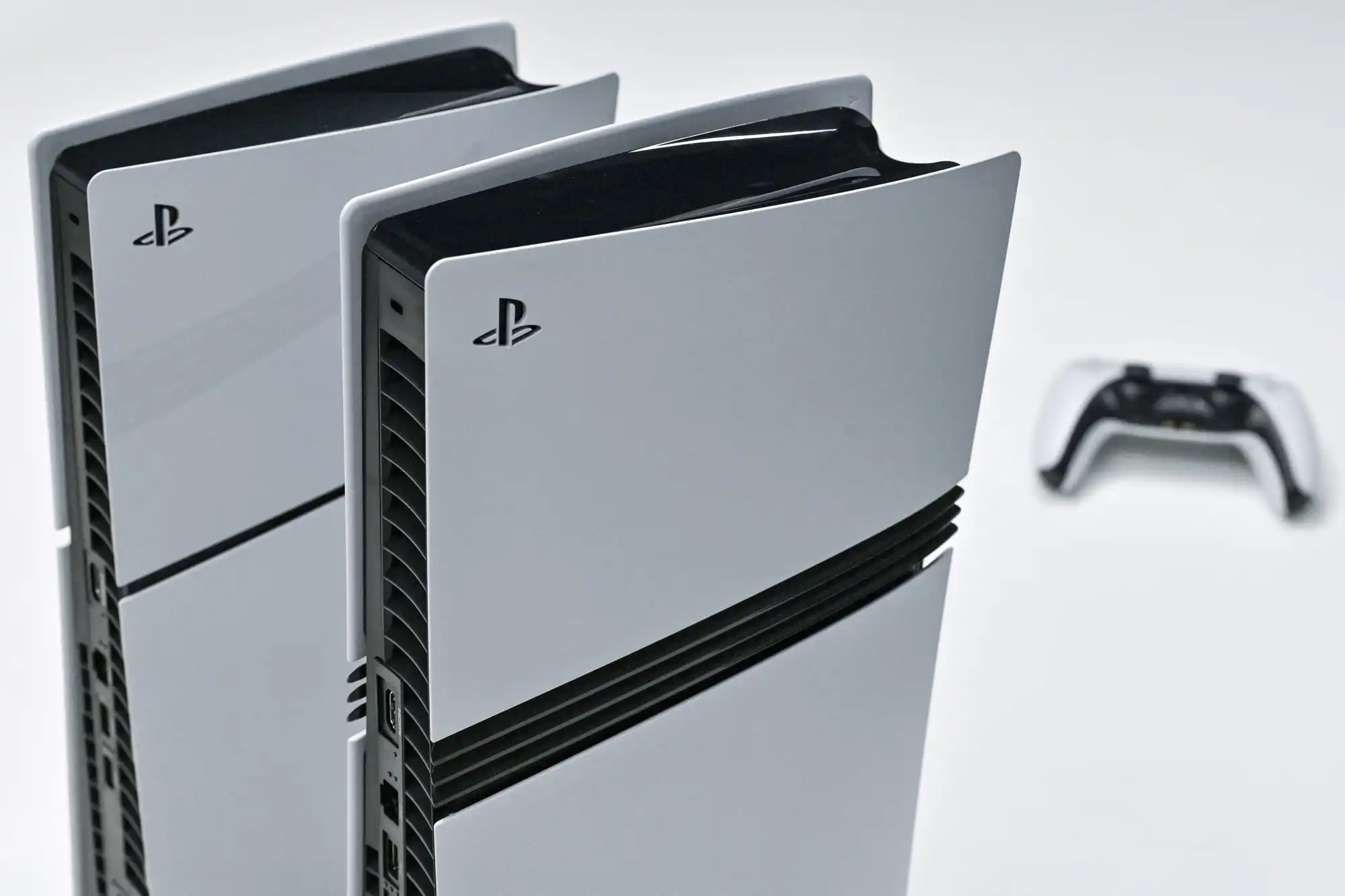
Sony is discontinuing physical media starting in 2028, sparking backlash across social media. The announcement comes at at time when it’s facing consumer lawsuits over how it handles the digital distribution of its games.
Sony announced earlier this month that it plans to discontinue physical discs for new PlayStation games starting in 2028, sparking anger among the gaming community.
Some are hoping that the European Union’s more consumer friendly approach to the law can halt the demise of physical games since companies have adopted rules from the region that end up affecting all their customers (like how Apple switched from its proprietary Lightning port to USB-C in compliance with EU regulations).
TheEU’s power to influence global policy has been dubbed “The Brussels Effect,” a term coined by Columbia Law School professor Anu Bradford.
Law experts told Marketplace it’s unlikely that the EU will be able to stop Sony from halting the production of physical discs.
But there are ongoing lawsuits in the Netherlands and the U.K.that claim Sony has been able to overcharge customers for digital games through its “dominant position” in the marketplace. These suits are seeking compensation for PlayStation users and calling for more open competition.
If these lawsuits are successful, Sony would not only have to provide financial compensation to these consumers, but they could be required to allow third-party retailers to sell digital PlayStation games, said Magdalena Tulibacka, a visiting assistant professor of practice at Emory University School of Law.
Marketplace reached out to Sony for comment, but did not receive a response by publication time.
Jelle Duijn, an attorney at the law firm Milberg Amsterdam, said the end of physical discs means Sony will have complete control over pricing.
Milberg Amsterdam serves as legal co-counsel for The Stichting Massaschade & Consument, the consumer group in the Netherlands that brought forth the lawsuit against Sony and launched a “Fair PlayStation” campaign criticizing Sony’s pricing practices.
“The end of physical discs removes the last place where a PlayStation game could still be bought and sold at a competitive price. No discs means no alternative to the PlayStation Store, so from 2028 onwards, Sony alone decides what a game costs and even how long you are allowed to use it. In the view of The Stichting Massaschade & Consument, that is exactly the harm the Fair PlayStation claim is about: a price cannot be considered fair when the buyer is left with no ownership and no alternative,” Duijn said.
The EU can’t stop the end of physical disc production
Michael McGrath, the EU’s commissioner for consumer protection, recently told reporters that the EU can’t stop Sony from discontinuing physical media.
“Companies are free to offer games and services in the manner that they see fit, provided that consumer rights are fully protected in line with national and EU law,” McGrath said.
Consumers are moving away from physical discs, with digital downloads constituting 85% of full-game software sales on the PlayStation 4 and 5 in the final quarter of the 2025 fiscal year
But without physical discs, consumers can’t buy them on the secondhand market, where they might be cheaper than their retail value. And the companies that sell you digital content can take it away from you. We saw this back in 2024, when the video game publisher Ubisoft closed the servers for an online racing game called “The Crew.”
“Physical games have traditionally provided consumers with an important alternative: they could buy from different retailers, compare prices, purchase secondhand copies, lend games to others, or resell them. Physical games gave gamers a level of ownership and control that is now increasingly disappearing,” Duijn said.
Under the Copyright Act’s first-sale doctrine, U.S. consumers actually own the physical version of any media they buy, whether that’s a game or a book, giving them the power to do whatever they want with it. But there is no digital equivalent.What you’re actually buying is a license to play that game.
Experts told Marketplace in our previous reporting on digital media that they think it’s unlikely consumers will gain greater protections when it comes to this issue. “It doesn’t feel like we’re living in the heyday of American consumer rights,” trademark and copyright attorney Ed Timberlake told us back in March. At the time, intellectual property law expert Jennifer Jenkins said she hadn’t seen enough groundswell support for this issue. If everyone stopped buying digital content and decided to buy physical media, for example, then that pressure could be the basis for change, Jenkins said.
The Court of Justice of the European Union is pretty much aligned with the U.S. on this issue and has clarified that there is no equivalent first-sale doctrine for digital media, said Eleonora Rosati, an intellectual property law professor at Stockholm University in Sweden. In the EU, discussion about this issue has died down in recent years, Rosati said.
But here’s what consumer lawsuits in Europe can change
While it’s unlikely that consumers will be able to own their digital games anytime soon, Sony’s announcement comes at a time when the company is facing class-action lawsuits in the U.K. and the Netherlands. These lawsuits argue that Sony has stifled competition, giving them the power to inflate digital game prices.
In the Netherlands, consumer group Stichting Massaschade & Consument filed a lawsuit against Sony in 2025 on behalf of 1.7 million PlayStation users in the region. The group alleges that Sony has been “exploiting its dominant position in the console market for at least ten years,” costing Dutch consumers 435 million euros (nearly $500 million) since 2013. The suit claims that the company is able to overcharge consumers because Sony has been able to eliminate competition and because it charges a 30% commission fee on digital game sales.
“Since Sony is the only party that controls the distribution of digital games and content, this structure creates a situation where Sony has the incentive to set the final retail prices artificially high,” said Duijn of Milberg Amsterdam.
PlayStation users in the Netherlands have had to pay 47% more for digital games than their physical versions,according to an independent economic report cited by Milberg Amsterdam.
The Netherlands suit wants there to be more open competition, although it’s not recommending “one specific technical solution,” Duijn said.
“Whether that means allowing alternative digital retailers, different distribution models, other forms of competition, or reducing the current commission, is ultimately a question to be addressed when determining the appropriate remedy,” Duijn said.
In the U.K., a $2.7 billion class-action lawsuit first filed against Sony in 2022 makes claims that are similar to the Netherlands lawsuit. The suit says that Sony is stifling competition because it only allows digital games and add-on content to be purchased or sold through the PlayStation Store, it doesn’t allow third-party operating systems to be used on the PlayStation and it charges developers and publishers a 30% commission on digital purchases. As a result, the suit alleges that Sony has the power to inflate prices.
According to 2023 court documents, one of the lawyers leading the lawsuit said,“We want the freedom for publishers to establish or third parties to establish their own distribution systems and not be required to use Sony’s.” The case was heard by the U.K. Competition Appeal Tribunal, a specialist court, in a trial held this year. Judgment is still pending.
Could these lawsuits be successful?
Sony has pointed out that itfaces competition from other console manufacturerslike Microsoft and Nintendo. But the plaintiffs are arguing that the Sony PlayStation ecosystem is its own market, which is an issue that gets exacerbated with the loss of physical discs, said Tulibacka at the Emory University School of Law.
“When Sony withdraws the physical game discs, its ecosystem will be even more closed and insulated from competition,” Tulibacka said.
More consumer groups and antitrust regulators could put pressure on Sony as a result.
“I think if they do this, they’re going to get into bigger trouble with the antitrust regulators, and there’s potential for more lawsuits against Sony and and more successful lawsuits because you’re narrowing the product market even further and you’re making yourself more dominant within that product market,” Tulibacka said.
The Dutch lawsuit has to prove that Sony occupies a “dominant position,” which does not actually require having a monopoly, Tulibacka said.
Dominance is possible even if a company only occupies 40% to 50% of the market Tulibacka said
But while Tulibacka said she thinks both lawsuits can succeed, she pointed out that the U.K. is no longer part of the European Union. “The decision of the Dutch court is likely to reflect the overall antitrust climate of the European Union,” Tulibacka said. “The EU’s approach to conduct by large international companies has been relatively strict, stricter for instance than the U.S. approach, and so the Dutch court may come out with a different judgement than the U.K tribunal.”
As part of the U.K. suit, Sony has said that its commission is used to help cover the costs of its investment in hardware and that allowing users to download from third-party stores could come with security risks.
In Sony’s announcement on the end of physical discs, the company did note that new games will be available “at retailers in digital formats.” But the company did not include details on what that model would look like.
“If those conditions turn out to be comparable to the terms Sony currently applies within its own PlayStation Store — with Sony effectively determining the price of the games sold through those retailers — then this would not represent a genuine alternative, but rather an extension of the current digital storefront under a different label,” Duijn said. “The exact details of this proposal are not yet public, including whether retailers would be able to set their own prices or would simply be reselling PlayStation Store codes on Sony’s terms.”
There are also other venues in the EU to open competition. Back in 2022, the EU passed a law called the Digital Markets Act, which designates certain businesses as gatekeepers and requires them to follow additional obligations on top of the typical antitrust rules in the EU, Tulibacka said. Those includeAlphabet, Amazon, Apple, Booking, ByteDance, Meta Platforms and Microsoft. Gatekeepers are “large digital platforms” that provide what are considered core services, like search engines and app stores. Because Apple is considered a gatekeeper, the EU is mandating that the company open its app store to third parties.
“Sony is not a gatekeeper according to that new law, but if it were to close that physical product pathway for themselves, you’re migrating a little bit more towards that notion of the gatekeeper,” Tulibacka said.
In the U.S., consumers brought forth a class-action lawsuit against Sony, also arguing that gamers had to pay more for digital PlayStation games because the company stifled competition. Sony denied wrongdoing, but agreed to provide $7.85 million in credits to customers to settle the case.
“It is clear that U.S. consumers can bring antitrust claims and obtain monetary relief. But this case does not establish any specific rights for third-party developers and does not force Sony to open their business model,” Tulibacka said.
Gamers who want Sony’s business practices to change might have to look to antitrust enforcement across the pond. “If the question is where we are more likely to see remedies that reshape Sony’s ecosystem, Europe currently has the stronger track record,” Tulibacka said.
If Sony’s business practices change in response, that could have an impact on PlayStation users everywhere.
“There are no direct effects, no binding effects of those judgments across the Atlantic. However, much has been said about the Brussels Effect and for a good reason,” Tulibacka said. “Companies that need to change their business models for millions of European consumers sometimes end up changing them for all their consumers.”

Artificial intelligence companies are coming to New York City
Workplace/Jobs

Traditional supermarkets are struggling. Kroger hopes its Giant Eagle merger will help
Retail
IBM and other old-school tech companies feel the AI pinch
Technology
