

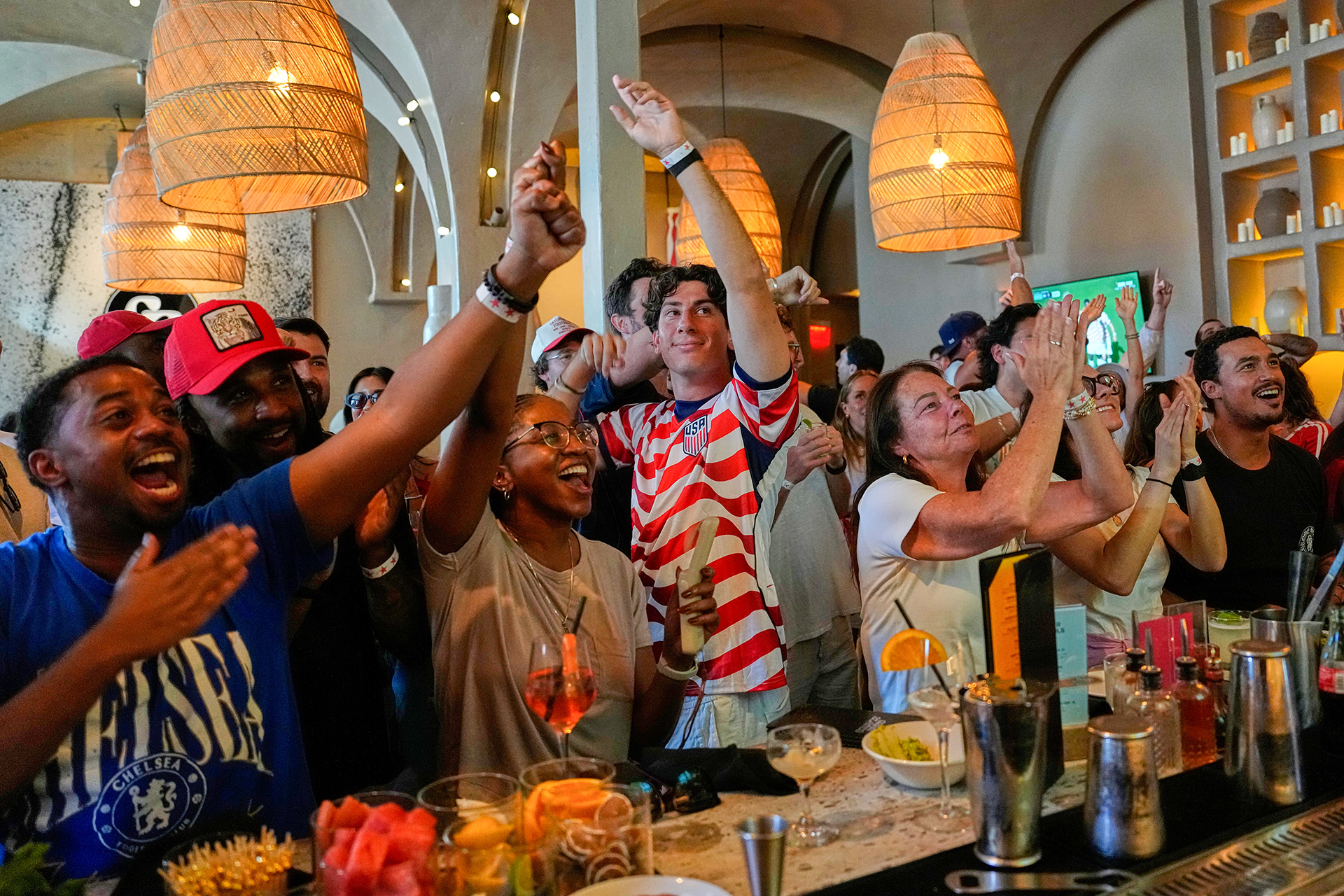
The state of the American social fabric — enormous, diverse, and rent by stark partisan divides — is daunting enough that it can be hard to think about, let alone try to mend.
At the Harvard Kennedy School, two social scientists are advancing the proposition that sports fandom, a powerful social phenomenon and force, may have a role to play in improving lives and strengthening societies.
That proposition is probably controversial. It’s certainly underexplored.
So a new project, launched by Professor Todd Rogers and doctoral student Audrey Feldman aims to fill the gap, with its first wave of findings set to publish in the months ahead.
Leaving aside the billion-dollar business, fandom is an undeniable social fact. In the U.S., nearly three-quarters of people say they follow a pro sports team, and the majority of those consider their fandom to be an important part of their identity.
(And on the week of the World Cup final, it’s noteworthy that 51 percent of people globally are fans of soccer alone. Americans are a bit less ardent (27 percent), but 40 percent planned to watch at least some of the games.)
Yet Rogers, Weatherhead professor of public policy at HKS, and Feldman have found that sports receive remarkably little scholarly attention. In top journals across the social sciences, only about 1 in 800 articles concerned sports.
The Fandom and Social Connection Initiative aims to change that.
Backed by a gift from FOX Sports and seeking partners among professional sports leagues, Rogers and Feldman have embraced the work as both an observational “green field” and as a target for social intervention — with a personal rooting interest for them both.
Feldman was drawn to HKS in the hope that behavioral science could improve human lives — for instance, by increasing access to underutilized social programs and promoting learning and social cohesion in refugee populations.
But amid conversations with Rogers on international development, Feldman said, “we realized we’re both big sports fans.”
Feldman, who completed a bachelor’s in economics at Notre Dame in 2024, didn’t escape the pull of Fighting Irish football, though her dad went to rival Michigan. And Rogers’ Mount Auburn Street office is dotted with Philadelphia Eagles gear.
“It’s social infrastructure in a world where there are few — if any — institutions left that are this wide, and deep, and diverse.”
Todd Rogers
The initiative attempts to apply rigorous modern tools to their shared passion.
Implicitly, the work involves a reclamation project for sports fandom itself, which Rogers argued is not only understudied but maligned.
“We did a survey where we asked non-fans to identify fans on that ‘ascent of man’ scale,” Rogers said. Presented with that famous succession of increasingly hominid silhouettes ambling to the right, most non-fans placed passionate sports fans somewhere around Homo erectus.
To Rogers, that’s a dangerously low appraisal of fandom’s social role. “It’s social infrastructure in a world where there are few — if any — institutions left that are this wide, and deep, and diverse,” he said.
With many forms of social organization — social clubs, political parties, and churches — in a kind of secular decline, sports fandoms loom larger than ever in their power to combine and motivate large groups of people, across racial, economic, and political divides.
Consider Congress. Nineteen of the 50 current state delegations are made up entirely of one party or the other.
And — as anyone knows who’s ever watched a game in a packed stadium or bar — shared fandom can serve as an instant de-polarizer.
In a paper currently under review, Rogers and Feldman applied game theory to test the effects.
In a computer survey, they presented participants with hypothetical “counter-partisans” — people who hold views on politics and culture starkly opposed to their own — and asked them to award a “bonus” to one or the other.
If they knew one “counter-partisan” also rooted for their favorite team, that one got the “bonus” at rates that outstripped those for counter-partisans with a shared race or ethnicity, education, or home region.
Only a shared religion came close to being that influential, which seems revealing.
Often enough, sports fandom is as inherited as any other marker of identity. But — like religion — it’s also both active and elective: a seasonal, ritual allegiance that people can either outgrow or choose to renew throughout their lives, Rogers argued.
And often enough, they do the latter — even when their favorite team is luckless, perennially “rebuilding,” or to all appearances cursed.
To Rogers, that opting-in suggests that sports fandom isn’t motivated principally by on-field events but by the bonds that form around them with parents, siblings, colleagues, and neighbors. (“How else would there be Cleveland Browns fans?” he joked.)
Sports fandom — like religion — is both active and elective: a seasonal, ritual allegiance that people can either outgrow or choose to renew throughout their lives.
The positive social effects of being a sports fan have not totally escaped serious notice before this summer. Rogers credits the book “Fans Have More Friends,” co- head of strategy and analytics for FOX Sports. And he speaks monthly with Daniel Wann, professor at Kentucky’s Murray State University, whom Rogers calls the under-appreciated “godfather of psychology and fandom.”
Wann gave him a useful metaphor. “He said shared fandom is like a shared photo album,” Rogers recalled. To follow the same team as another person — even a perfect stranger — is “to know where [they] were in February 2018, and where they’re going to be next September,” he said. “Our hearts are going to be synchronized.”
(Literally, Rogers added: Some psycho-physiological results suggest that spectators’ EEGs start to synchronize around the highs and lows that punctuate big games.)
Still near the outset of their shared work, Rogers and Feldman are still theorizing why sports are such an effective social solvent — say, in conversations with a stranger. But it makes sense. Relative to the weather, they’re engrossing, human, and almost inexhaustible. And compared to politics or current events, sports are safe.
That’s usually true even in cases of acrimonious rivalry, they argued. Feldman spoke of the fun of watching a football game even with fans of Ohio State. “I think their team is the worst, but at least we can talk about football,” she said. “There’s a mutual respect there.”
Rogers noted one draft finding that backs that up: in which fans of rival teams in the English Premier League said they’d sooner socialize across the aisle separating, for example, Man United and Liverpool than with people who don’t watch soccer at all.
Even as their theoretical work is ongoing, Rogers and Feldman are already pursuing opportunities to intervene in the real world.
Their first published work together was an op-ed published last fall for TIME, arguing that the football-averse should embrace a team in America’s most popular sport. NFL fandom, they write, is a “simple and universally accessible medicine” in an age of loneliness.
That work will continue this summer, in partnership with the Boston Red Sox’s AAA affiliate, looking for ways to nudge spectators into conversation with their neighbors in the bleachers.
Though their papers are still being written up, the first indications support the idea that sports can serve as a kind of social glue, Rogers said.
“Audrey and I have experiments where we can induce 40 percent of participants to watch a game with others, and — at the end — they feel more connected, and in a way that persists for weeks,” he added.
