

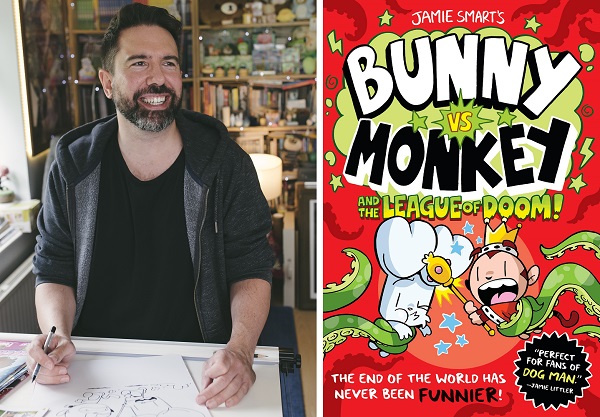
Moving On Up: Jamie Smart’s ‘Bunny vs Monkey’
By Brigid Alverson
|
Jul 14, 2026
While Dav Pilkey continues to be the top-selling creator of children’s graphic novels both in the U.S. and the U.K., he has a serious competitor across the pond: Jamie Smart, whose Bunny vs Monkey books are hugely popular among British readers. The series had sales of £2 million in the first 18 weeks of 2025, compared to £4.4 million for Pilkey’s Dog Man and Cat Club titles, according to the Bookseller, and between them, Smart and Pilkey were responsible for about 75% of all U.K. graphic novel sales during that period. The books are translated into 32 different languages, and now Smart is making inroads in the U.S. as well: His U.S. publisher, Union Square Kids, will release Bunny vs Monkey and the League of Doom, the third volume of the series, this August. (The series is much farther along in the U.K., where book 12 has just been published.)
There’s a reason Smart has fans on both sides of the Atlantic. “The humor in the Bunny vs Monkey books translates so well to a U.S. audience because Jamie completely respects his readers,” said Chris Duffy, executive editor at Union Square Kids. “The stories are packed with entertainment, inventiveness, great jokes, and constantly shifting and evolving premises. Kids can tell it’s worth their time, and Jamie never lets them down.”
In the U.K., Smart has an edge over Pilkey in terms of exposure, because a Bunny vs Monkey comic runs in the weekly comics magazine thePhoenix, which was started in 2012 by David Fickling, whose David Fickling Books publishes the graphic novels in the U.K. The weekly serialization keeps readers engaged, according to Anthony Hinton, senior commissioning editor at Fickling Books. “As Jamie’s comics are first run weekly in the Phoenix magazine, we can see the reader response in real time,” Hinton said. “The fan art tidal waves of drawings of Bunny vs Monkey characters and hand-made comics by Jamie and the Phoenix’s young readers show over and over again that Bunny vs Monkey has sparked their own creativity, and a new love of making comics themselves.”
As Smart has learned, format seems to make a difference. Fickling’s first Bunny vs Monkey graphic novels, launched in 2014, had a larger trim size and a smaller page count than the current chunky, 256-page editions, which launched in 2023. “The thinner volumes did all right, but they didn’t break any records,” Smart told PW. “But as soon as we switched to these thicker volumes, everything took off. I think that kids want to hold a book that feels satisfying.”
Like Pilkey’s Dog Man and John Patrick Green’s InvestiGators, the Bunny vs Monkey books are colorful, cheeky, and goofy. They are set in a forest with an ever-growing cast of characters, including Bunny; his friends Pig and Weenie (a squirrel); Monkey, who was launched into space, landed in the woods instead, and thinks he has found a new world to conquer; and Skunk, a mad scientist
Smart was in his 20s and working on pitches for TV shows when he got the idea for the comic. “I thought it’d be funny if a bunny and a monkey were fighting each other,” he said. “That’s literally it.” His attempts to develop it for television flopped, however. “One of my bosses at the network took me to one side and said, ‘Do you really want to keep making TV shows? Because it seems like all you want to do is draw comics,’ ” Smart recalled. That was a revelation: “I could literally put what I thought it should be down on the page, and that proved to be the most satisfying way to tell the stories,” he said.
Because the comic is serialized in a weekly magazine, the episodes are short. “I tend to do quite large panels for the opener of each episode,” Smart said, “and that can either be a crazy invention coming in, and then they’ve got to figure out how to stop it, or it can be something really small, like discussing the nature of the universe. That opener has to be the memorable bit.”
While other creators might struggle with a weekly schedule, the ensemble that Smart has put together for this series makes his job easier, he said. “What I like about Bunny vs Monkey is it’s very much a cast of characters,” Smart said. “Often when you’re writing comics, you’re [following] the smaller, sassier character and the bigger, dumber character and how they get along, and that’s kind of a formula you can slip into. With Bunny vs Monkey, each of them has their own flaws and foibles, and if I get bored of one, I can just dip into the other, and I can put them in different situations. It gives me a lot of creative freedom to be able to play around with them like that.”
