

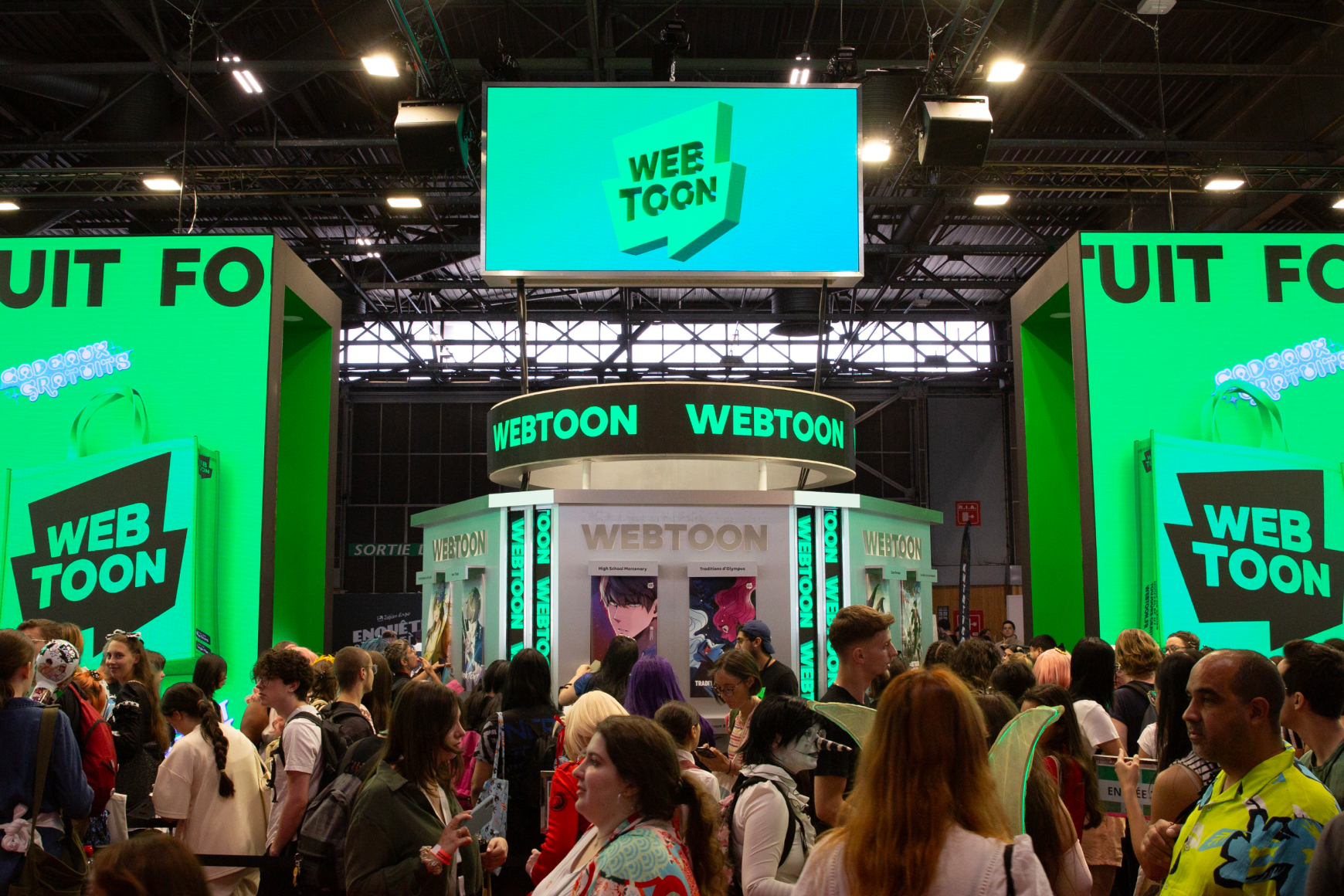
San Diego Comic-Con has always been where entertainment industries announce what they’re becoming. Starting July 23, WEBTOON Entertainment (Nasdaq: WBTN) will use four panels across three days to argue that webtoons — the mobile-optimized, vertically scrolling digital comics format that generated an estimated $14 billion globally in 2026 — have crossed the threshold from niche curiosity to pop culture institution. The company’s flagship Saturday announcement panel and a separate high-profile vampire crossover event featuring K-pop group ENHYPEN give it the most concentrated convention footprint the format has ever assembled at SDCC.
For fans and industry observers alike, the programming answers a practical question first: what’s happening, when, and where. But it also opens a harder one — about censorship, creator economics, and whether a format serving 144.3 million monthly active users has grown large enough to attract the institutional scrutiny that mainstream media has historically earned
WEBTOON’s Four-Panel Schedule: What to Know Before You Go
WEBTOON Entertainment’s official programming opens Thursday, July 23, with “Creature Craft: Visionaries of Horror Comics Share Their Secrets” (10:00–11:00 a.m. PT, Room 29AB). The panel brings together Punko — creator of WEBTOON’s Stagtown and Cinderella Boy — alongside print comics veterans Cullen Bunn (Ripcord, Deluge) and Cat Staggs (co-creator of Death Mask), moderated by Nerdist Editor-in-Chief Rotem Rusak. The genre-forward opener signals WEBTOON’s intent to position its horror catalog alongside established print talent rather than apart from it.
Friday, July 24 brings two panels in Room 32AB. “Love in Every Universe: The Great Romance Trope Debate” (10:00–11:00 a.m. PT) pairs ROSEOAK, creator of Not So Silent on WEBTOON, with Wattpad’s Head of Content Alessandra Ferreri, author E.M. Wilson (Situationship), and Becca Erin Title, founder of Meet Cute Romance Bookshop, moderated by Mashable Culture Editor Crystal Bell. The presence of a brick-and-mortar romance bookseller alongside a WEBTOON Original creator reflects how webcomics now compete for the same readership that sustains genre fiction publishing. Later that afternoon, Derek V. Song — the writer behind WEBTOON’s Fantasy High, The Primal Hunter, and Paranoid Mage — takes a solo spotlight panel on adapting a beloved tabletop-inspired property to the vertical-scroll format.
The convention’s WEBTOON week closes Saturday, July 25, with “What’s Next from WEBTOON Entertainment” (11:30 a.m.–12:30 p.m. PT, Room 24ABC). Ryan Lee (Head of Content), Sydney Bright (Head of Global Animation at WEBTOON Productions), producer Erik Kozura, and creators ROSEOAK, Derek V. Song, Punko, and Ucheomaaa (creator of Vibe Check!) will present exclusive first looks and new content announcements spanning WEBTOON Originals, WEBTOON Productions, the print imprint WEBTOON Unscrolled, and additional entertainment initiatives. Journalist, comics critic, and 2026 Eisner Award judge Tiffany Babb will moderate. This is the panel where announcement-minded fans will want to be.
ENHYPEN and Twilight Icons Share Ballroom 20 in SDCC’s Biggest Vampire Crossover
The highest-profile cross-genre collision of WEBTOON’s SDCC week unfolds Thursday morning, July 23, and it will require a separate ticket. “Bite Me: Calling All Vampires” (11:15 a.m.–12:15 p.m. PT, Ballroom 20) brings K-pop group ENHYPEN together with Twilight director Catherine Hardwicke and cast members Peter Facinelli and Ashley Greene — best known as Carlisle and Alice Cullen — for a conversation on how vampire storytelling has evolved across film, television, music, webtoons, and animation. TV Guide Magazine Senior Writer Damian Holbrook, a veteran SDCC moderator, will host.
ENHYPEN’s place on that panel is earned by IP, not celebrity alone. The group co-created the DARK MOON franchise — a vampire-themed original story universe that launched as a webtoon and web novel in January 2022 through HYBE’s Original Story initiative — and has since watched it accumulate over 200 million cumulative views and expand into an animated series now streaming in more than 80 countries. The franchise’s name comes from ENHYPEN’s vampire lore; the panel’s name comes from their 2023 single.
The DARK MOON presence extends well beyond the panel. ENHYPEN will appear at an official DARK MOON booth on the convention floor (Booth No. 4129) on July 24 from 3:00–3:40 p.m. PT. And on Friday evening, HYBE will stage “DARK MOON BLOOD NIGHT with ENHYPEN” at the House of Blues in San Diego’s Gaslamp Quarter — an 18+ all-standing event running 7:00–10:00 p.m. PT, with DJ/networking during the first hour and a main event of talk session and live ENHYPEN performances beginning at 8:00 p.m. Entry is by lottery only. Dress code: vampire.
The DARK MOON activation illustrates what K-entertainment conglomerates have built out of the webtoon format in its platform-era form: a vertically integrated IP incubator where a story begins as a digitally native webcomic, builds a fandom through the CANVAS and Originals pipeline, and then expands simultaneously into music, merchandise, animation, and live events. HYBE and BELIFT LAB did not put ENHYPEN in Ballroom 20 to introduce them to comics fans. They put them there to introduce DARK MOON to the global pop-culture industry.
How Vertical Scroll Became a $14 Billion Business
Understanding why WEBTOON’s SDCC footprint carries market-level significance requires a brief look at the format’s structural economics. The webtoon’s defining feature — vertical scrolling optimized for mobile — is not just a reading preference; it is the infrastructure of a specific business model. Mobile devices account for approximately 74% of webtoon reading time globally, per Mordor Intelligence. Episodic chapter release (typically weekly) enables micro-payment per episode rather than requiring a reader to buy a volume upfront, dramatically lowering the barrier to monetization. And the format’s panel structure accommodates ad insertion between panels in a way that horizontal print cannot, enabling ad-supported free reading alongside paid-content tiers.
WEBTOON Entertainment’s specific pipeline works in two layers. The first is CANVAS — an open amateur platform now hosting over 27 million creators — which functions as the discovery and talent-development layer. The second is WEBTOON Originals, a professionally contracted tier where selected creators receive direct support, editorial guidance, and revenue from paid-content, advertising, and IP adaptation deals. The OSMU (one-source, multi-use) licensing framework then enables any breakout Originals title to be licensed into anime, live-action, merchandise, and gaming with the audience already built. That is how Stagtown and Not So Silent move from webcomic to SDCC panel to potentially a streaming deal.
The result is a publicly traded company (Nasdaq: WBTN) reporting Q1 2026 revenue of $320.9 million, with paid content — readers buying early-access chapters and subscriptions — as the largest segment at $261.4 million. The company has distributed $2.7 billion to creators globally from 2021 through 2025, a figure it cited prominently in its Q1 2026 earnings call as evidence of creator ecosystem health. The global webtoon market, according to Mordor Intelligence estimates, stood at roughly $14.44 billion in 2026 and is projected to reach $60.25 billion by 2031.
What the Censorship Panel Signals About the Format’s Growing Stakes
Beyond WEBTOON’s branded programming, two independent panels at SDCC 2026 reflect a harder-edged moment for the format. “How Webtoons Have Changed the Comics Industry” (Thursday, July 23, 4:30–5:30 p.m. PT, Room 24ABC) gathers journalists and critics — Deb Aoki (Mangasplaining), Kalai Chik (K-Comics Beat), Heidi MacDonald (The Beat), Leeanne M. Krecic (Let’s Play), and Derek V. Song — to examine how a format that generated $1.3 billion in South Korea alone has reshaped reader habits, publishing economics, and creator pipelines globally.
The more urgent conversation comes on Friday. “Anime, Manga, and K-Comics Censorship” (July 24, 1:00–2:00 p.m. PT, Room 11) features the Comic Book Legal Defense Fund’s Jeff Trexler, Deb Aoki, and USC Annenberg doctoral researcher Samantha Tecson addressing a rising wave of restrictions on the format — specifically school and library bans, import prohibitions, platform debanking, and criminal proceedings — alongside First Amendment implications for digital comics in the United States
The presence of a CBLDF attorney and a doctoral researcher on an SDCC panel is itself a signal. The format now reaches tens of millions of young readers across North America and Europe, and the legal mechanisms targeting it are distinctly digital-era: payment processors refusing to handle transactions for content deemed objectionable (“debanking”) has no precise historical parallel in print. A book can be pulled from a library without the author losing income; a webtoon that gets debanked by a payment processor loses its monetization channel entirely, without any court order. That is the specific institutional threat the censorship panel is designed to address — and it is the reason the Comic Book Legal Defense Fund, which was founded in 1986 to fight battles with physical books and physical shops, has had to relearn its brief.
Does Arrival Look Like This?
WEBTOON’s SDCC 2026 programming is, in its framing, a statement of arrival — the company’s own communications language for the week includes phrases like “celebrating the format’s explosive global rise.” The business context is worth holding alongside that framing. WEBTOON Entertainment’s Q1 2026 revenue declined 1.5% year-over-year. Monthly active users fell 5.9% — partly due to a methodology change in how the company counts users (beginning in Q1 2026, it excluded bot traffic and unauthorized automated access from its MAU calculation, a decision that improved accuracy but reduced the reported figure). The company’s IP adaptation revenue dropped 22.8% year-over-year in the same quarter.
These figures don’t make the SDCC programming a marketing exercise so much as they contextualize what kind of inflection point this actually is. A $14-billion global market with a dominant platform posting revenue declines is an industry going through structural maturation, not simple linear growth. The Saturday “What’s Next” panel is likely to address some of those pressures alongside the announcement slate. The censorship panel is not an optional side conversation — it is about the legal and commercial environment in which the format’s next phase will operate.
Fans without SDCC badges can access WEBTOON-adjacent activations in the Gaslamp Quarter and Petco Park area, which require no badge. DARK MOON BLOOD NIGHT at the House of Blues on July 24 requires a separately obtained lottery entry. SDCC 2026 runs July 23–26 at the San Diego Convention Center
Frequently Asked Questions
What WEBTOON panels are happening at SDCC 2026, and when?
WEBTOON Entertainment is presenting four panels. On Thursday, July 23: “Creature Craft: Visionaries of Horror Comics” at 10:00 a.m. PT (Room 29AB). On Friday, July 24: “Love in Every Universe: The Great Romance Trope Debate” at 10:00 a.m. PT (Room 32AB) and “Bringing Fantasy High to WEBTOON: Spotlight on Derek V. Song” (Room 32AB, afternoon). On Saturday, July 25: “What’s Next from WEBTOON Entertainment” at 11:30 a.m. PT (Room 24ABC) — the flagship announcement panel. Additionally, the ENHYPEN “Bite Me: Calling All Vampires” panel takes place Thursday, July 23 at 11:15 a.m. PT in Ballroom 20, with DARK MOON BLOOD NIGHT at the House of Blues on July 24 from 7:00–10:00 p.m. PT (18+, lottery entry required).
How much does WEBTOON actually pay its creators?
WEBTOON Entertainment reported paying $2.7 billion to creators globally from 2021 through 2025. That is a legitimate headline figure, but its distribution matters: spread across the platform’s 27 million registered creators, it averages roughly $100 per creator over five years. The company’s economic model concentrates payouts heavily at the WEBTOON Originals tier — a professionally contracted layer where selected creators receive direct support and revenue from paid content, advertising, and adaptation deals. The much larger CANVAS amateur platform primarily functions as a talent-discovery and content-discovery layer rather than a significant income source for most of its 27 million participants. WEBTOON stated in its Q1 2026 earnings call that it does not plan to increase revenue-sharing rates, focusing instead on expanding the value of its tools, including AI-powered translation and global distribution.
What is the DARK MOON franchise, and why is ENHYPEN at a vampire panel with the Twilight cast?
DARK MOON is a HYBE Original Story IP — a multi-format narrative universe developed in collaboration with K-pop group ENHYPEN. It launched in January 2022 as a webtoon and web novel set in a vampire-and-werewolf fantasy world where ENHYPEN members appear as fictional characters. The flagship title, DARK MOON: THE BLOOD ALTAR, has accumulated more than 200 million cumulative views and expanded into an animated series now streaming in more than 80 countries. The SDCC panel title “Bite Me: Calling All Vampires” references ENHYPEN’s 2023 single of the same name, which is woven into the franchise’s lore. ENHYPEN joins Twilight director Catherine Hardwicke and cast members Peter Facinelli and Ashley Greene for a conversation on vampire storytelling across film, music, webtoons, and animation — effectively positioning DARK MOON as a generational successor to the franchise that filled Ballroom 20 two decades ago.
What is the “debanking” issue the censorship panel will address, and why does it matter to webtoon readers?
Debanking refers to payment processors — credit card companies, digital payment platforms — refusing to handle financial transactions for content they deem objectionable. For print comics, censorship historically meant a book could be pulled from a shelf, but the author’s broader business remained intact. For digital-native comics, debanking cuts off the monetization channel itself: a creator whose payment processor stops handling their transactions loses subscription and micro-payment income without any court ruling or formal legal process. Jeff Trexler of the Comic Book Legal Defense Fund, Deb Aoki, and USC Annenberg doctoral researcher Samantha Tecson will address this mechanism — along with library bans, import prohibitions, and criminal proceedings — at the “Anime, Manga, and K-Comics Censorship” panel on Friday, July 24 at 1:00 p.m. PT in Room 11. For readers: the practical stake is whether the content you read today remains available and monetized for the creators who make it.
ⓒ 2026 TECHTIMES.com All rights reserved. Do not reproduce without permission
Tags:SDCCK-PopCensorship
