

Front page
InterviewWorkspace Tech32m · 12:01 GMT · 6 min read
Eye Tracking Could Make XR Training More Responsive
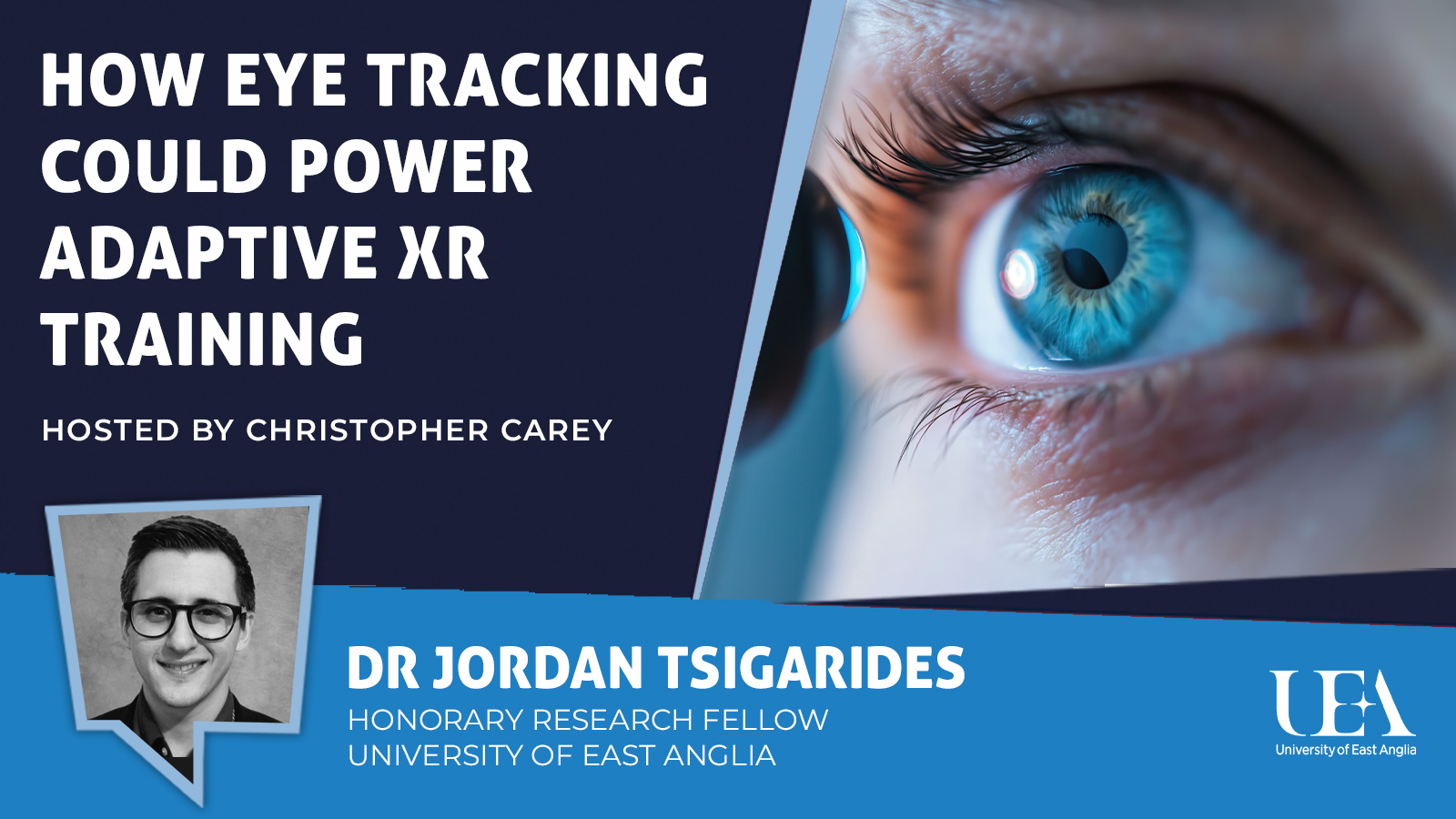
Research led by the University of East Anglia found that eye-tracking signals in VR can identify changes in mental workload. Dr Jordan Tsigarides explains how the findings could support adaptive workplace XR training, while raising important questions around biometric-data governance
A study into eye tracking in VR has found that changes in pupil size and blink rate can identify shifts in mental workload, raising the prospect of XR training that adjusts to an employee’s ability during a session.
Published in Scientific Reports, the research assessed whether eye tracking built into a consumer VR headset could act as a marker of cognitive load during a graded working-memory task.
Its machine-learning models distinguished between low and high workload with up to 88 percent accuracy among healthy volunteers.
Speaking to UC Today, Dr Jordan Tsigarides, Honorary Research Fellow at the University of East Anglia and Senior Clinical Fellow in Rheumatology at Norfolk and Norwich University Hospital, said the opportunity is to make VR experiences more responsive to the individual.
“It’s about being able to take what is an impactful virtual reality experience and supercharging it by being able to provide the information and the content that that person needs at that time,” he said.
The study was conducted in the context of chronic pain, but the underlying approach has potential relevance for enterprise learning.
Rather than giving every employee the same VR module at the same pace, workplace XR platforms could eventually use eye tracking alongside task performance and learner feedback to adjust the experience in real time.
The research involved 84 volunteers, including 42 people living with chronic musculoskeletal pain conditions, such as arthritis and fibromyalgia. Participants undertook increasingly demanding N-back memory tasks in VR while researchers collected data on pupil size, blink rate and gaze direction.
As task difficulty increased, participants’ pupils widened and their blink rates increased. The results indicate that eye signals could offer an accessible way to estimate cognitive workload in headsets that already support eye tracking.
Targeting the Productive Middle Ground
The goal of adaptive XR is not simply to make training more difficult. Instead, it is to keep people in a productive range where the task is engaging enough to hold their attention without becoming overwhelming.
Tsigarides described this through flow theory, where challenge is matched to a person’s ability and their mental capacity at that time.
“We want people to be on task at all times,” he said.
“That looks like having a workload which is not too high, that you are cognitively overloaded, but not too low where you are under-engaged and unmotivated.”
In a workplace setting, this could mean an XR application identifying signs that a learner is struggling with a scenario and responding by slowing the pace, offering prompts or reducing complexity. Conversely, if the learner is under-challenged, the system could remove guidance or increase task difficulty.
That approach could be valuable in areas where training must accommodate varied experience levels, including technical onboarding, safety exercises, complex equipment instruction and simulated customer interactions.
However, the research does not establish a universal threshold for the right level of cognitive workload. A task that is manageable for one employee may be too demanding for another, while the same individual’s capacity may vary from one day to the next.
Combining Signals Could Improve Accuracy
Eye tracking is a useful candidate for adaptive training because it is already available in several commercial VR and mixed-reality headsets. Tsigarides said pupil size change in particular could provide a strong indication of cognitive workload during a task.
But eye tracking should not be treated as a standalone judgement on an employee’s ability or state of mind.
“You would need the ability to measure that person’s subjective experience of that task and have some sort of understanding over time of what that person is able to achieve, because everyone is different,” Tsigarides said.
In the study, participants also reported how demanding they found each task through validated questionnaires. The researchers collected performance data, including reaction times and correct or incorrect answers.
Combining these inputs could enable a more robust model than relying on a single biometric signal. Tsigarides also pointed to heart-rate variability and other wearable data as possible
The study’s results underline the importance of this nuance. While the model achieved up to 88 percent accuracy among healthy participants, its accuracy was lower among people living with chronic pain. Tsigarides said pain itself, medication, health conditions and differences such as age may influence the way pupils respond.
For enterprise deployments, the lesson is clear: models should be calibrated and validated for the people using them. Employers should be cautious about applying generalised biometric assumptions to diverse workforces.
Keeping Biometric Data Out of Surveillance
The biggest barrier to workload-aware XR may not be the sensor technology. It may be employee trust.
Eye movements, pupil response and attention data can feel highly personal, especially if workers believe they could be used to assess their productivity, competence or suitability for a role.
Tsigarides said organisations need to be transparent about what they are collecting and why.
“You have to be making your employees aware of what you’re using the technology for,” he said.
“You don’t want to be seen as the big brother entity that’s recording people’s eye tracking and using that to identify whether they’re underperforming or performing well.”
He argued that employers should frame the use of eye tracking as a way to support personalised learning rather than as a performance-management mechanism. Clear consent processes, limited data access, defined retention periods and a separation between learning analytics and employment decisions will be important safeguards.
Giving learners visibility of their own information could also make the technology more useful. Tsigarides cited separate work in surgical education, where learners are shown their gaze direction after completing a procedure and can compare it with an expert’s visual attention.
In enterprise XR, similar feedback could help employees understand where their attention went during a simulation and identify opportunities to improve.
Lighter Headsets Must Retain Immersion
Tsigarides also addressed the market’s move towards lighter, glasses-style XR devices. Less weight and greater comfort could help organisations run longer training sessions, particularly for users who are new to immersive technology.
He said bulkier headsets can become difficult to wear beyond roughly 20 to 30 minutes, limiting both the type of training that can be delivered and the willingness of employees to use them.
However, he cautioned against reducing immersion too far. In healthcare training, VR can put people into environments that would otherwise be difficult to access, such as a surgical theatre, an emergency situation or a patient’s home.
“The immersion of VR is what we’re looking to achieve,” he said.
For workplace learning teams, that means balancing device comfort against the level of presence a scenario requires. Lighter hardware may lower adoption barriers, while more immersive headsets may remain better suited to high-stakes training where context, focus and realism are essential.
rate this storyhelps rank stories across uc today
More from the Workspace Tech desk
<img src="https://comicvibe.com/wp-content/uploads/2026/11/image-8.png” alt=”Why AI Success Starts With Managers, Not Technology”>
Why AI Success Starts With Managers, Not Technology
Jabra’s WorkLife 2026 research reveals a widening AI gap between leaders and individual contributors. Daily AI use is 2.4 times higher among employees with an AI-competent manager, suggesting manager capability, training and permission to experiment matter more than access to the technology
Christopher Carey · 5 Nov 2026News
This Week: Logitech’s Room Refresh, Google Beam, AI PCs
Meeting-room hardware is back on the procurement agenda as organisations replace ageing systems, but higher component costs and supply constraints remain. This week, Logitech reported stronger video collaboration sales, Google expanded Beam, and the AI PC debate continued
Christopher Carey · 30 Oct 2026Interview
AI Laptops: Useful Upgrade or Expensive AI Washing?
New laptops increasingly carry AI branding, but businesses may not need new hardware to use AI tools. Egiss’ Ole Bülow explains the difference between AI-ready devices and machines able to run AI locally – and why IT leaders should look beyond the label
Christopher Carey · 26 Oct 2026

2 Comments
Pingback: Before He Tried to Kill Batman, Liam Neeson Was a Cult '90s Superhero, And He Should Return for a Sequel - Comic Vibe
Pingback: Amazon Ads and Twitch reframe 'Git Gud' for Movember - Comic Vibe