

Finding a good graphics card in the current economy can be daunting. Buzzwords like “path tracing” and “AI” make it seem like a person is missing out on much if they don’t go for the latest GPU. Users may end up overlooking used GPUs, fearing second-hand goods might be unsafe or underperform. However, just because a GPU is a couple of years old doesn’t mean it can’t compete with the graphics cards of today. In fact, many Nvidia flagship GPUs of the early 2020s are faster than the latest RTX 5050 and 5060 Ti cards. Older generations of Nvidia GPUs includes some of the strongest cards to date, ones that can run modern AAA games at 4K and handle demanding workloads that involve 3D rendering and video editing.
Right behind asking if used GPUs are safe, the second most asked question is always the same: what is the best value-for-money used Nvidia GPU to buy in 2026? Despite the soaring inflation driven by oil prices and the AI bubble, a lot of old RTX graphics cards perform incredibly well today. GPUs from the RTX 20 and 30 series are among the top choices in the used market. They offer ray tracing, DLSS, and feature-rich experiences at a fraction of the price of the latest tech. In that vein, this guide narrates the best Nvidia GPUs that are still worth buying in 2026. These picks have the best return on investment, have abundant listings online, and should easily last for many more years to come.
1. Nvidia GTX 1080 Ti 11GB
Those who purchased the Nvidia GTX 1080 Ti at launch invested in a remarkably long-term piece of <a href="https://comicvibe.com/rog-strix-b860-i-gaming-wifi-motherboard-hardware-review/” title=”ROG Strix B860-I Gaming WiFi Motherboard (Hardware) – Review”>hardware. The GTX 1080 Ti came loaded with 11GB GDDR5X VRAM, which was a huge selling point for it in 2017, and a factor that makes it alluring even by 2026’s standards. The raw power of the 1080 Ti allowed users to game in 1440p and 4K easily back in 2017. Fast forward to 2026, and this Nvidia GPU is better suited for 1080p content. The 1080 Ti can render popular blockbusters like “Red Dead Redemption 2,” “Cyberpunk 2077,” and “The Last of Us Part 2” at 1080p with optimized-medium settings. That massive 11GB VRAM leaves ample breathing room to load heavy textures found in AAA 2026 titles.
Moreover, the 1080 Ti can also tackle basic 4K video editing and light 3D workloads. However, Nvidia ended support for the GTX 1080 Ti in late 2025, meaning it won’t have any optimizations for upcoming games or software. The GPU also lacks DLSS support. You can compensate for that using AMD’s FSR in supported games. The raw power and big 11GB VRAM of the 1080 Ti have showcased unimaginable longevity. For its time, the GTX 1080 Ti was an exceptional piece of hardware, and now, being $200 used, it’s a bargain. Considering it still holds up well and the fact that there isn’t really any great Nvidia alternative at this price range, the GTX 1080 Ti is worth every penny. It’s simply the best-used Nvidia graphics card to set foot inside 2026 at an entry-level.
2. RTX 2080 Super 8GB
Released over seven years ago, the RTX 2080 Super still holds up incredibly well. Its Turing architecture was a landmark moment for Nvidia. The hybrid model of rasterization, 3072 CUDA cores, and the 8GB GDDR6 VRAM made the RTX 2080 Super a highly capable GPU. But what makes the 2080 series so special is that it is the first-ever consumer-oriented graphics card lineup in history to support ray tracing, something that’s very popular in 2026. The base variant RTX 2080 was the beginning of ray tracing, and the 2080 Super arrived a year later with more polish.
The RTX 2080 Super packs enough horsepower for all 1080p and basic 1440p gaming. Demanding AAA games from 2026 will work without any hiccups. With the DLSS feature on, it provides a stable 60 frames per second on screen. The 2080 Super also does not disappoint when it comes to other productivity needs like sculpting in Blender or editing in Premiere Pro. The only two real downsides to owning the RTX 2080 Super are its power inefficiency and that it is on the lower end of the spectrum for future-proofing.
The card draws about 250W, almost 50% higher than its current-generation equivalents. Even so, the 2080 Super provides impressive value for money. Originally launched at an MSRP of $699, the 2080 Super is going for $250 these days. For that price, it’s a good choice for budget-conscious users who want ray tracing, DLSS support, and reliable 1080p performance without breaking the bank.
3. RTX 3070 8GB
The RTX 3070 is perhaps Nvidia’s second-best offering in terms of longevity, right behind the 1080 Ti. The third-generation Tensor cores are equipped with newer upscaling tech, providing a sharper image with DLSS on. Similarly, the second-generation ray tracing cores are perfect for rendering games in the highest fidelity. Raw performance comparisons with Sony’s PlayStation 5 reveal the RTX 3070 to be about 30 to 40% more powerful than the previous generation. The difference is especially visible in 2026’s biggest video games, such as “Control Resonant.” The PlayStation 5 runs “Control Resonant” at 60 frames per second by upscaling the resolution from 864p to 1440p on medium settings. At similar graphics settings, the RTX 3070 upscales “Control Resonant” from 960p using Nvidia DLSS and runs the game at a stable 75 frames per second.
That makes the 3070 the perfect used Nvidia GPU for 1440p and entry-level 4K gaming in 2026. Another reason why it comes highly recommended by everyone is the affordability. The RTX 3070 usually sells for $300 to $350, depending on the condition and variant. The dual-fan ZOTAC will be the cheapest and most reliable option since even with only two fans, the GPU rarely goes beyond 75 degrees Celsius under maximum load. The biggest weakness of the 3070 lies in its low 8GB memory capacity. It takes quite a hit when loading high-quality textures, causing stuttering when playing the latest games on Ultra settings. But with 1440p optimized settings and DLSS enabled, it gets the job done splendidly. The scenario with the 3070 right now is that it is future-proof, with at least 3 to 4 years to go before any real performance drops are noticeable. Until then, the RTX 3070 can deliver an enjoyable 1440p experience, albeit with some restraint.
4. RTX 3080 Ti 12GB
For those searching for premium performance in the used GPU market in 2026, the RTX 3080 Ti is the logical next choice. In terms of pure performance, the RTX 3080 Ti 12GB is essentially a reskin of the once-flagship RTX 3090 24GB. At first glance, that seems surprising because there’s clearly a massive difference of 12GB in memory. However, most modern games with 4K textures at Ultra settings never go past the 10-12GB mark. Furthermore, the 3080 Ti features 10,240 CUDA cores, while the 3090 is only 2.5% stronger with 10,496 CUDA cores. What that means for in-game performance is that the 3080 Ti will produce identical results to the 3090 in any 2026 game, which is usually a stable 4K at 60 fps. The RTX 3090’s extra 12GB only helps with professional 8K video editing and developing video games. Otherwise, they are both the same for playing games.
Another rationale for purchasing a used RTX 3080 Ti over a new Nvidia card is its cost. The asking price for one in 2026 is about $550. It’s a little on the higher end of used GPUs but still hundreds of dollars cheaper than what a 3090 and RTX 5070 are going for these days owing to the AI bubble. A point of note is that there is one understandable drawback that makes some people hesitant to purchase an RTX 3080 Ti. It’s that under max load, the GPU pulls about 300 to 350 watts. That’s the highest out of any used card on this list. Nevertheless, the RTX 3080 Ti is a powerhouse. It gives 4K gaming performance similar to the RTX 3090 and RTX 5070 at about half the price, and given its large 12GB memory size, it will last for another two whole generations at the bare minimum.
5. RTX 4070 12GB
The RTX 4070 may seem like an odd recommendation, especially when the RTX 3080 Ti already offers 10% more performance for less. However, the 4070 beats the 3080 Ti in many other aspects. Its Nvidia Ada Lovelace architecture is far more power-efficient. At maximum stress, the RTX 4070’s 5nm process size keeps the electricity bill low by only drawing 180-200W, nearly half of the RTX 3080 Ti. This saves users from buying an expensive PSU and doesn’t strain the monthly electricity bill. Additionally, only GPUs in the RTX 40 series and newer support Nvidia’s AI-powered Frame Generation that can boost frames by up to 4x. The end result using this feature is 4K gaming at a hundred frames and a much lower power draw.
On top of the AI Frame Generation, the newer Tensor cores also perform better with AI-based applications overall, another factor that makes the RTX 4070 the most future-proof used Nvidia cards one can buy. It’s definitely steep coming in at around $700 when side-by-side with the 3080 Ti. However, while the RTX 3080 Ti can complete some tasks faster, the RTX 4070 pulls ahead through efficiency and a more feature-rich experience. In a nutshell, the 4070 strikes a versatile balance between gaming and productivity, making it a highly sought-after used Nvidia GPU in 2026.
How we chose the best used Nvidia GPUs
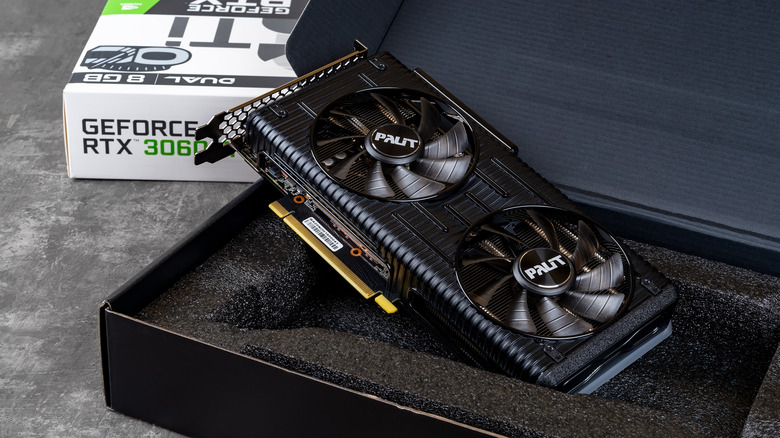
To select the Nvidia GPUs in this list, we considered several denominators. The price-to-performance ratio was at the center of the selection process. Using a mix of reviews and personal experience with desktops equipped with these GPUs, we evaluated their performance in the latest AAA games such as 2026’s “Control Resonant.” This was done primarily to help users pick an Nvidia GPU that won’t let them down for another five years.
Affordability and power consumption came in as the secondary drivers of the selection criteria. Listings on eBay and Facebook Marketplace aided pricing quotes, whereas benchmarking tests from reliable websites were sourced for power consumption. Furthermore, we evaluated the strongest Nvidia GPUs for each mainstream resolution: 1080p, 1440p, and 4K. Key features like DLSS, ray-tracing, and VRAM size were also factored into the selection process. The main goal was to identify the best pre-loved Nvidia graphics cards in 2026, ones that have a compelling spec sheet and can even rival their newest-generation counterparts.

1 Comment
Pingback: Twitch streamer HAchubby reveals type of cancer she’s been diagnosed with - Comic Vibe