

Sprint Vector was the last time I tried to fight it. Survios built a whole racing game around pumping your arms like a speed skater, and on paper that should have been the answer, because your body is doing the work and your brain has less to argue about. It made me sick. Properly sick, from all that motion.
So VR StrideS had an uphill climb with me before I read a word about it. It came out on Steam on Thursday, November 5, from a developer called gnuj industries, and it costs $12.99, or $11.69 until November 12. It is a PC app that turns jogging on the spot into thumbstick movement in games that already support smooth locomotion. No treadmill, and no trackers strapped to your ankles. Just a headset and the two <a href="https://comicvibe.com/the-switch-2-pro-controller-can-make-zelda-ocarina-of-time-even-better/” title=”The Switch 2 Pro Controller Can Make Zelda: Ocarina Of Time Even Better”>controllers you already have.
A thumbstick you run with
The trick is less exotic than it sounds. A companion app on your PC reads your headset and controllers 90 times a second. The bounce and rhythm of your head set your speed, and the tilt and motion of the headset and controllers set your direction, so you can look one way and jog another. All of it gets boiled down into the same two-axis signal your left stick sends, then handed to the game through SteamVR or, when SteamVR is off, through an OpenXR layer. The game never finds out. As far as it is concerned, somebody is pushing a stick.
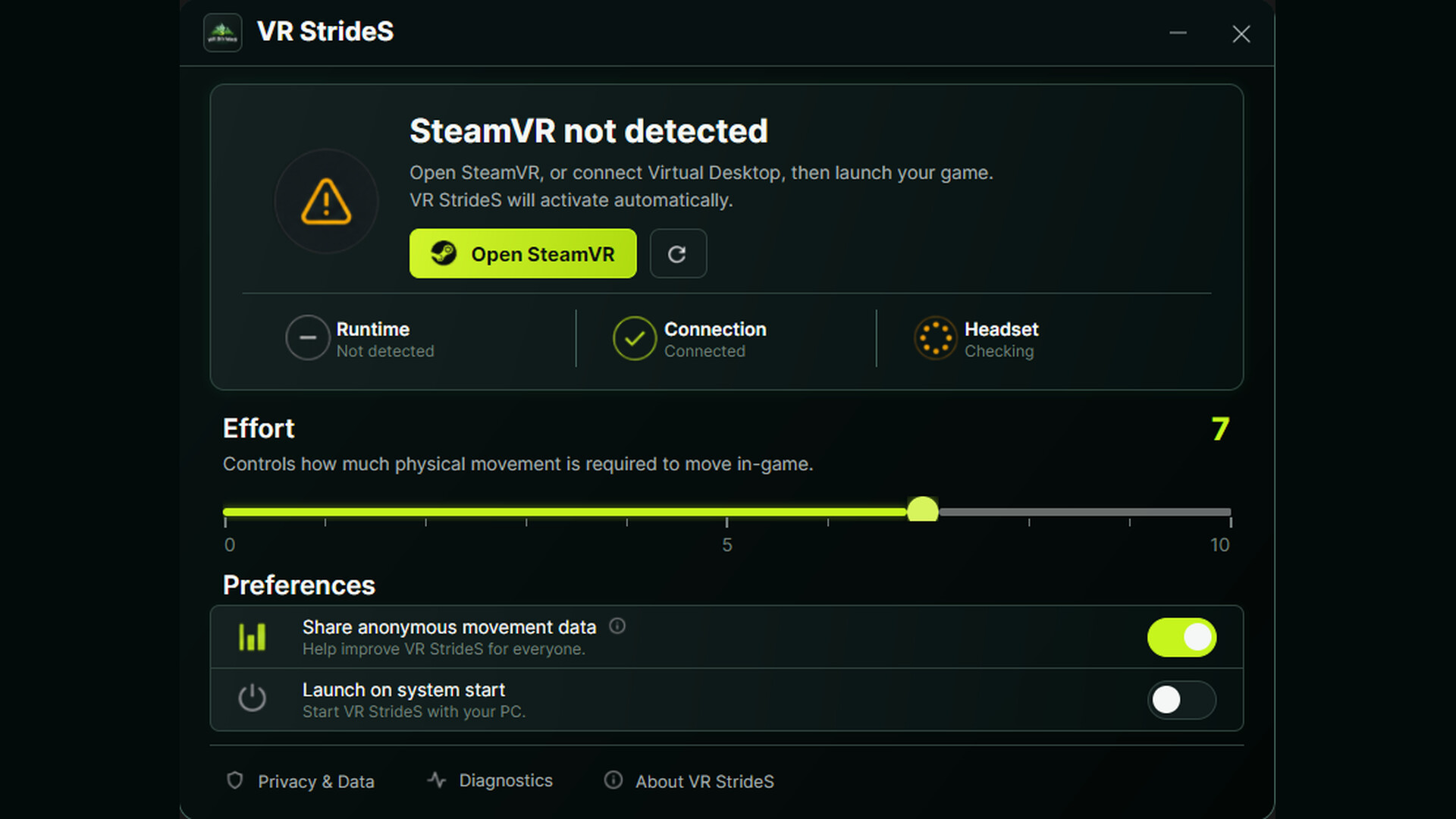
That is why the compatibility list reads the way it does. Half-Life: Alyx works once you set its movement to continuous. Blade & Sorcery, VRChat, BONELAB and BONEWORKS are confirmed, and so are flat games you have converted with UEVR, which is a fun wrinkle if you have been working through our UEVR guide. Skyrim VR, No Man’s Sky and Phasmophobia are among the games still in testing, and Phasmophobia is the one I noticed first, since it is the VR game I actually play with friends. Beat Saber is out, because there is no stick movement to drive, and so is anything that only lets you teleport.
Two dials do most of the work. Effort runs from 0 to 10, with 5 as the default, and sets how hard you have to move to reach a given speed. Turn it down and a light jog gets you to top speed. Freedom of Movement limits which directions you can drift in, from a full circle down to a forward cone, and the developer suggests the narrow cone for people who keep sliding sideways while they learn. It is also straight about one weakness: a very slow walk in place may not register. It wants a jog.
Will my stomach care?
The idea behind every scheme like this is simple enough. Stick sickness is an argument between your eyes, which say you are moving, and your inner ear, which says you are standing still. Give your body real motion and maybe the argument gets quieter.
