

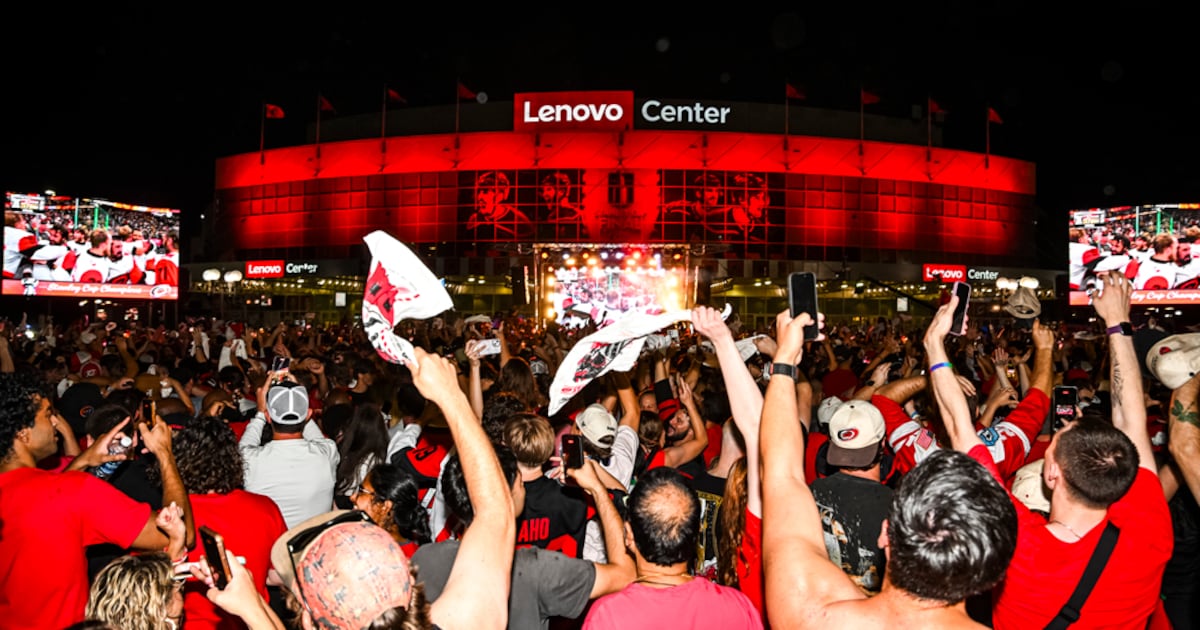
The best Stanley Cup tickets in Raleigh this year cost just $10; the most expensive cost well over $1,000. But here’s the catch: The home team wasn’t in the building for the $10 crowd. In fact, neither team was.
For all three road games of this year’s Stanley Cup Final, the Carolina Hurricanes opened Lenovo Center and put the away game on the video board. Admission was $10, proceeds went to the team’s charity foundation and parking was free. At least two of the three games sold out. Imagine, thousands of in-venue fans while the home team played more than 2,000 miles away.
This past June, I wrote in Sports Business Journal that 86% of U.S. sports fans agree that live sports are becoming a luxury experience rather than something for everyday consumers. That data point clearly struck a chord, as soon thereafter, this same YouGov data was referenced in Congress by the House Ways and Means Committee, which oversees federal tax policy. And if my column were an industry diagnosis, the Hurricanes spent two weeks demonstrating at least one potential treatment.
In a YouGov Sport poll of 1,007 U.S. sports fans conducted July 23-27, we asked a simple question: Would you attend a watch party inside an arena for a team you follow, with the away game on the big screen? More than half (51%) said yes.
Half of fans (50%) would consider one for a championship series such as the Stanley Cup Final, 37% for a playoff game, 34% for a rivalry game and 24% for a regular-season match. The rarer the event, the greater the interest. That isn’t new, just simple supply-and-demand economics. This isn’t a weekly strategy — to start, it’s likely three to five dates a year, ones fans already have circled.
When analyzing what’s driving demand for watch party events, low ticket price leads at 41%. Fans might not be able to afford the “real” game, but they can afford the watch party. Reasons beyond price are experiential rather than economic, led by crowd atmosphere (30%), the giant screen and arena sound (26%), a family friendly environment (24%) and food and beverage (22%). Fans aren’t describing a cheap substitute for a game; they’re describing a different kind of experiential event that happens to be cheap.
Fifty-two percent of fans agree that watch parties are a good lower-cost alternative to attending in person, and 78% agree or are neutral. They’ll still pay: Just over half (51%) would spend $10 or more on the ticket, and 34% would spend $20 or more. Carolina priced at $10 without seeing any of this, and YouGov data suggests $10 is the floor, certainly not the ceiling. On top of that, 59% expect to spend $10 or more inside on food, drinks and merchandise, and nearly 1 in 4 (23%) expects to spend $35 or more.
Let’s put rough numbers on it. Ten thousand seats at $15 is $150,000 at the gate, and a per-cap in the same neighborhood roughly doubles that, on a night the building would otherwise sit dark. No gate split, no home date to cannibalize and the content is the club’s own broadcast. Most importantly, a family of four who can’t justify several hundred dollars on a regular game can now walk in for the price of a pizza. That’s where the next generation of fans comes from.
None of this has to be sport, either. One in three fans would come for a concert in another city (Taylor Swift, anyone?), 31% for a movie or TV premiere and 23% for a stand-up comedy special. This is how eight dark dates eventually become zero dark nights for operators. Even if these nights break even or lose a little, getting new attendees through the doors is worth its weight in gold.
A first live game is still one of the best fan acquisition tools this industry has, and unfortunately, one of the more expensive things someone can buy. Nobody decided that. It’s the predictable outcome of rational actors optimizing their own inventory. Dynamic ticket pricing works, premium seating pencils out, the secondary market captures the rest and each call is defensible on its own. What’s missing is any team or league owning the total number any one fan has to pay across tickets, parking and hot dogs, and whether it leaves a way in for those who aren’t already inside.
This is why I’d run the sequence backward from how it usually is. Start in the regular season, where risk is cheap. Pair three theme nights with rivalry road games, target the lower bowl, price admission at $15-$30 and capture buyer information at the point of sale. That’s how we learn whether stated interest fills a real room, and whether buyers are new names or existing account holders in cheaper seats. Then carry it into the postseason, where demand does the work and the Hurricanes already showed the ceiling.
Carolina proved the concept can work in the biggest week the franchise has had in years. The harder question is whether the same building fills in the regular season. But the hardest question of them all remains: What happens if the 86% of fans who already say live sports are becoming a luxury experience soon approaches 100%? Can the industry afford to wait and find out?
Davey Chadwick (Davey.Chadwick@yougov.com) is Head of US Sport — Client Services at YouGov Sport.
