

2 minutes agoConventions, Interviews, Latest News, News, Television Shows
Prime Video’s up<a href="https://comicvibe.com/whats-coming-to-netflix-in-november-2026/” title=”What's Coming to Netflix in November 2026″>coming historical drama explores brotherhood, betrayal, Norse mythology, and the collapse of paganism, with a complex new generation of Viking legends ready to make their mark.
The world of the Vikings is returning to television with a new story of ambition, bloodshed, and family conflict. At New York Comic Con 2026, the creative team behind Prime Video’s upcoming historical drama Bloodaxe offered audiences an exciting first look at the series, unveiling its teaser trailer and revealing new details about the characters, mythology, and epic battles that will shape the story.
Series stars Xavier Molyneux (Erik Bloodaxe), Jessica Madsen (Gunnhild), and Levi Miller (Haakon) joined showrunners, writers, and executive producers Michael Hirst and Horatio Hirst to discuss bringing this turbulent chapter of Norse history to life.
From a fierce rivalry between two half-brothers competing for Norway’s throne to a passionate marriage that defies the political conventions of the time, Bloodaxe promises a sweeping historical drama with larger-than-life characters, supernatural elements, and plenty of action. The series also reunites audiences with the kind of immersive storytelling that made Hirst’s Vikings a global phenomenon, while establishing an identity entirely its own.
Set to premiere January 20, 2027, on Prime Video, Bloodaxe has already secured a second-season renewal, signaling that this is only the beginning of a much larger saga.
A New Viking Saga, Not a Sequel to Vikings
For fans hoping to return to the world of Norse warriors, Bloodaxe offers familiar historical territory while charting a distinctly different course. Set approximately a century after the events of Vikings, the series draws from real historical figures and the turbulent struggle for power that shaped Norway’s future.
However, Michael Hirst was quick to emphasize that the new series should not be viewed as Vikings Part 2. Instead, the show is an original historical drama with its own characters, conflicts, and themes.
That distinction is central to the Hirsts’ approach. Although the two series share historical settings, cultural traditions, and an interest in Norse mythology, Bloodaxe tells a new story about a kingdom confronting a defining moment in its history.
At the center of that story are Erik Bloodaxe and Haakon the Good, half-brothers whose competing claims to the throne represent more than a personal feud. Their conflict reflects a larger cultural transformation, as traditional Norse paganism confronts the growing influence of Christianity.
“What is amazing about the first season is it’s about two brothers and the collapse of Paganism, but at its heart it is about family,” the showrunners explained.
That family-centered approach gives the historical drama an emotional foundation beneath its battles and political maneuvering. The characters may be fighting over a kingdom, but their choices are shaped by resentment, abandonment, loyalty, and the complicated bonds that can make family both a
The Hirsts also see the historical setting as a wealth of storytelling possibilities. With so many remarkable figures and pivotal events to explore, they believe the series has the potential to continue for years, should audiences embrace its expanding world.
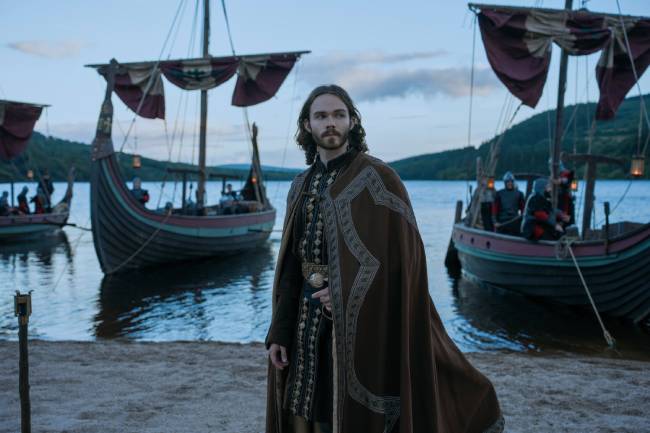
Xavier Molyneux on Playing Erik Bloodaxe: “He’d Rather Just Flip the Table”
For Xavier Molyneux, stepping into the role of Erik Bloodaxe meant portraying a young warrior whose fearsome reputation is still taking shape. Although his name carries the promise of violence, the Erik audiences meet in the first season is a man with plenty of growing left to do.
“Well, he is Bloodaxe, so the name really speaks for itself, and the questions remain about how he earned it,” Molyneux explained. “Where we find him in this series, he is young and he has life to live and lessons to learn.”
Unlike characters who carefully calculate their next political move, Erik operates on instinct. He is direct, impulsive, and unapologetically himself, qualities that make him both a formidable opponent and a potentially unpredictable ruler.
“He wears everything on his sleeve,” Molyneux said. “A lot of characters try to play games and politics, and Erik is just straightforward. Everyone is playing chess, and he would rather just flip the table.”
That distinction also defines Erik’s relationship with his half-brother. Erik believes he has earned the right to rule Norway through his strength, experience, and commitment to traditional Norse values. Haakon, meanwhile, represents a radically different vision for the kingdom, one that Erik views as a threat to everything he believes in.
Their rivalry is personal as well as political. Erik resents the idea that Haakon, who spent much of his life outside Norway, could return and claim a throne Erik believes he has worked toward. Their opposing worldviews ensure that the struggle between them will extend far beyond the battlefield.
Molyneux also teased the physical demands of the role, describing Erik’s relationship with his weapon in memorable terms. His axe is practically an extension of himself, almost like a pet that needs feeding from time to time.
That physicality translates into some ambitious action sequences. Among the highlights is an approximately five-minute continuous shot in which Erik fights three different opponents, an impressive undertaking that promises to showcase both the choreography and Molyneux’s commitment to the role.
For the actor, however, the spectacle is only part of the appeal. Erik is still discovering the man he will become, and audiences will get to witness the experiences that shape the fearsome historical figure behind the name.
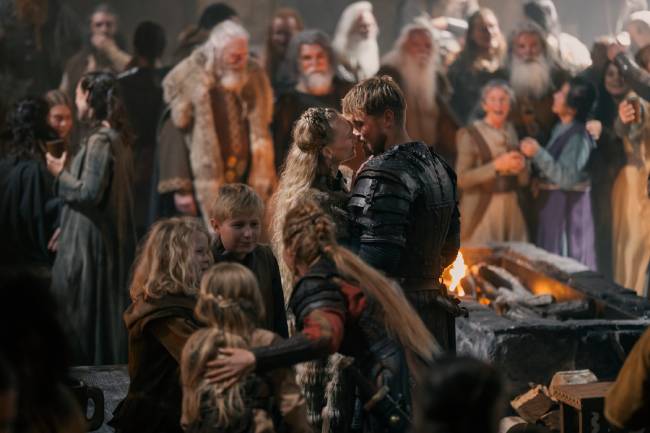
Jessica Madsen on Gunnhild: Love, Power, and the “Witch Wife”
While Erik may be the warrior whose name commands attention, Jessica Madsen’s Gunnhild is a character who refuses to be confined to the traditional expectations of a Viking-era wife.
The showrunners described Erik and Gunnhild as a kind of medieval Bonnie and Clyde, a couple whose devotion to each other makes them formidable allies. Unlike many marriages of their time, theirs was built on genuine affection rather than political convenience.
Madsen described their relationship as “a pure love in an impure love,” capturing the unusual sincerity at the heart of a partnership surrounded by violence, ambition, and shifting loyalties.
When discussing how she approached Gunnhild’s relationship with Erik, Madsen credited the writers with establishing a compelling dynamic between the characters.
“The showrunners and writers created a dynamic between them that was very apparent and resonant,” she explained. “For Xavier and I, it was very much about being in the moment and being honest with each other and continuing to challenge one another.”
That sense of mutual challenge is important. Gunnhild is not simply standing beside Erik as he pursues the throne; she has her own perspective, ambitions, and instincts. Their love makes them stronger together, but it doesn’t mean they always see the world in the same way.
When asked what she was most excited for audiences to discover about Gunnhild, Madsen highlighted the character’s many contradictions.
“I think she represents many different things. To some she is a lover, and to some she is an enemy, and that was really fun to explore.”
The actress also spoke about the responsibility of portraying a younger version of a historical figure who would become known as a powerful political presence and the mother of kings.
“I was so cautious as to where we see her character in this first season to who she becomes,” Madsen said, explaining that she wanted to explore Gunnhild before she fully developed into the formidable woman history remembers.
Historical accounts and later traditions have given Gunnhild a complicated reputation. Some portrayals emphasize her frightening influence, while others depict a charismatic woman who could command a room. Madsen wanted to embrace that complexity rather than settle on a single interpretation.
“Sometimes she is as hotheaded as Erik, and other times she is the voice of reason. She is always full of surprise in herself and quite unpredictable.”
Gunnhild’s nickname, the “witch wife,” also hints at one of the series’ more intriguing dimensions. Madsen teased the character’s supernatural abilities, while the showrunners explained their philosophy for incorporating mythology into a historical setting: if the characters can see these phenomena, audiences should be able to see them, too.
That approach allows Bloodaxe to explore the beliefs and supernatural traditions that were part of the Norse worldview without abandoning its historical foundation.
Madsen was less forthcoming when asked about Gunnhild’s favorite physical weapon, suggesting that revealing it would spoil something audiences should discover for themselves. She also clarified an important distinction about the character: although Gunnhild is a warrior emotionally, she will not be portrayed as a shield maiden.
Instead, her strength comes from a different combination of qualities, including conviction, emotional intelligence, ambition, and an ability to surprise both her allies and her enemies.
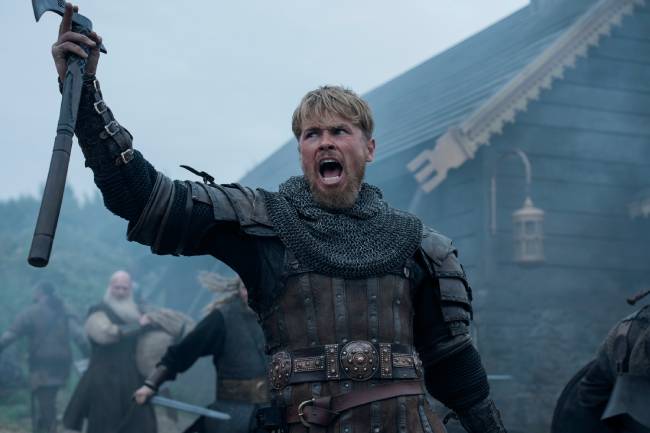
Levi Miller on Haakon: A Thoughtful Man in a Warrior’s World
If Erik is the embodiment of direct action, Haakon the Good represents a very different kind of power.
Played by Levi Miller, Haakon is a thoughtful and driven young man whose upbringing outside Norway has fundamentally shaped his beliefs. Raised as a Christian, he returns to a kingdom whose traditions are rooted in Norse paganism, making his claim to the throne a potential turning point in Norway’s history.
Miller described Haakon as a deeply tortured character, but one whose determination never wavers.
The actor sees Erik as everything his character has come to resent, not only because of their opposing religious beliefs but also because of the emotional wounds left by their childhood.
“Erik represents everything Haakon detests,” Molyneux explained when discussing the brothers’ contrasting perspectives, reflecting the fundamental divide that drives their conflict.
For Haakon, Erik is more than a political rival. He is also a symbol of the abandonment Haakon has carried throughout his life. Having been sent away from Norway while Erik was allowed to remain, Haakon struggles with why their lives took such different paths.
Miller explained that Haakon has built up an image of Erik as a villain, and that perception informs how he approaches their relationship.
Haakon’s resentment makes the struggle for the throne especially complicated. He may believe he can offer Norway a different future, but his personal grievances threaten to influence his judgment just as much as Erik’s impulsiveness influences his own.
The result is a rivalry in which neither brother can be understood solely through his political ambitions. Both men have deeply personal reasons for wanting the throne, and both believe the other represents a danger to the future of their homeland.
Despite the dramatic weight of their relationship, Miller said some of his favorite experiences on the production involved the physical challenges of the series.
The cast underwent extensive weapons and stunt training, which he likened to a Viking boot camp. For an actor stepping into a world defined by warriors and warfare, that preparation offered an immersive way to understand the demands of Haakon’s environment.
Miller particularly enjoyed filming the battle sequences, where the physical work and choreography brought the series’ conflicts to life.
Those battles may ultimately determine who rules Norway, but the emotional struggle between the brothers promises to be just as consequential.
Norse Mythology, Supernatural Encounters, and Viking Techno
Although Bloodaxe is grounded in the lives of historical figures, the series will also embrace the mythology that shaped the world in which they lived.
For the characters, supernatural beliefs are not necessarily separate from everyday life. Norse mythology was woven into the culture, traditions, and understanding of the world, creating opportunities for the series to explore the mysterious alongside the historical.
Molyneux offered an enthusiastic perspective on the challenge of bringing those elements to the screen.
“You have to believe in the fairies,” he said of his approach as an actor. “You go, ‘Yeah, that’s crazy,’ but hell yeah… let’s jump on board with that!”
For Molyneux, the key is committing to the world of the story, even when it ventures into the extraordinary.
“If you love mythological kind of realism, then you are going to be very happy with this product.”
The Hirsts’ approach aims to make the supernatural feel like a natural extension of the characters’ reality. Rather than treating Norse mythology as a decorative addition, the series can use it to deepen the atmosphere and reveal how its characters understand their place in the world.
The production’s musical identity is another element designed to distinguish Bloodaxe. The creative team teased a distinctive “Viking techno” score, suggesting a modern sonic approach to a story rooted in the distant past.
Combined with large-scale battles, atmospheric storytelling, and supernatural elements, the music promises to help establish a recognizable identity for the series.
The action itself is equally ambitious. The showrunners revealed that naval combat scenes were filmed on the ocean, adding another layer of scale and physical realism to the production.
Between those sequences and the extended fight choreography highlighted by Molyneux, Bloodaxe appears determined to make its Viking world feel immediate, immersive, and unpredictable.
A World Filled With Compelling Characters
Although the brothers and Gunnhild occupy the center of the story, the Hirsts emphasized that Bloodaxe will feature a broader ensemble of colorful and complicated figures.
Among them is Greta, a shield maiden played by Alina Tomnikov, whose presence adds another perspective to the series’ world of warriors and political conflict.
Rune Temte portrays King Gorn of Denmark, also referred to as Gorm the Old and nicknamed “Sleepy Gorn.” The character is another example of how the series will draw on historical figures while allowing room for distinctive personalities and unexpected interpretations.
Then there is Egil, played by Karlis Arnolds Avots, a character whose description alone suggests that audiences should prepare for trouble.
The Hirsts characterized Egil as a “psychopath, poet, lady’s man, murderer,” a combination that makes him sound simultaneously dangerous, fascinating, and difficult to predict.
Despite the character’s initially detestable behavior, Michael Hirst expressed confidence that viewers would quickly find themselves drawn to him.
That promise speaks to one of the creative team’s central strengths: creating characters who are rarely defined by a single quality. In Bloodaxe, a devoted husband can also be a ruthless warrior, a thoughtful prince can be consumed by resentment, and a dangerous murderer can possess the charisma to win an audience’s affection.
These contradictions are what give the series its dramatic possibilities. The struggle for Norway’s throne will involve more than deciding which contender has the strongest army. It will bring together people with competing beliefs, personal loyalties, and vastly different ideas about what makes someone worthy of power.
Season Two Is Already Underway
Perhaps the most exciting news for fans is that Bloodaxe has already been renewed for a second season, with production on the new episodes underway.
Molyneux teased that the opening sequence of Season 2 will push the production into territory it has not explored before, with the team making ambitious use of the re
While he kept the specifics under wraps, his comments suggest that the series intends to expand its scope rather than simply repeat what audiences will see in the first season.
For the Hirsts, the historical period offers an almost endless supply of dramatic possibilities. The world of Bloodaxe is filled with significant political upheavals, cultural transformations, and fascinating personalities whose stories have yet to be fully explored on screen.
The showrunners described the series as a writer’s dream, pointing to the abundance of compelling historical material and the natural drama embedded in the events themselves.
They also reflected on the unusual family dynamic behind the production, noting that the writing and showrunning partnership between Michael and Horatio Hirst adds another father-and-son relationship to a series already deeply concerned with family bonds.
With three father-and-son relationships operating within the production and story, the theme of family takes on an additional dimension behind the scenes.
Ultimately, the Hirsts believe they have only scratched the surface of what this historical era can offer. If the series continues to find an audience, there is plenty of room to explore new characters, rivalries, and chapters in Norway’s turbulent history.
Why Bloodaxe Should Be on Your 2027 Watchlist
The appeal of Bloodaxe lies in its combination of epic historical spectacle and intimate personal drama. The promise of ocean battles, Norse mythology, and intense sword-and-axe combat will undoubtedly attract fans of Vikings, but the emotional conflict at the center of the series could prove just as compelling.
Erik and Haakon are not simply two warriors fighting for the same crown. They are brothers whose contrasting beliefs and unresolved grievances reflect a kingdom at a crossroads. One wants to preserve the traditions that shaped his identity, while the other represents the possibility of profound religious and political change.
Gunnhild adds another dimension to that struggle, offering a character whose love for Erik is genuine but whose identity extends well beyond her marriage. Her unpredictability, supernatural associations, and evolving political significance promise to make her one of the series’ most fascinating figures.
With Xavier Molyneux, Jessica Madsen, and Levi Miller leading the cast, and Michael and Horatio Hirst guiding the story, Bloodaxe has the ingredients for a sweeping saga that balances brutal action with complex characters and historical intrigue.
And with Season 2 already in production, the creative team is clearly looking beyond the first chapter.
Bloodaxe premieres January 20, 2027, on Prime Video. Prepare for a battle over the Norse throne in which the fate of a kingdom may ultimately depend on two brothers who cannot agree on what Norway should become.
