

The following content is a recap of an industry interview; the views are for discussion purposes only and do not constitute investment advice
Over the past few years, Web3 games have experienced numerous cycles of narrative highs and lows. But what Web3 gamers truly care about is straightforward: Is this still a highly playable Web3 game? Can it generate consistent earnings? How does the project generate revenue?
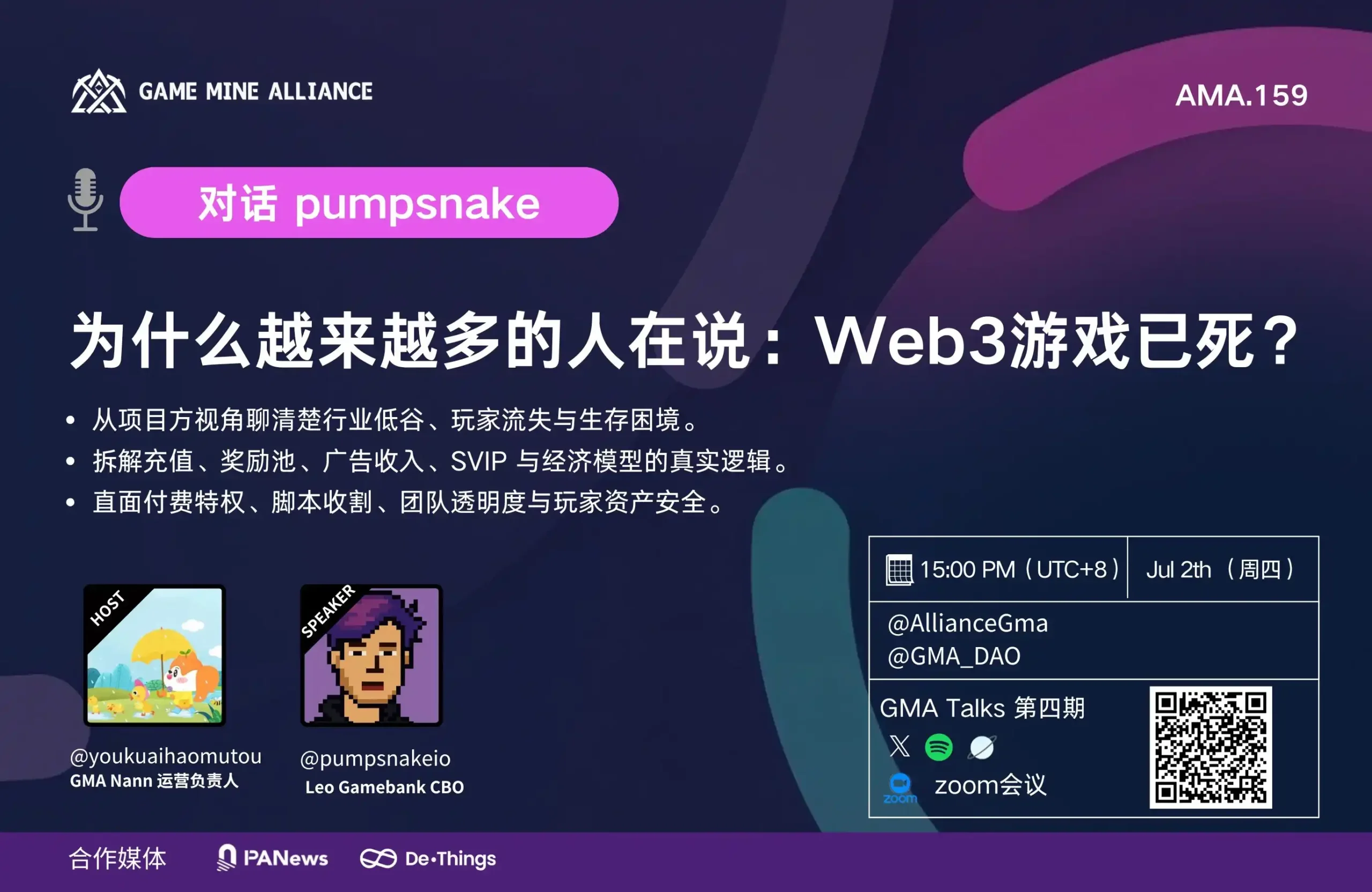
This episode of GMA features an interview with Leo, a representative from the project team, who shares insights from the project’s perspective on why Web3 gaming is so challenging: long development cycles, uncertain cash flow, and traditional capital markets’ aversion to nonlinear returns, compounded by Web3’s inherent financial and speculative nature
GMA TALK: “Why are more and more people saying that Web3 gaming is dead?”
Interview time: July 2, 2026 (Thursday), 3:00 PM
Host: GMA Nann
GMA Talk Q&A
Q1: Why did you transition from a traditional finance and investment background to a Web3 gaming project?
Leo: I previously worked in private equity investment, primarily engaging with traditional industries such as consumer goods, real estate, hospitality, cruise lines, and media. But over time, I increasingly realized there’s an inherent tension between truly creative entertainment industries—especially gaming—and traditional capital markets. Game development has long cycles and unstable cash flows, yet when a title becomes a hit, the returns are extremely nonlinear, which doesn’t fully align with traditional finance’s emphasis on predictability and linear growth. I first encountered blockchain around 2013 or 2014. Initially, I had many questions about its financial characteristics, regulatory conflicts, and technical challenges. But over the past decade, I’ve grown increasingly convinced that blockchain represents a part of the future of finance. And since gaming itself is a convergence of culture, emotion, and creativity, I believe the integration of gaming and Web3 is not a short-term trend, but a long-term shift.
Q2: What exactly is Pump Snake?
Leo: Pump Snake is first and foremost a casual competitive game supporting multiple players battling simultaneously—it can be thought of as a multiplayer, competitive version of Snake. We wanted it to be easy to pick up, yet still competitive and entertaining, allowing dozens or even hundreds of players to compete in the same room. We conducted extensive research initially, including studying battle royale games. For example, if everyone pays one dollar and the winner takes the entire prize pool, some players find it fun; but others prefer a model where the top ten players all receive rewards. Eventually, we realized that Snake, with its broad appeal, simple mechanics, and inherent competitive potential, was ideal as our first product. Our goal isn’t simply to create a “play-to-earn” game, but to enable players to become stakeholders during gameplay. You’re not just depositing and spending money—you’re gaining tangible value through interaction, competition, and asset distribution.
Q3: Is Pump Snake positioned as a game or a financial asset issuance platform?
Leo: Our primary focus is undoubtedly gaming. Without a compelling game experience, no players will want to engage—and without players, all subsequent financialization and assetization become meaningless. However, if in the future our DAU reaches scales of 100,000 or even 1 million, this platform could gradually evolve into a platform for asset issuance and IP value monetization. For instance, a KOL or IP looking to go on-chain traditionally faces high costs, and fans and users are limited to simply buying and selling tokens. But through our gaming ecosystem, they can build a Gindex around their audience, attracting fans and players into interactive gameplay. So in the short term, it’s a multiplayer casual competitive game; in the long term, it could become a platform that enables asset issuance, community engagement, and value monetization through gaming. But the essential precondition remains: the game must succeed first.
Q4: Are there any real revenues now? How will monetization be carried out?
Leo: We don’t strictly separate Web2 revenue from Web3 revenue because, at its core, this is a game. For example, each match can be viewed as a transaction with a fixed transaction fee; we also offer subscription services, such as SVIP, which provide high-activity users with additional features or bonus points. In the future, we’ll introduce monetization points like skins, blind boxes, and in-game items. However, these designs won’t compromise competitive fairness—just as Honor of Kings sells skins, the core gameplay must remain as fair as possible. At the same time, we’ve implemented some more Web3-oriented mechanics, such as “Loss = Mining.” When players lose money, they receive an equivalent amount of points, which can be used to open blind boxes, obtain skins, items, or future map fragments. Since launching this mechanism, the average number of games played per player per day has increased from 12 to nearly 18, demonstrating that it has significantly boosted engagement.
Q5: Why do you emphasize “losses equal mining”? What problem does this mechanism aim to solve?
Leo: Since our game operates on a ticket-based system, there will always be winners and losers in each round. While winners are naturally happy to receive rewards, players who lose only money will have a poor experience and are unlikely to stay. That’s why we designed a “loss equals mining” mechanism: for every amount you lose, you earn corresponding points, which can be used to open mystery boxes. These mystery boxes cannot be purchased directly with money—only with points. The goal is to give players a reason to keep participating, even when they lose. We want this economic system to be more than a simple zero-sum game; instead, we aim to ensure that players of all skill levels and spending capacities feel engaged. Skilled players can win money, while less successful players can accumulate points and items, thereby improving overall game retention.
Q6: How does Pump Snake bring Web2 users into Web3?
Leo: My thought is that in the future, 90% or even 95% of users may be traditional Web2 users. But their entry into Web3 shouldn’t begin with going to an exchange to buy crypto—it should start through games. If a user first finds a game enjoyable, is willing to spend money and play, and then discovers along the way that they can open a wallet, cash out rewards, and interact with on-chain assets, they naturally enter the Web3 world. This process is far smoother than directly telling users, “Go buy crypto first.” That’s why we keep our payment channels open—iOS, Google, traditional payment methods, and Web3 wallets are all supported. Users can choose whichever option is more convenient and has lower fees. For us, Web3 isn’t about forcing education on users; it’s about letting them naturally encounter a new value system while playing games.
Q7: Why is the team relatively low-key, even somewhat anonymous, on the Web3 side?
Leo: This is mainly because we currently want to focus our attention on the product itself. The game has already been released on the Apple App Store and Google Play, and we’ve had thorough communication with both platforms during the listing process. However, from a Web3 perspective, we’re not in a rush to highlight our team background, token issuance plans, or on-chain timeline on day one. Our priority is to first refine the product experience, monetization mechanics, and user retention. If the game ever truly takes off, the team’s background and project details will naturally come to light. Right now, what matters most is continuous iteration and making the game better. This doesn’t mean we’re abandoning Web3—on the contrary, token issuance and on-chain asset systems are definitely part of our direction. But the pace must align with the product’s development, market conditions, and regulatory environment; we won’t rush to unveil everything prematurely just for short-term hype.
Q8: Will a token definitely be issued in the future, or does it depend on the project’s outcomes?
Leo: We will definitely launch our token—that is certain. However, the exact timing depends on many factors. First, the broader market environment needs to gradually recover from its current downturn. Second, the regulatory landscape must become clearer, especially regarding how U.S. regulators define models like PolyMarket and Kalshi. Third, our own product and user base must continue to mature. I don’t believe it’s most important right now to invest significant effort into designing an overly complex token launch plan, since infrastructure, development costs, and regulatory conditions are still evolving. For us, this is actually an ideal window to focus on building a strong product, growing our user base, and refining our business model. Once the market and regulatory environment become more mature, we’ll fully implement the token launch and on-chain mechanisms.
Q9: How can you prevent a token economy from entering a death spiral?
Leo: What we value most is player experience and the long-term operation of the game. If a mechanism benefits project teams or certain speculators in the short term but harms the game’s long-term development, we will never implement it. In the past, many projects initially attracted significant attention and a large player base, but ultimately failed because their economic models did not align the long-term interests of the project team, players, and ecosystem. We do not want to repeat those mistakes. Therefore, if we haven’t fully figured out a mechanism, we’d rather hold off on releasing it. We prioritize refining the product and gameplay experience first, then gradually integrate on-chain elements and binding mechanisms. Games inherently involve many uncertainties—markets, regulations, and user demographics are always evolving—so we don’t want to lock in all economic models on day one.
Q10: Do advertising revenue, subscriptions, and gacha mechanics affect player fairness?
Leo: We strive to ensure fairness between free and paying users in terms of gameplay. For example, SVIPs may receive cool avatars, additional features, or bonus points, but these will not directly enhance your in-game strength. The same applies to ads—we won’t force players to watch them, as many free games do; instead, we give players the choice after each match: watch or skip. If ad revenue is generated, we’ll return a high percentage to users; if revenue is low, we’ll still reward players with in-game items. The mystery box system is accessed using points, and the probability of drawing a mystery box is the same for all players, regardless of their ticket tier. Players with higher-tier tickets might lose more per match but earn more points as a result, while lower-tier players may need to play more matches to earn the same amount of points—but the draw probability remains identical for everyone.
Q11: How will AI impact your game design?
Leo: AI will definitely have a significant impact on gaming. Currently, we use AI tools to detect anomalous behavior, prevent bots, and combat cheating—just as traditional game companies do with anti-cheat systems. But I believe the more interesting direction in the future is not treating AI solely as something to defend against. If a game becomes popular enough, players will naturally wonder: I can only play a few rounds per day—could there be a bot that plays for me? This demand is inevitable. So we’re also exploring how to integrate AI mechanics directly into games—for example, allowing players to have an AI-controlled snake, binding AI behavior to NFTs, or even opening an SDK so players can program their own AI. This could be a fascinating path forward. Web2, Web3, and AI will become increasingly intertwined, and Web3 may eventually serve as the underlying infrastructure for AI payments and asset transfers.
Q12: What is the current data for Pump Snake? What are the upcoming plans?
Leo: Three months after the game launched, total registered users reached nearly 15,000 to 20,000. After removing duplicates, the number of genuine players is close to 10,000. Daily active users (DAU) range between 1,000 and 2,000. For a startup project with almost no marketing investment, I consider this a strong result, and many metrics are improving as we continue to update the game. In July, we’ll roll out major monetization updates, including skins, blind boxes, and an NFT system. We’ll also expand promotion efforts in Southeast Asia, Japan, Korea, and Taiwan. Previously, at offline events, simply telling users “This is the world’s most fun Snake game” was enough to get many to download and try it. Once the monetization features are more complete, I believe they will significantly boost retention and word-of-mouth spread.
Q13: If someone says, “Web3 gaming is dead,” how would you respond?
Leo: I don’t believe Web3 gaming is dead. On the contrary, I think the ultimate form of true value realization in gaming will inevitably emerge in Web3, or Web3 combined with AI. The issue now is that we’re in a transitional phase between two eras. In the past, Web3 gaming has seen many failures and issues such as immature mechanics and excessive speculation. But that doesn’t mean the direction is wrong—it simply indicates that products, users, regulations, and infrastructure have not yet fully matured. I believe more Web2 games will actively embrace blockchain technology, and more Web3 games will truly succeed. However, the next phase of Web3 gaming cannot rely solely on token issuance and short-term hype; it must deliver genuine gameplay, user retention, paying customers, and leverage blockchain to solve problems around asset ownership, value distribution, and community participation.
