

Unlike its competitors, Nintendo’s consoles aren’t known for chasing processing and graphical power, instead focusing on innovation and user experience. While Sony and Microsoft compete over tech specs, consoles like the Wii and Nintendo Switch have flown off shelves with their unconventional approaches to gaming. That’s why, though the Nintendo Switch 2 is a major upgrade over the original, it can’t rival the PlayStation 5 or Xbox Series X in speed and power despite those consoles being over four years older.
Just like with the original Switch, which was less powerful than the then-three-year-old PlayStation 4 at launch, the Nintendo Switch 2 sacrifices hardware power for the convenience of handheld mode and creative Joy-Con features. But while the Nintendo Switch 2 is outclassed by its current-gen rivals, overall, it’s a more powerful console than the PS4. That’s evidenced by how well the hybrid console runs ports of demanding games, including new and upcoming releases like “Diablo IV,” “Resident Evil Requiem,” and “Final Fantasy VII Revelation.”
Here’s how the Nintendo Switch 2 and PS4 compare in terms of processing power, as well as how the hardware compares to the PS4 Pro.
Nintendo Switch 2 has a stronger processor than the PS4

Nintendo only reports using a custom NVIDIA processor for the Switch 2’s CPU and GPU, so we have to rely on data from experts, including journalists and game developers, who’ve compared it to other hardware. According to Digital Foundry, the Nintendo Switch 2 uses a Nvidia T239 (said to be similar to the T234) using the Ampere architecture.
The Switch 2’s CPU is an eight-core ARM Cortex A78C with 12GB of RAM; two cores and 3GB of RAM are reserved for the hardware itself, leaving six cores and 9GB for games and game developers. Meanwhile, Sony lists the PlayStation 4’s CPU as an AMD x86-64 Jaguar with eight cores and 8GB of RAM. Interestingly, the PS4 reserves the same number of cores and amount of RAM as the Switch 2, but since Nintendo’s console has more to start with, it comes out on top.
As for graphics, the Switch’s GPU is most similar to the AMD RX 570 Mobile in handheld and RX 560 when docked, or equivalent to the NVIDIA RTX 2050. These are lower-end GPUs, especially compared to the kinds used for modern gaming computers, but the custom processor allows the console to display 4K graphics when docked, 1080p in handheld mode, and run at up to 120fps. Frame rate depends on the game. Most won’t be able to achieve the maximum, especially graphically intensive ones. Still, the Switch 2 has a higher ceiling than the PS4, which has an AMD Radeon GPU that’s limited to 1080p and 60fps.
Nintendo Switch 2 is neck-and-neck with the PS4 Pro
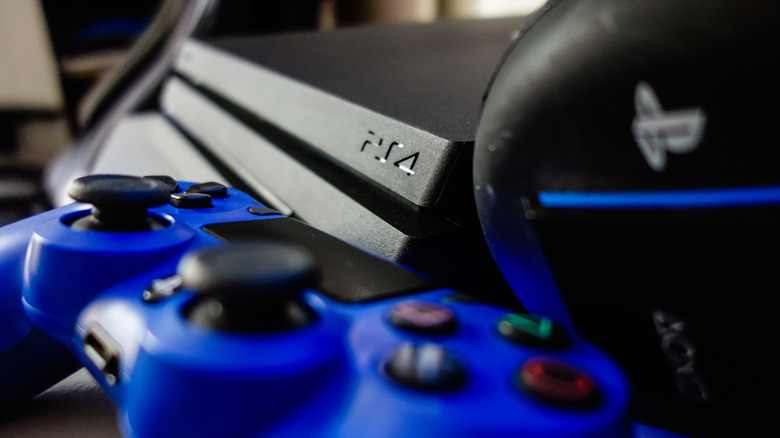
While the Nintendo Switch 2 pretty clearly wins out over the base PlayStation 4, the PS4 Pro is another story. Released three years after the original (and just months before the original Nintendo Switch), the PS4 Pro’s GPU is over twice as powerful as that of its predecessor. As for its processor, the Pro’s CPU is around 30% faster.
With these boosted specs, the PS4 Pro can upscale games to near 4K and output some at a native 2160p. The Switch 2 benefits from its processor’s additional cores, but comparison tests show that Pro runs graphically demanding games just as well, if not better, than Nintendo’s console in docked mode.
That’s impressive for a console that’s a decade old, which is why it’s still worth buying a PS4 Pro. While you’ll miss out on new games like “Marvel’s Wolverine” and “Grand Theft Auto 6,” a used PS4 Pro is a budget-friendly alternative to paying current-gen console prices.

3 Comments
Pingback: PlayStation Permanently Shutting Down Popular Service Next Month - Comic Vibe
Pingback: Crisis on Infinite Earths Is Fantastic and It Does These 5 Things Better Than Any Other Event Book - Comic Vibe
Pingback: Ninjala 2 dev want the franchise "to continue for 10 years, 20 years, and beyond" - Comic Vibe