

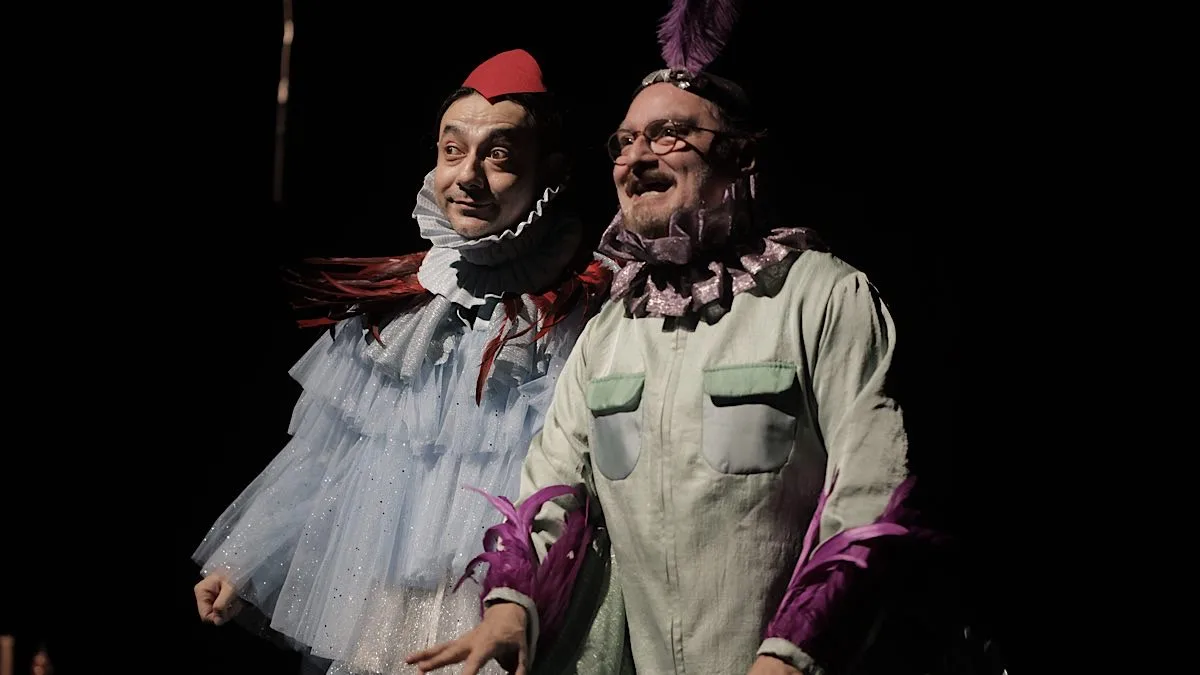
Amid the ongoing tension, protests and crime in the country, Rajat Kapoor’s new play, ‘The Thing with Feathers’, reminds us that whatever the situation, one should not lose hope, even when the world gives every reason not to.
“Hope” is the thing with feathers
That perches in the soul
And sings the tune without the words
And never stops at all
The lines from Emily Dickinson’s poem serve as the foundation of ‘The Thing with Feathers’, directed by Rajat Kapoor and written by Rabia Kapoor and Chandrachoor Rai. The play features Vinay Pathak, Neil Bhoopalam, Mantra, Bhavya Rampal, Amit Purohit, Radhika Mehrotra, Bhagyashree Tarke and Aarsha Mukherji, among others. It is set at the beginning of the 20th century, a century that was hopeful for a new world, where humanity would triumph over all its problems, but what followed was a very different story etched into our history.
The 100-minute play revolves around the story of a Punjabi couple who find love after an awkward and humorous encounter on their first night after marriage. Their love evolves as they face their families and the hardships and expectations that society puts on them. There is also another couple living in England, who meet when one of them is about to commit suicide. They find a new meaning to life with each other, fall in love, get married and open a small cafe, where they serve food with love. Around the time of the World War, the lives of both the men connect as they serve England. With this, the stories of both the couples, at one point, seem to be the same.
As the title of the play reflects, the story is being told from the point of view of two birds, played by Vinay Pathak and Mantra. The two fly across the sky and over humans and everything around them, providing commentary with humour and a little bit of reference to the current scenarios. But the two do not merely act as narrators; they provide two different ways of looking at the same history. While Vinay Pathak’s bird talks about the negativity, deaths and hardships of the war, the number of people dying and how no one is benefiting from the war, Mantra’s bird, on the other hand, looks at the little ray of light in all these hardships, focusing on the technological advancements after the war. He talks about the invention of the telephone, electricity and the airplane. There is a banter between both the birds, with one pointing out that the invention of electricity is good for the human race, while the other reminds us that it also brought the shameful invention of the electric chair. They also talk about factories that are making goods for consumers, which, before this, were making goods for war.
Pathak and Mantra not only provide commentary on history but also draw parallels with current events, showing how we have failed to learn from history and continue to repeat its lessons.
While discussing the geopolitical situations of that time and how each nation jumped into the war and what stand each nation held during it, the writers cleverly take a dig at the recent resignation of one of the ministers. In one of the interviews, Rajat Kapoor said, “Because history repeats itself, we know that we can survive it. No matter how bad the times are, we know that we’ve been through this before and we will carry on no matter what.”
Rajat Kapoor’s play is not holding out a solution; it just presents things the way they are. It is loaded with imagery and political references and perfectly manages to balance a little humour with the intensity and emotions of the second half. At some point, the pacing of the play might be slow, but the performances and some of the sequences performed bring the audience’s attention back.
History is not all about war, revolutions, economic collapses, political movements and technological breakthroughs. But history also has people falling in love. People losing someone. The stories of two wives hoping that they would be alive and would come back after the war. The men hoping that the war would come to an end and they could meet their families. People surviving another day while the world outside their window is changing forever.
The last act of the play beautifully summarises what hope is all about: a group of people dining together happily, enjoying themselves, but as soon as the war siren is heard, there is mayhem, missiles, fire and cries everywhere, with each one of them trying to save their lives. But as soon as the firing stops, all are saved. And in the moment they share with each other after all this mayhem, perhaps that is what Rajat Kapoor’s ‘The Thing with Feathers’ is ultimately about, finding that little ray of hope in the middle of chaos, holding on to it and continuing to live, even when the world gives you every reason not to.
