

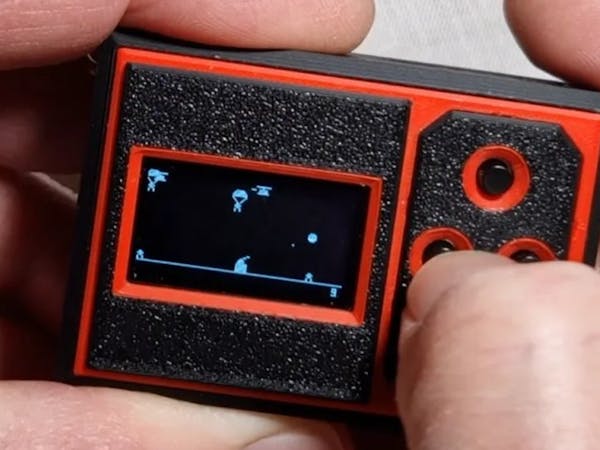
Building a handheld game console once required a dedicated team of engineers, specialized hardware, and a budget well beyond the reach of most hobbyists. Today, inexpensive microcontroller development boards and off-the-shelf modules have changed that entirely, putting hardware that would have seemed unbelievably impressive just a few decades ago within easy reach of makers
To demonstrate just how accessible game hardware has become, Ronald Nelson built a retro-style handheld using just a handful of off-the-shelf parts. Rather than starting completely from scratch, Nelson remixed an existing open source design, transforming it into the Pic-O-Pocket — a tiny keychain-sized console measuring 5.5 × 4 × 2 cm. Nelson redesigned the original enclosure to accommodate a speaker, developed an entirely new operating platform, and packed in some additional new features as well.
The hardware (📷: Ronald Nelson)
The console is built around a Raspberry Pi Pico 2 W, which provides both the processing power and built-in Wi-Fi connectivity needed to drive the system. An OLED display serves as the primary interface, while four tactile buttons handle navigation and gameplay. Power comes from a rechargeable LiPo battery paired with a USB charging module, and a miniature slide switch disconnects power when the device is not in use
One of the biggest hardware additions is the integrated speaker. Instead of driving it directly from one of the Pico’s GPIO pins, Nelson routes the audio through a transistor, allowing the speaker to play much louder while protecting the microcontroller from excessive current draw. The redesigned 3D-printed enclosure includes dedicated sound openings to help the tiny speaker project audio more effectively
Pic-O-Pocket fits on a keychain (📷: Ronald Nelson)
Nelson wrote a custom operating system that occupies only about 52 KB while offering more than just a game launcher. In addition to hosting 13 built-in games — including classics like Pong, Breakout, and Tic Tac Toe — the interface provides battery and memory statistics, CPU information, uptime tracking, configurable screen timeouts, screensavers to reduce OLED burn-in, and automatic deep sleep for improved battery life
Once configured to connect to Wi-Fi, the Pic-O-Pocket synchronizes its clock using NTP, retrieves local weather information, and supports timers, alarms, and a stopwatch. There’s also a simple music player, along with sound effects and chiptune audio integrated into every game. The complete project, including source code, circuit diagrams, build guide, and 3D-printable enclosure files, has beenreleased publicly, making it easy for other makers to build or customize one of the smallest feature-packed handheld consoles around.
games
game console
retro
display
microcontroller
Nick BildR&D, creativity, and building the next big thing you never knew you wanted are my specialties.
