

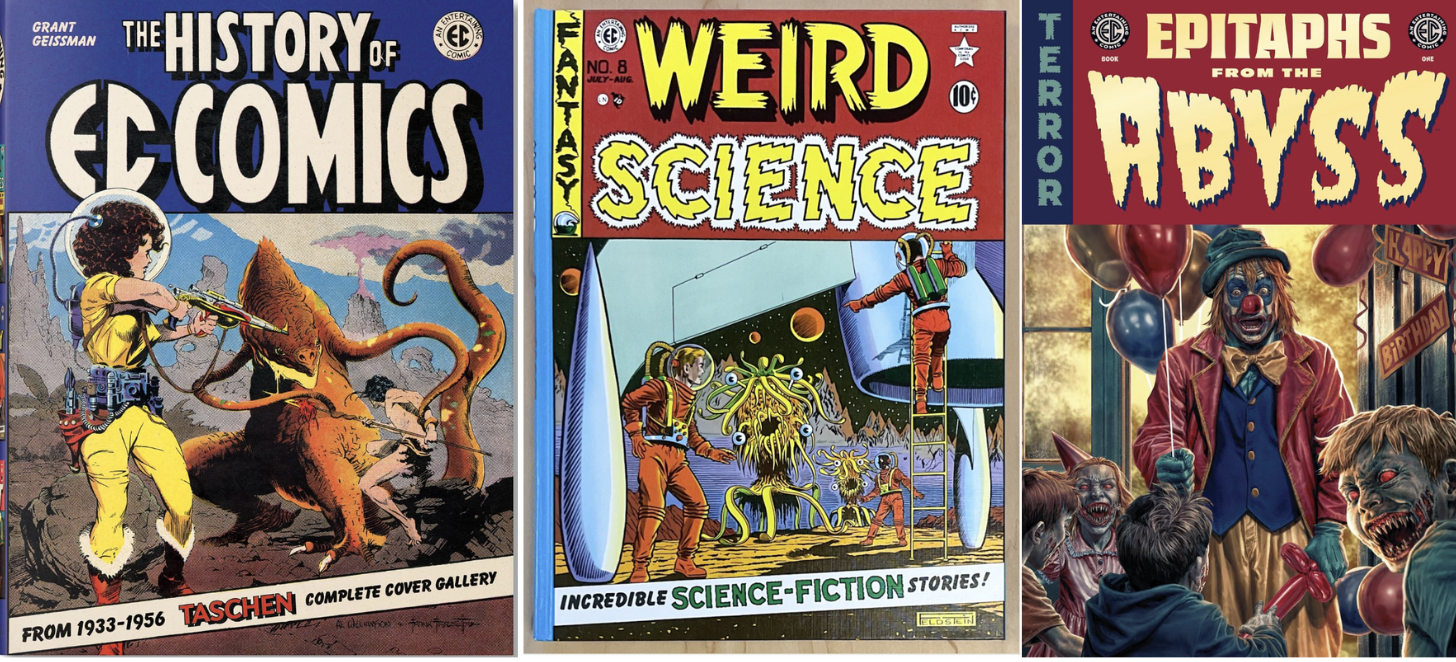
Seventy years ago, a small, family-owned comic book company known as Entertaining Comics went out of business. Starting in 1950, EC had published some of the most innovative and beautifully illustrated comics on stands, covering a wide range of genres including horror, crime, humor, and science fiction, while excluding superheroes. The publisher also boasted a stable of talented artists that included Johnny Craig, Wallace Wood, Al Williamson, Jack Davis, Harvey Kurtzman, and Frank Frazetta, among others.
But that run, still remembered so fondly by comics readers and historians, came to an end after only five years. That’s because in 1954—at the height of McCarthyism—came the establishment of the Comics Code Authority, a self-censoring organization of comic book publishers that sought to make their products more suitable for young readers. EC editor Al Feldstein believed it was established, at least in part, to put EC out of business. (He has a point: one of the CCA’s first acts was to ban the words “horror,” “terror,” and “weird” from comic book covers, essentially driving a stake into EC’s heart.) Distributors refused to carry EC’s titles, some of which had come under fire for their violence and gore, and sales plummeted. When the dust settled, publisher William M. Gaines was left with only his humor publication, Mad magazine. Mad eventually made Gaines a millionaire, but the sting of losing EC Comics never went away.
At the forefront of the mid-‘50s comics crusade, and pivotal to the creation of the CCA, was child psychiatrist Fredric Wertham, whose 1954 book Seduction of the Innocent squarely blamed comic books for a national rise in juvenile delinquency. Wertham drove the point home with images of comics panels depicting scenes of violence, crime, and scantily clad women—including several from EC titles. (Some of the examples were a stretch, such as shading on a man’s shoulder that Wertham suggested looked like a woman’s private parts.) The book sold well, and was excerpted in Readers’ Digest and The Ladies’ Home Journal, though Wertham was later criticized for manipulating and fabricating evidence.Nonetheless, Wertham’s work had a detrimental impact on comic books for decades.
Though EC closed its doors seven decades ago, interest in the company has never waned. Fantagraphics Books is currently publishing an ongoing series of hardbound collections known as the EC Artist’s Library that highlight the work of individual artists. Taschen Books issued the oversize History of EC Comics in 2020, and recently released the first 11 issues of EC’s WeirdScience in a $200, large-size, prestige format, with plans for additional EC volumes. And Oni Press recently partnered with Gaines’ family on a new series of horror and science fiction comics under the EC Comics name. But that’s not all. Soon to come from Fantagraphics is The Crypt of Covers: The Complete EC Covers Compendium and MAD: The Complete Harvey Kurtzman Years, while Dark Horse will be publishing The Complete Tales from the Crypt Archive, which will be a back-breaking 1,032 pages.
“Every generation has had something about EC Comics to relate to,” observes says EC historian Thommy Burns, who has contributed to numerous books about EC Comics, including Home to Stay: The Complete EC Ray Bradbury Stories(Fantagraphics).
Burns’s introduction to EC came in 1979 by way of The EC Horror Library of the 1950s (also known as Horror Comics of the 1950’s), an oversized hardbound volume published in 1971 by Nostalgia Press known among many fans today as “The Big Book.” Still more discovered EC through East Coast Comix, an authorized line of EC reprints published by Bruce Hershenson and Ron Barlow starting in 1973. The company published 12 issues before pulling the plug.
In 1978, publisher and comics archivist Russ Cochran released The Complete Weird Science, a slip-cased set of four hardbound, black-and-white volumes (with color covers) collecting the entire run of EC’s flagship sci-fi title. Over the next 18 years, Cochran’s EC Library would comprise 17 sets and 66 volumes collecting almost everything EC had published, including Tales from the Crypt, The Vault of Horror, The Haunt of Fear, Weird Fantasy and Mad, which was a comic book for its first 23 issues. The final volume, released in 2006, was The Complete EC Picto-Fiction, Gaines’ ill-fated, last-ditch attempt at keeping EC Comics alive.
Grant Geissman, author of The History of EC Comics (Taschen) and Foul Play! The Art and Artistsof the Notorious EC Comics! (Harper), discovered EC at age 11 by way of Ballantine’s reprint paperbacks in the mid 1960s. He believes Cochran’s EC Library to be one of the most influential efforts in driving continued interest and attracting new fans.
“Russ Cochran, of anyone, deserves the most credit for keeping the EC flame going,” Geissman says. He credits the availability of Cochran’s boxed sets in the ‘80s with inspiring HBO’s Tales from the CryptTV series, which aired 93 episodes over seven seasons from 1989-1996. Free from network censorship, the series featured live-action adaptations from several EC titles in all their gory glory, and familiarized new generations with the publisher’s anthology style of genre storytelling.
EC’s classic comics have had a long afterlife, thanks to their remarkable art and their willingness to tackle serious social themes, even in the repressive ‘50s. That sustained interest has led to a full resurrection of the brand.
“EC offered a spectacular combination of incredible artwork and stories that were several cuts above the traditional 1950s comic-book fare,” explains Geissman. “William Gaines and Al Feldstein understood their audience, but they didn’t write down to them.”
Burns agrees, noting, “If something pushes boundaries, we tend to say it’s ahead of its time, and I hear that a lot about EC Comics. They were ahead of their time, but they were also of their time. They had the guts to address topics that few others in popular media were discussing at the time, including racism, antisemitism, and police brutality.”
Gaines and Feldstein called such stories “preachies,” and perhaps the best example is “Judgement Day,” a sci-fi parable about racism involving a Black astronaut who visits a planet populated by robots. When Gaines attempted to reprint the story in 1955, he drew the ire of the CCA, which told him that the astronaut could not be Black. Gaines balked. He was then told that the Black astronaut could not have sweat beads on his face. Beyond angry, Gaines slammed down the phone and reprinted the story without changes.
Supporting these stories was artwork that many critics consider to be among the finest the medium has ever produced. Unlike many comic book publishers of the time, which required their artists to work in a “house” style, Gaines and Feldstein encouraged their artists to develop their own styles, published artists’ bios on the comics’ inside covers, and in so doing turned them into superstars. Many artists who got their big break at EC went on to have impressive careers in and out of comics, most notably Jack Davis, who enjoyed a lengthy career as a book and magazine illustrator.
Today, EC fandom remains robust with ongoing zines such as Horror from the Crypt of Fear, published by longtime EC fan Bill Leach; Chet Reams’ The Crypt of Madness, which places its focus on Mad magazine and its creators; and EC Fan-Addict Fanzine, published by Fantagraphics Underground and currently in its 7th issue.
Oni Press hopes its new EC Comics line will also help bring younger readers into the fold. Many of the books feature reprints of classic EC stories alongside new new horror and sci-fi comics penned and illustrated by industry superstars like Brian Azzarello, Stephanie Phillips, and Peter Krause, among others.
Oni Press president and publisher Hunter Gorinson himself was first introduced to EC in the 1990s by his father, who gave him a reprint of a Vault of Horror comic. “That flipped a switch on everything I thought was possible in comics as far as storytelling and pushing the narrative boundaries of what the medium could do,” Gorinson says.
Gorinson says sales of Oni’s EC titles—which include Epitaphs from the Abyss, Catacomb ofTorment, Blood Type, and Cruel Universe—have been “phenomenal,” with more than 1 million full-priced copies sold since the line debuted in 2024. At last year’s San Diego Comic Con, he adds, retailers expressed enthusiasm over the titles’ strong sales, and Oni’s EC titles were heavily promoted at SDCC 2026 via contributor signings and panels. Most recently, Oni released EC Epitaphs from the Abyss: Book One Library Edition, a deluxe, hardbound collection of the first 12 issues of Epitaphs from the Abyss, with other titles to follow.
For EC fans, it’s a new golden era. Whereas original EC comics can sell for thousands of dollars, high-quality reprints can now be found for a fraction of that cost, and in a variety of formats.
“EC appeals to older readers who might have a little more money to spend on something like Taschen’s new Weird Science volume, but also to younger readers who can afford $9.99 to put something on their tablet, and everything in between,” says Geissman. “It’s the best of all worlds.”
