

Arizona State University
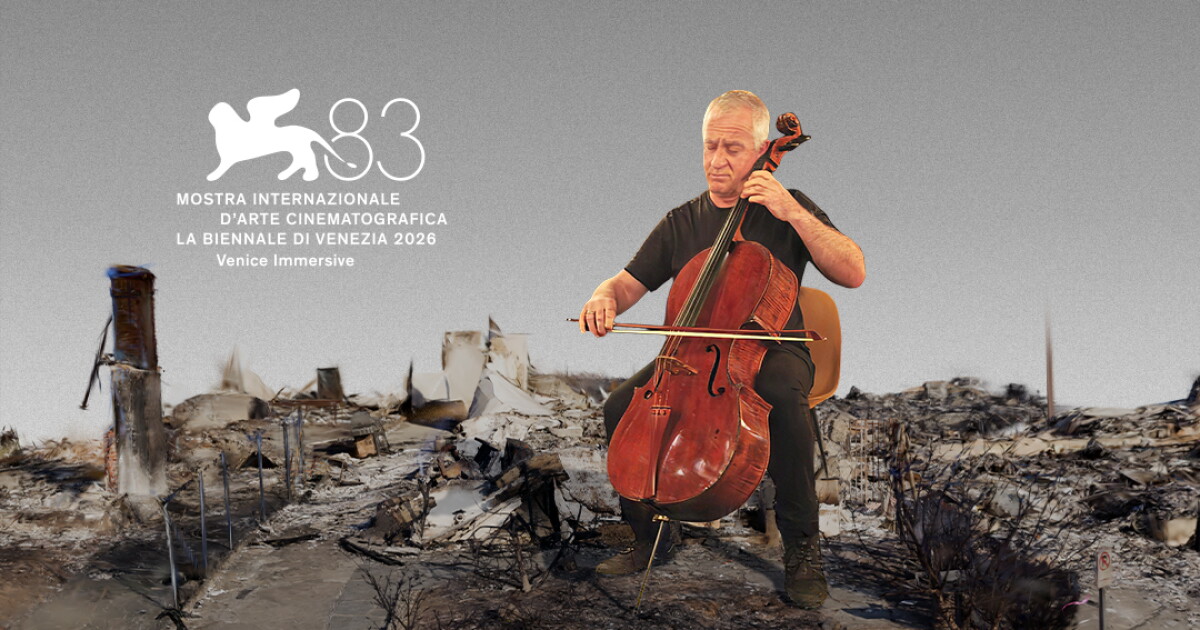
Two ASU professors are showing a very personal documentary at the Venice International Film Festival, which is taking place through Sept. 12. And they’re doing it with new technology, which allows for a more immersive experience.
“Out of the Ashes” tells the stories of people who lost their homes in the wildfires that burned through Pacific Palisades and Altadena, California, last year. The fires destroyed more than 16,000 buildings and killed more than 30 people.
Nonny de la Peña is program director at Arizona State University’s Narrative and Emerging Media Program and Rory Mitchell is a professor of practice there. They’re also both co-directors and co-writers of the documentary. They joined The Show to talk about it.
MARK BRODIE: Nonny, am I right that you’re from LA originally?
NONNY DE LA PEÑA: Yeah, both Rory and I are from L.A., which is one of the reasons this project is so special. And I’ve been working in what we call now XR technologies, these emerging technologies for narrative storytelling, for about 20 years. And for Rory and I, this project was incredibly, you know, important and special, because we really love this city, and we decided we needed to do this project together.
Arizona State University
/
Handout
MARK BRODIE: So Rory, what is it about this particular story, telling, you know, what happened with these fires and the loss that people endured, that spoke to you and said to you, “This is something we need to work on”?
RORY MITCHELL: Yeah, I think after the first few days, you know, we felt that we had to go out and do what we do, which is to to document what was a historic tragedy. Really, like the worst tragedy the city — the worst natural disaster, I think, the city has experienced. I guess there’s some question about how natural it was and who might have been at fault. That’s not for for us to talk about.
But, you know, we knew that it was going to be historic, and we knew that it had to be had to be documented. And using these immersive and spatial tools that Nonny and I have been working with for for some time and are fascinated by the affordances that they allow storytelling.
MARK BRODIE: Yeah, Nonny, talk about, if you could, the technology that you were using. Because this is not just going out like with a video camera or an iPhone or something like that. Like, this is a very different type of documenting you were doing.
NONNY DE LA PEÑA: Yeah, right after the fires broke out, I knew that we needed to deploy the new technologies that we’ve been, really, frankly, developing here at Arizona State University. I got my colleagues and students, and we began to do something that’s called Gaussian splats. Sometimes people have heard of Gaussian mathematics, some people understand Gauss in terms of, you know, lens settings, etc. for film.
But what this was, a relatively recent breakthrough, to use the Gaussian mathematics to allow us to use video and photographs to capture a scene and then translate it into fully dimensional content.
MARK BRODIE: Rory, what does using that kind of technology do for this story, and maybe how does it show itself to viewers in a way that sort of a straight documentary just on film or video does not?
Arizona State University
/
Handout
RORY MITCHELL: Well, this is really a unique spatial archive. And I think we talk about the history of framed entertainment or documentary in which you have a rectangle hanging on the wall, and now we’re stepping through that rectangle into the scene itself, and you’re stepping into the world. And we’re able to put people standing in the ashes of our subjects’ homes.
And that’s a much more visceral and a much more intense experience than really anything that humans have experienced in the form of a captured media before.
MARK BRODIE: Nonny, was it hard to convince the subjects that you talked to to talk about this? I mean, it’s a pretty personal thing and pretty significant loss that these folks endured.
NONNY DE LA PEÑA: Well, there were a couple of things here, Mark. About a year and a half before this fire, I had a fire. My electric bicycle battery blew up and pretty much, because I’d moved during COVID, all of my gear and computers, etc., etc., and all my personal stuff, into my studio in the back of my home. I pretty much lost everything.
And I scanned my own remains, and it was really useful in my literal fights with the insurance company, because I could find things like a couch frame that they didn’t want to pay on, and they had to pay on it.
So I immediately wanted to help folks who’d been, you know, devastated by the fire. Most of these people whose homes we went to were friends of mine. We — both Rory and I know dozens and dozens of people who lost their homes.
So I would usually check with them before I went to scan. And for some of these people, they hadn’t been back yet. They didn’t know what their home looked like, and I was providing them one of the first visuals. And then what we found, especially as time went on, people really wanted to talk about their experience, A, because they didn’t want people to forget, and B, because it’s natural to want to express what you went through.
RORY MITCHELL: You know, we found that like the grieving process happens in different stages for different people at different times. And that the process of telling that story, or possibly when you can’t tell your own story, to experience someone else’s story that’s similar to yours can kind of provide you with the enough detachment that you’re able to access and confront parts of your story that you haven’t been able to to that point.
MARK BRODIE: Nonny, what was that like going to friends’ houses and seeing what was left and what was not left before they saw it even, and maybe having to tell them what their situation was?
NONNY DE LA PEÑA: So this is like places, for example, that the home had been my son’s cello teacher for 10 years, or the place where I’d had my first child’s baby shower. I mean, these were incredibly close personal friends. And there were some times where I would just have to stop, I mean, I mean, and go and sit in the car.
I mean, one place was I’m standing over the remains of a room where I had literally kissed one of my dear friends goodbye the night before she died of cancer a year previously, and now just a rubble over that room.
So some of it would sometimes be incredibly, incredibly emotional. And obviously for my friends, trying to tell them what what’s left, I think they saw like the fires and they kind of knew.
MARK BRODIE: Rory, for viewers of this documentary, like what is the experience like? You talk about sort of stepping inside the rectangle on the wall. Like, what is it — what is the experience like for people who will be watching this?
RORY MITCHELL: Well, when you put a VR headset on, we talk about these as experiences, because you really have to experience this in order to start to understand what it feels like. Because when you put a VR headset on, and you can then take a, when you take a step, the entire world moves with you, so that you’re able to step through this digital world that we’ve created that looks, because of the Gaussian splats that Nonny was mentioning, looks incredibly lifelike and photorealistic.
And so as you turn your head to the right, you can look over here. It’s just your, your bodily experience is akin to our bodily experience in real life. And so in this particular experience, as you, you know, walk to the front door of of this house, and one of our subjects greets you and says that this is this is their house, and you see their house start to build around them, because we took photos and videos that they had shot in their homes and using a variety of processes, we managed to build spatial assets out of it in order to reconstruct their homes around them as they tell their story.
So if you turn your head to the right, you’ll see the ashes of their homes, and if you look up, you just just over here, so it’s kind of merged together as space and time are kind of collapsed upon each other.
MARK BRODIE: Nonny, what do you hope that people who who see this take away from it?
NONNY DE LA PEÑA: So in terms of, you know, personally in my career, this is an extraordinary moment to be able to tell the story like this, tell a story like this. Now we’re talking about a story that is personal in Los Angeles, telling a story that’s so personal as someone who’s grown up in the city, who’s, you know, so many of our friends have been affected by what happened.
And I just hope that as people go through this piece in this much bigger, bigger part of it all, this represents one of the many, many fires that are burning across the world. And we need to recognize that, and we need to recognize it by hearing personal stories to really understand the impact of what’s going on.
MARK BRODIE: Rory, how about you? What do you hope that that folks who see this take away from it?
RORY MITCHELL: I think that the thing that we found throughout all of our interviews was how much our subjects and our communities cared for each other. In every story, our subjects went and checked on their neighbors before they fled before the fires themselves.
And what we’ve seen after the fires is a tremendous outgrowth of people coming together to help each other heal, to help each other rebuild, to help Los Angeles and the Palisades and Altadena come back to to where it was. So that’s — I think that there is there’s hope. There’s, I think, there’s a lot of hope in this story, too.
NONNY DE LA PEÑA: I think, Mark, that was one of the things Rory and I really talked about, is we didn’t want people to walk away from this feeling like, “Oh, my god, there’s nothing we can do.” And I know that the people that we interviewed, they all also felt really — that was really important that we provided a sense of inspiration.
Each of these individuals who lost their homes recognize that their loved ones matter more, that their, you know, what they were left with, despite the the incredible pain of having lost many personal items, that we can rise. We can rise out of the ashes, and we can come together to build something super beautiful for for the future.
MARK BRODIE: All right. Nonny, Rory, thanks to you both so much. I really appreciate it.
NONNY DE LA PEÑA:Bye now.
RORY MITCHELL: Thanks so much for having us, Mark.
MARK BRODIE: That’s Nonny de la Peña and Rory Mitchell with ASU’s Narrative and Emerging Media Program. They’re also co-directors and co-writers of the documentary “Out of the Ashes,” which will be showing at the Venice International Film Festival, which runs through Sept. 12.
KJZZ’s The Show transcripts are created for audience accessibility. Transcripts are created on deadline with the assistance of AI tools and then edited, and may not be in their final form. The authoritative record of KJZZ’s programming is the audio segment.
The Show
Phoenix had a LGBTQ+ ‘Pride band’ in the 1980s. This wind symphony honors their legacy
There are many symphonies and orchestras throughout metro Phoenix, but Scott Helms leads one that is on something of a mission.
News
Voices of Arizona: Award-winning artist joins the Colored Pencil Society of America
Phoenix-based artist Daniel Ragsdale Combs has earned four decades of awards for his work. Now, he’s a new member of the Colored Pencil Society of America.
The Show
Matt Scott, founder of Rasputin’s Marionettes, on puppetry magic and who influenced him as a kid
Matt Scott is the founder of Rasputin’s Marionettes, and he’s been a puppeteer for most of his life.
The Show
Lani Cupchoy explores past, present, future of healing practices in an Indigenous culture
Lani Cupchoy wears many hats. She’s a public historian, an artist and a filmmaker as well as an assistant professor at Cal State University in Los Angeles.
Business
In honor of Tim Curry, watch ‘The Rocky Horror Picture Show’ at these Arizona theaters
Film screenings and stage productions of “Rocky Horror” will be shown in theaters across Arizona in the coming weeks.
