

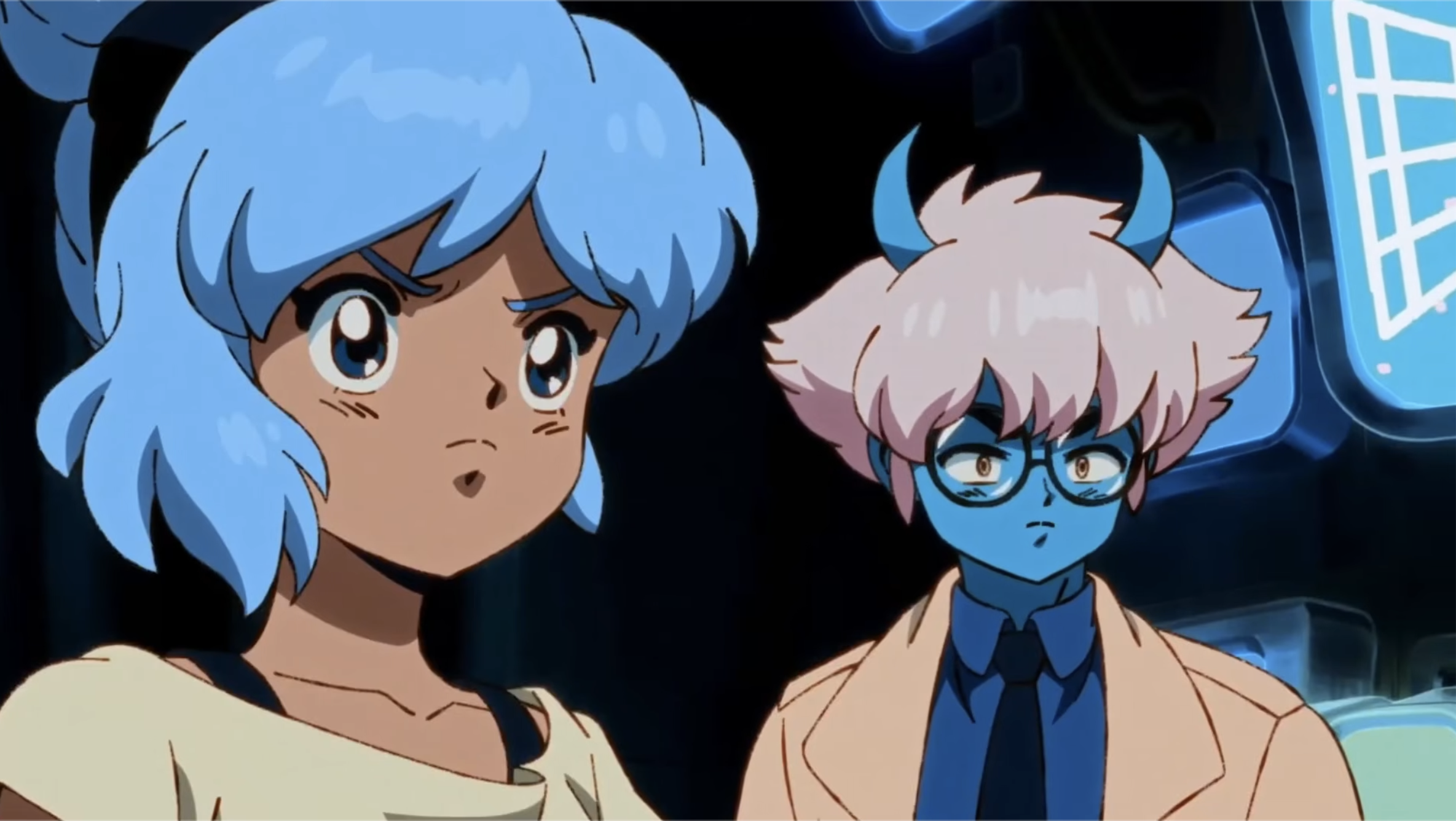
Orbitals, the asymmetric co-op adventure from Tokyo-based Shapefarm and publisher Kepler Interactive, launched today on the Nintendo Switch 2 eShop — and the reviews that dropped alongside it make a case for something the platform has been missing: a purpose-built, story-forward cooperative experience with genuine design pedigree behind it. The game has landed at 83 on OpenCritic and 81 on Metacritic, with 96% of critics recommending it, making it one of the better-reviewed Switch 2 exclusives of the year.
That pedigree has a name. Game Director Jakob Lundgren spent years at Hazelight Studios, the Swedish co-op specialist behind A Way Out, It Takes Two, and Split Fiction. Those games shaped the co-op adventure genre, each requiring two players to hold different tools and information, solving puzzles that are structurally impossible alone. Lundgren brought those institutional lessons directly into Orbitals’ design: the asymmetric tool system, the communication-first puzzle architecture, and the deliberate accessibility tuning are all traceable to lessons learned at Hazelight.
What Makes Orbitals Tick: Asymmetric Design as a Communication Engine
At the mechanical core, Orbitals gives its two players — Maki and Omura — distinct tools that <a href="https://www.animenewsnetwork.com/news/2026-04-23/tokyo-based-developer-shapefarm-orbitals-switch-2-game-streams-gameplay-trailer-with-director-/.236724″ rel=”nofollow noopener” target=”_blank”>neither character can use alone. One player wields the Scraphook, a grappling device for grabbing platforms, levers, and doors. The other carries the Beam Cannon and must continuously recharge the CH1B1 drone’s battery to keep systems operational while their partner clears the path. A third tool, the Liquid Launcher, adds water-based mechanics that arrive as the adventure expands.
This is not incidental asymmetry. It is the structural mechanism that turns co-op from “two people doing the same thing side by side” into “two people who must actually talk to each other.” The design lineage for this approach traces from early experiments through Portal 2‘s shared-portal chambers to the We Were Here series’ separated rooms, where each player holds critical information the other cannot see. Orbitals sits in that tradition but adds continuous tool-dependency: you don’t just need to communicate to solve a puzzle, you need to coordinate in real time just to keep the lights on.
“A lot of those learnings are things that have been there from day one on Orbitals,” Lundgren told GameSpot, referring to the design lessons accumulated across his years at Hazelight. Reaching the balance where the game works for both experienced and casual players required, in Lundgren’s words, “a lot of balancing, a lot of tweaking the numbers” — with constant in-office and external playtesting from the earliest playable builds.
One notable departure from the Hazelight model: Orbitals gives both Maki and Omura full freedom over their tools rather than locking each player into a fixed-ability path. The puzzles are solvable with different tool combinations, which preserves replayability and avoids the frustration of a player who picked the wrong character feeling like the weaker half. The game is also designed to be shorter than its Hazelight-adjacent peers, with Lundgren explicitly saying the team “wanted players to finish the game” — a design goal that shapes the pacing throughout.
Maki and Omura: Where the Story Lives
Maki is the youngest person in the Settlement: strong-headed, a mechanic by training, and the kind of person who grabs the ship’s cat out of pure enthusiasm. Omura is her childhood partner, a quiet cartographer who spends more time lost in his own thoughts than paying attention to the chaos around him — and who, according to the cast description, handles that same cat with deliberate gentleness. The two grew up together in the Settlement as something close to twins.
The Settlement has been storm-trapped fifteen years, cut off from the wider world by a supernatural cosmic event that no ship has successfully navigated. Maki and Omura — who have more determination than experience — set out into uncharted space beyond the storm wall in a desperate bid to find help before the station crumbles entirely. The central dramatic question is not complicated: can two young, underqualified explorers navigate asteroid fields, discover mysterious abandoned stations, and communicate well enough under pressure to save everyone they care about?
That simplicity is deliberate. Creative Director Marcos Ramos — who came to Shapefarm after working on anime game adaptations including Naruto to Boruto: Shinobi Striker and Samurai Jack: Battle Through Time — cites Dragon Ball as inspiration, an anime driven by a sense of freedom and fun rather than genre complexity. “Simple plots, making it character-first, that was it,” he said. The game’s emotional register sits in what the team calls “the right amount of cheese” — warm and earnest, occasionally silly, never ironic enough to undercut the adventure.
The Anime Pipeline Behind the Pixels
The visual achievement of Orbitals is inseparable from its production origin story. Shapefarm partnered with Studio Massket — the animation studio behind Lycoris Recoil, Attack on Titan, and One Punch Man — for hand-crafted cinematic cutscenes. Storyboard Director Hidetoshi Yoshida, a veteran who was working in the anime industry during the 1980s and 1990s, brought historical authenticity to the aesthetic choices.
Getting that aesthetic to function inside a modern game engine required building essentially from scratch. Because Unreal Engine’s default rendering pipeline is optimized for realistic graphics, art director Johannes Varmedal built a custom backend specifically to support the stylized anime look — “unconventional things,” as Varmedal described them, that took significant iteration before producing the final rendering pipeline. The art direction runs on a set of strict internal rules governing color usage, object shapes (“almost like you’ve inflated objects and they’re ballooning out a bit”), and the deliberate avoidance of textural detail in favor of a painterly, flat-color aesthetic.
The integration between gameplay and cutscene was itself a design challenge. Games and anime operate on very different production pipelines, and the collaboration required sharing environments and assets across both teams — 3D environments built for gameplay appearing in cutscenes, and 2D paintings from Massket appearing in the game world. The Forbes review noted that the transitions from anime video to gameplay are “near-seamless,” a result the team explicitly designed for.
One Copy, Two Players: How the Access Model Actually Works
The headline commercial decision Shapefarm made for Orbitals is structural: one copy of the game is all that is needed for two players to complete the full adventure, online, for free.
The mechanism is the Orbitals Global Friend’s Pass, a companion app available for free on the Nintendo Switch 2 eShop starting today. The game owner sends an invite; the partner downloads the Friend’s Pass app, accepts the invite, and joins the full game at no cost. The Friend’s Pass also includes a free local co-op demo of the game’s opening chapter — meaning any pair of Switch 2 owners can try the game together before committing $39.99 on a single copy.
This is distinct from Nintendo Switch 2’s GameShare feature, which also enables one-copy play but works differently at the infrastructure level. GameShare uses Wii U GamePad streaming technology: the host Switch 2 renders the game on its own hardware and transmits video and controls wirelessly to the guest’s console. Nothing installs on the guest’s device; once the session ends, the game disappears from their home screen. Local GameShare works with original Nintendo Switch, Lite, and OLED models as guest devices (though only a Switch 2 can serve as the host). Online GameShare requires both players to have a Switch 2, plus an active Nintendo Switch Online membership.
Orbitals supports all of these modes, giving co-op pairs multiple access paths: local split-screen on a single console, local GameShare across two consoles with one copy, online GameShare for Switch 2 pairs, and the Global Friend’s Pass for fully online play between a game owner and anyone who downloads the free app.
Editions, Pricing, and What You Get
The standard edition is $39.99. A physical edition launches alongside the digital version, at the same price point from local retailers.
The Deluxe Edition adds four categories of bonus content, all accessed through the base game’s main menu: a digital artbook filled with retro anime-inspired concept art and illustrations; the original digital soundtrack; two exclusive character costumes (one for Maki, one for Omura); and two unique ship skins. The Deluxe Upgrade Pack DLC — for players who start with the standard edition and want to add those extras later — is available for $14.99.
The game runs at approximately 9.8 GB with E10+ rating by the ESRB for Animated Blood, Fantasy Violence, and Mild Language.
Full voice acting ships in eight languages: English, Japanese, Simplified Chinese, French, Spanish, Latin American Spanish, German, and Brazilian Portuguese — eight casts independently selected per Shapefarm’s global cast announcement. An eight-language vocal roster for an indie title is unusual; the fact that Kepler Interactive’s publishing network spans London, Tokyo, and Singapore likely facilitated the international casting effort.
Where It Fits in the Switch 2 Co-op Library
Reviews have uniformly cited It Takes Two as the natural point of comparison, and the Hazelight connection makes that comparison accurate rather than lazy. Nintendo Life awarded the game 9/10, calling it “the new high bar for co-op games.” Gaming Trend gave it 95/100, noting it “builds on the co-op legacy of A Way Out, Split Fiction, and now Orbitals.” Giant Bomb awarded it 4.5/5; Forbes called it a stunning co-op masterpiece.
The most common criticism across reviews is one the team anticipated: because asymmetric co-op requires one player to complete an action before the other can proceed, there are occasional moments where one partner is simply waiting. The design of the short experience — deliberately completable in a single dedicated session — is partly a response to that structural tension. The game wants to be finished, not maintained.
Orbitals costs $39.99, requires one Switch 2 in the group to own it, and launched this morning on the Nintendo Switch 2 eShop. Players looking for a co-op partner can find one on the official Orbitals Discord server.
Frequently Asked Questions
Do both players need to buy Orbitals to play together?
No. One purchase covers both players onlinehe Nintendo Switch 2 eShop. The game owner sends an invite; the other player downloads the free app and joins the full game at no additional cost. The Friend’s Pass also includes a free local co-op demo of the opening chapter. Note that guest progress through the Friend’s Pass does not transfer — if the partner later buys their own copy, they begin from the start
What is asymmetric co-op, and why does it matter for Orbitals?
Asymmetric co-op means each player controls a different character with different tools — and neither character can complete the game’s challenges without the other. In Orbitals, Maki and Omura carry distinct equipment — Scraphook, Beam Cannon, Liquid Launcher — that must be combined to open paths and overcome obstacles, mechanically requiring real-time communication rather than just running in the same direction. This is the same design philosophy that made It Takes Two and the We Were Here series compelling — forced interdependence as the engine of co-op engagement.
What is actually in the Orbitals Deluxe Edition?
The Deluxe Edition (and the $14.99 Deluxe Upgrade Pack DLC for standard-edition buyers) contains retro anime-inspired digital artbook content, the original digital soundtrack, one exclusive costume each for Maki and Omura, and two unique ship skins. All bonus content is accessed through the base game’s main menu rather than as separate downloads.
Is Orbitals only on Nintendo Switch 2, or will it come to other platforms?
At launch, Orbitals is a Nintendo Switch 2 exclusive title. Shapefarm and Kepler Interactive have not announced any additional platform releases. The game uses GameShare, a Switch 2-specific feature, as part of its access model — meaning the one-copy-plays-two online experience is structurally tied to Switch 2 hardware for now.
ⓒ 2026 TECHTIMES.com All rights reserved. Do not reproduce without permission.

1 Comment
Pingback: Best gifts for Naruto fans in 2026: 6 picks we actually recommend [Pop Shop] - Comic Vibe