

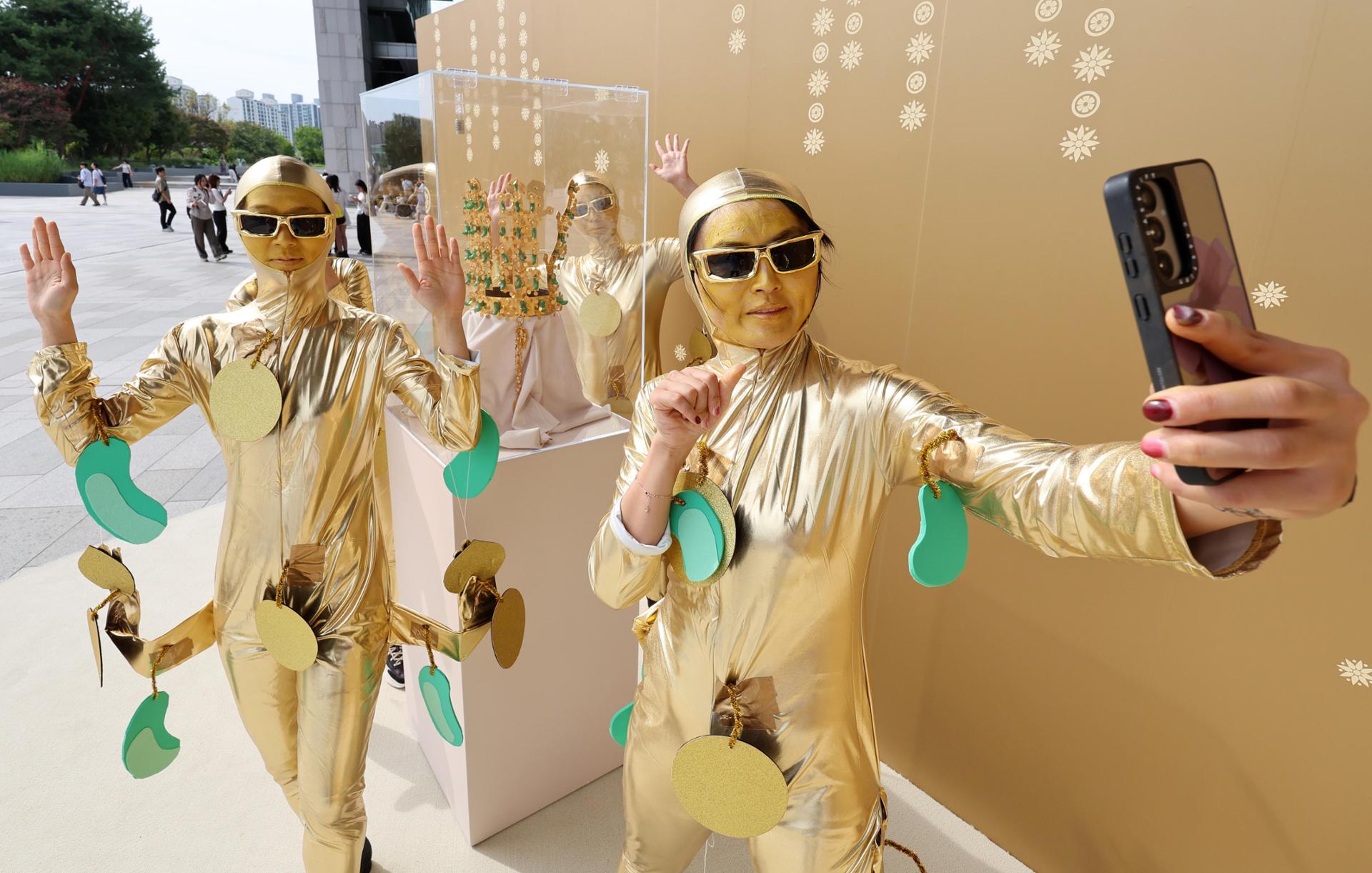
Contestants dressed as the gold crown from Seobongchong Tomb pose during the National Museum of Korea’s 2025 edition of “Dress Like a Museum” in Seoul, Sept. 27, 2025. Newsis
- Published Sep 2, 2026 7:00 AM KST
- Updated Sep 2, 2026 12:37 PM KST
Cultural treasures become favorite characters for new generation of visitors familiar with fandom culture
For one day, Korea’s most revered artifacts are no longer kept behind museum glass.
Instead, they stride down runways, pose for selfies and perform choreography in front of crowds as golden Buddhist sculptures, smiling Silla-era roof tiles, Bronze Age bells and even a life-size map of the Korean Peninsula come to life through the National Museum of Korea’s cosplay contest. The relatively new tradition has become a distinctly Korean version of Halloween, when for one day in September, participants become the cultural treasures they love most.
This year, “Dress Like a Museum” drew 275 teams and 643 participants — more than triple last year’s 83 entries — turning what began as a museum participation program two years ago into a fast-growing heritage fandom event.
Poster for the National Museum of Korea’s “Dress Like a Museum” / Courtesy of National Museum of Korea
Contestants are not only asked to imitate heritage but also to bring it to life through their own storytelling.
Echoing the contest’s poster slogan — “It is time to awaken the artifact sleeping inside you” — the event invites participants to discover a personal connection with heritage and give it a living form of their own.
Judges assess applicants’ motivation for selecting the heritage, ties to their region, their understanding and creative reinterpretation of the artifact, performance and potential for public outreach. The contest offers prizes and awards worth a combined 40 million won ($29,000).
The result is a new kind of heritage literacy: Museumgoers of all ages and backgrounds select their favorite object, study its details and bring it to life through makeup, handmade props and performances designed for both the runway and social media.
The appeal extends well beyond the contestants, drawing crowds of fellow visitors who gather to watch familiar artifacts come to life through playful reinterpretation. Last year, about 6,000 visitors joined the on-site event after photographs of contestants went viral across social media.
Contestants dressed as Korean cultural heritage for the 2026 edition of the National Museum of Korea’s “Dress Like a Museum” / Courtesy of National Museum of Korea
The museum’s public relations specialist Jung Jae-hyun said her team was thrilled by the program’s continued popularity.
“We’re happy to see more people getting interested in artifacts through the program,” Jung said.
Jung explained that the museum started the program in 2024 as part of a promotional event to boost public awareness of the museum and the nation’s cultural treasures, as well as to make people more familiar with them. The first time the program was held, 36 teams participated, but entries jumped more than seven-fold in just two years.
“It was a small event, but as we saw huge interest from the public, we expanded the program from last year. This festival is meaningful in that it connects people of different ages and different locations through artifacts.”
Among the 275 participating teams, one person painted themselves gold from head to toe to recreate the museum’s iconic Pensive Bodhisattva, a figure seated with one leg resting across the other while immersed in deep thought.
Another team turned a Bronze Age ritual bell into a two-person costume. Their bodies were painted dark bronze and joined by a large fabric structure, with their heads and hands, also painted in bronze, pushed through openings in the cloth.
A team of office workers reimagined the smiling face of a tile roof from the Silla Kingdom. The famed circular gray tile was once placed at the end of a row of tiles on a roof as a decorative element. The three teammates painted themselves gray, lay down under a costume made to look like the crest of a traditional tile roof and smiled brightly with only their faces visible.
Contestants dressed as Korean cultural heritage for the 2026 edition of the National Museum of Korea’s “Dress Like a Museum” / Courtesy of National Museum of Korea
Some brought unmistakably contemporary language to ancient objects.
“Bangtap Goryeo-dan,” a pun on K-pop superstar BTS’ Korean name, chose a Goryeo-era bronze pagoda as inspiration. The team built a towering multitiered structure modeled after the Buddhist ritual offering, positioning members in bronze armor around it and placing a figure in black at its center.
The museum’s contest takes the grammar of K-pop fandom and cosplay, where fans select a favorite, study details, make it their own and seek recognition from a community that understands the reference.
The event is also closely tied to the museum’s broader transformation. With popular museum merchandise, photogenic exhibition spaces and extended cultural programming, the museum has increasingly positioned itself as a lifestyle destination rather than a solemn institution.
Participants will compete in regional rounds at national museums in Chuncheon, Gongju, Daegu and Jeonju during the weekends in September. The final round will take place at the National Museum of Korea’s open plaza in Seoul on Sept. 19.
