

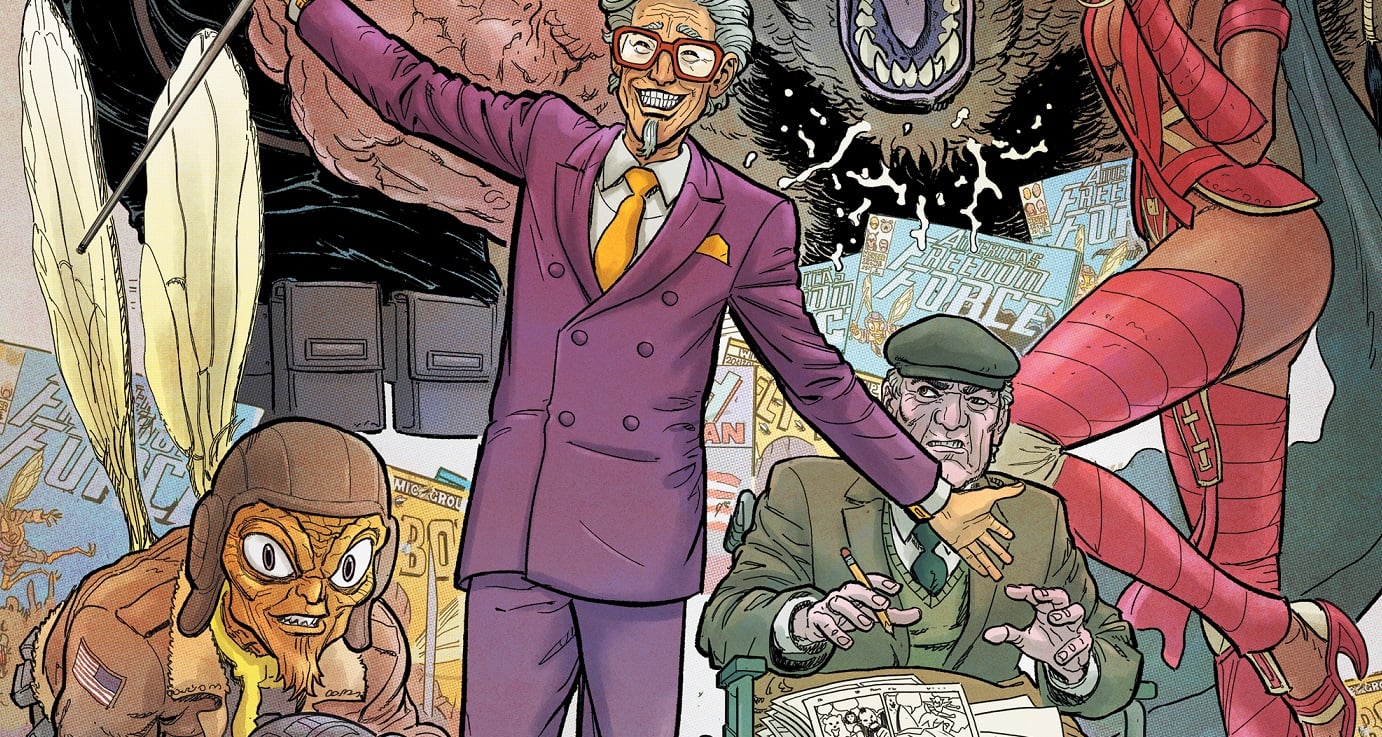
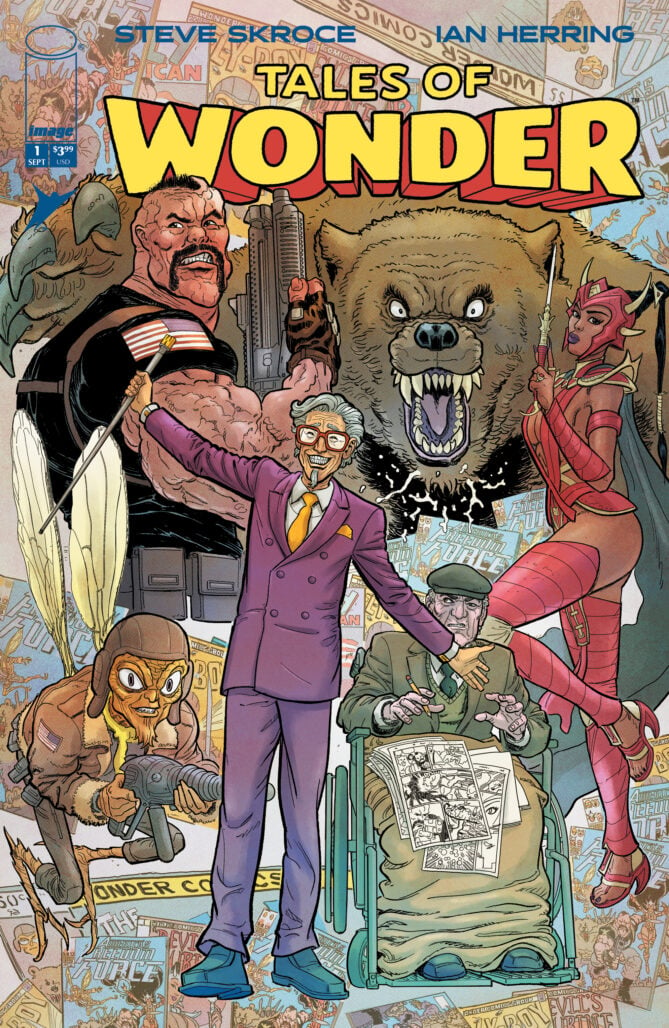
After working as a storyboard artist on various films for a number of years, most notably The Matrix franchise, fan-favorite comic book creator Steve Skroce has been making up for his time away from the comics industry with various creator-owned projects. Skroce is playing double duty writing and drawing Tales of Wonder, a new miniseries from Skybound that follows two estranged comic book creators embarking on a quest to save the world with their most superhero creations.
Ahead of the release of the first issue, The Beat had the opportunity to interview Skroce about the origins and inspirations for this unabashedly meta story. Additionally, the prolific creator discussed his evolving art style and shared his opinions about the invasion of AI in the creative spaces.
 This interview has been edited for length and clarity.
Taimur Dar: You said in the official press release that Tales of Wonderis a project you’ve had in your for some time. When did you first get the idea and how did it end up at Skybound?
Steve Skroce: It wound up at Skybound through Ben Abernathy. He’s someone I’ve known for a long time. I’ve always thought he was great. He’s got an amazing reputation. We’ve worked together on little stuff but we never did a whole series. When I had this idea, he was one of the first people I reached out to. He’s been a great editor.
The holy trinity of influences for this were Three Amigos, Tropic Thunder, and of course Galaxy Quest. That idea of the creators going on a similar adventure to the kind of fiction they create has always appealed to me. It’s just so fun to take these characters who made adventure stories and put them in an adventure story. It’s super fun. Also throwing some shade and love at the comic industry that I’ve devoted my professional life to. In the first issue, there’s a character who’s a movie producer for all the Wonder Comics characters. He has this speech that’s an evil capitalist view of selling back your childhood through an $80 Funko Pop. We set the table with that cynicism but by the end of it there will be counterarguments to all these things. It’s really a celebration of fandom and how it informs our values and how we feel about the world a lot of the time. I think it’s where a lot of our humanist values come from. I think I’m anti-death penalty because of Batman and Spider-Man. It’s fun to go into a parallel universe comic book industry and mess around.
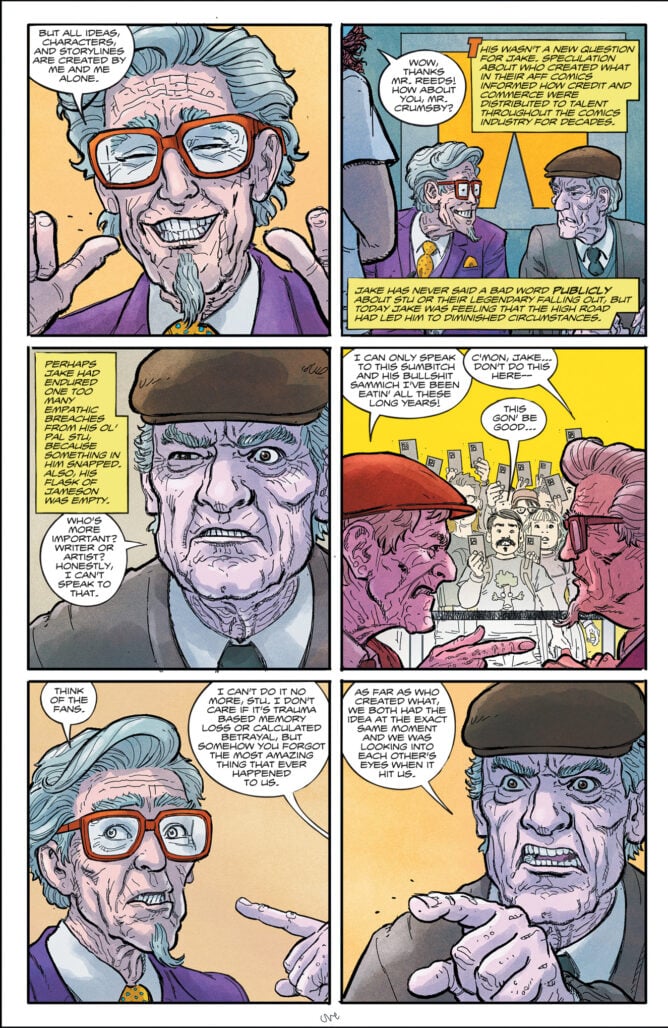 Taimur Dar: It’s clear that the fictional book creator characters Stu Reeds and Jake Crumsby are pastiches of Stan Lee and Jack Kirby respectively. Just like Stan Lee, the Stu character is a showman. It’s so easy to despise these types of chauvinists and though flawed, Stu isn’t the complete scumbag I was expecting. It’s a very nuanced and balanced approach when it comes to depicting the Stan/Jack debate. Did you find that difficult at all?
Steve Skroce: You’re right. The biggest struggle for me was trying to balance that and not try to vilify one character over the other. It’s not really the Stan and Jack story at all. The falling-outs in the creative industries are part of the game. In comics we have tons of legendary fights that have happened over the years between collaborators. You could have picked from any of those. Probably our most famous archetypes are Stan and Jack. So I created two characters who aren’t them but could do the same job and inhabit the same space with their real-world counterparts. As you’ll see, it’s less a comment on their specific relationship and more of personal experiences that are underneath those two characters and feeding their worldview. I didn’t look at any Stan Lee or Jack Kirby biographies. My two characters are childhood friends and worked together since they were kids making stories. It’s not quite the same. Stu becomes sort of the hero of the piece. It’s not like The Boys or a cynical hit job on anyone. Like I said it’s probably more Galaxy Quest. It’s about wish fulfillment for me.
My interests in the pitfalls in creative collaboration come from my own experience. I had a falling-out with a friend when I told him an idea and the next thing you know he stole it and made his own book out of it. It ruined the friendship with this guy. I wondered if he was a good friend for many years. When something like that happens, it ruins the relationship. That was big on my mind. Even though I don’t want to have a healing relationship with that person, I did mourn and regret the loss of the friendship. I regretted how angry I became about it. It wasn’t even my idea. It was something I was working on with a writer. It was a watershed moment in my life in terms of my creative relationships. That was something that was always there and fed into this story. I wanted to use that as a vehicle and catharsis for myself that these friends could have a second chance to get it right.
Taimur Dar: America’s Freedom Force, the fictional in-universe team in the story, are obviously pastiches and archetypes of classic Marvel characters. It’s very much in a similar vein as the Adult Swim animated series Venture Bros. which is clearly inspired by Jonny Quest but is able to stand on its own. How did you go about creating America’s Freedom Force?
 Steve Skroce: In the comic, you find out America’s Freedom Force was a name Jake and Stu came up with. They didn’t have their own name and [the America’s Freedom Force characters] thought it was dumb. The Ugly American is like the Super Soldier guy but he wasn’t a 4F weakling who got drafted into a program. He’s more of The Great Gatsby’s neighbor in the 1920s. He a super patriot and oilman and venture capitalist. He didn’t like what the Nazis were doing so he made his own A1 Patriot Pill. It was a tablet that he took but it was experimental and deformed his body and so he lost his handsome face. Dragovexia is not really Doctor Strange or Scarlet Witch. She was a baby abandoned on the steps of a nunnery. When she’s nineteen years old, a demon prince collapses on the same steps and she decides to save him and they fall in love. He teaches her the way of demonic magic and she becomes Draovexia, the devil’s concubine. Man-Bear and Fly-Boy were scientific collaborators and partners. They were doing scientific trials and a fly flies in while they’re doing a procedure on a bear. The energy emitter is activated and they’re all hit and their DNA gets scrambled. They all touch on the classic tropes but I add my own little weirdness.
Taimur Dar: Did you encounter any issues with clearance?
Steve Skroce: Not really. That’s the other thing. Most of it takes place at a comic book convention. If you’re at a regular comic convention, you’d see corporate IP everywhere in your line of sight. I had to cook up my own IP everywhere. I did this comic called Post Americana so I drew some of those characters in the background because you can’t have Superman or Spidey. I think I have one reference to DC and there’s a couple of references to actual living comic book artists.
Taimur Dar: I had the chance to get an advanced screener of the upcoming Bill Sienkiewicz documentary. It’s always strange for me to hear his art was at initially compared to that of Neal Adams before developing the distinct style that we know today. How would you say your own art style has changed and developed since you first broke into the industry?
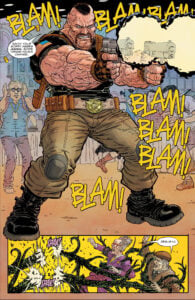 Steve Skroce: When I started back in the ‘90s, they would hire anyone with a pencil. I didn’t have a lot of skills. But I was a kid who didn’t know any real anatomy and hadn’t taken any art lessons. I learned everything just by looking at comics. My style was a pastiche of all the trendy tropes going on in comics like oversized eyeballs and big feet. One of my first comics was this comic that the Wachowskis, The Matrix creators, worked on. They liked me and brought me along to work on their movies. Through working on their movies, I got to work with Geoff Darrow which was one of the real blessings of my creative life. I didn’t really have an education. He would come over and give me drawing notes. Geoff is a master. My work suddenly became all about volume and perspective. Working on the movies with the Wachowskis taught me about composition. For a while, I had that Darrow vibe. I still do. What’s different now is I have my own storytelling style and pace. I like to spot blacks in my work now. Darrow would call it Hergé style where everything is open. I’ve left that behind. These days a lot of my big influences are [Katsuhiro] Otomo and of course Mœbius comics. François Boucq is a big influence from European comics. So many artists inspire me.
Taimur Dar: On the subject of storyboarding, I was completely taken aback when film director Martin Scorsese jumped on the AI bandwagon to use the controversial technology for storyboard work on his next film. So as someone who works in both film and comics industry as an artist, it’s only fitting I ask your opinion regarding AI?
Steve Skroce: It’s very scary. We’ve already seen what it can do. Marvel Studios already cut a whole team of artists. You’re going to get a prompter and one guy who fixes or tweaks whatever the AI puts out. And that will be your art department. There will still be artists involved and help the AI along. The thing about movies is the artwork generated from movies is in service of the bigger thing. The artwork isn’t the product on its own. The movie and the DVD is the product. You’re just the helping hand in the process of creating it. Helicopter shots used to be expensive but now we have drones. Your cheap show can now have a cheap drone shot. Do I agree with it? I think it’s unethical. I don’t know how to stop it.
But in comics, I don’t want something that just looks good. I want to know that a person did it. I would buy a novel from Stephen King but would I buy one from R2-D2? I don’t know. Once I know a human is not involved, that affects my interest in the authorship. I feel like AI is going to work its way in. I think Valiant tried to do a bunch of AI stuff and it poo pooed pretty hard. As time passes, these things get normalized. That’s what concerns. Over time the perception of the author will be modified by AI so that you are okay with robotic crap in there. The comics community seems pretty savvy and smart. These people like to read and like artwork so that already puts them ahead of the game than a lot of humans. Fingers crossed that comics will keep that AI crap out. I don’t know if any AI is going to come out with something you want more than Daniel Warren Johnson’s latest.
Taimur Dar: As we wrap up things, any other or future projects you want to plug?
Steve Skroce: I’ve got a bunch of irons in the fire. Nothing I can really talk about next, but they’re coming. I think the next thing I do someone else is going to write it. Writing and drawing is fulfilling but super hard. I’ve got a couple of writers that I really admire that I’m working with. After this, I can take a break and just get a script. I’m still doing the storytelling. It’s like an assembling the IKEA. It’s nice to have a solid script in front of you after a process like Tales of Wonder.
Taimur Dar: I know Tales of Wonder is a miniseries but could we see it continue?
Steve Skroce: The comics industry still has lots of things to talk about and fun to be had. If fans show up, there will be more.
Tales of Wonder #1arrives in comic shops on September 2, 2026.
