

It has been 50 years since Jack Kirby began work on a Marvel Comics series that adapted one of the greatest sci-fi movies of all time into comic form. However, what many fans might not remember is that this series also introduced a robot hero who went on to become part of the mainstream Marvel Universe and is still around today. In the 1970s, Marvel was licensing more movies to turn into comics, with books based on Star Wars, Godzilla, Planet of the Apes, and more. Then, one of the most unusual adaptations arrived 50 years ago, and Jack Kirby was the man chosen to bring this story to life. This was the perfect choice considering the source material.
Videos by ComicBook.com
On September 28, 1976, Marvel Comics released Jack Kirby’s new Marvel series, 2001: A Space Odyssey #1, which he wrote and penciled. This series brought the themes from Stanley Kubrick’s movie to Marvel Comics, while also going on to introduce none other than Machine Man to the Marvel Universe.
Jack Kirby Adapted Stanley Kubrick’s 2001: A Space Odyssey
Jack Kirby was one of Marvel’s most brilliant minds when it came to the idea of the cosmic and supernatural corners of the Marvel Universe. He was instrumental in creating godlike creatures in Thor’s world, and he also worked on creating the cosmic focus of Marvel’s alien races in titles like The Fantastic Four. He helped bring the Inhumans, Silver Surfer, and Galactus to life, and he then created an entire world of alien gods like Darkseid for DC Comics. After his work on the Fourth World saga at DC, Kirby returned to Marvel in 1975. The next year, he got the chance to write the adaptation of 2001: A Space Odyssey.
What is most interesting is that Marvel asked Kirby to adapt the movie into comic book format, but he didn’t want to do a straight adaptation. Instead, Kirby wanted to use the comic to narrate the story from his point of view. He then followed that up by starting a new series that used the concepts that Stanley Kubrick set up in his movie, with the prehistoric men and then futuristic aliens, all with a touch of time travel. Just like in the classic movie, the comic book opened with a man called the Beast Killer, who was learning how to hunt, how to create weapons, and it all ended up in a slaughter with him battling his fellow villagers. Kirby also had the Monolith there as the device that taught this Neanderthal how to create weapons and kill.
In the movie, the timeline jumped into the future where a man was planning a long space trip, which was the main focus of the movie. This comic also went into the future after that, where two men involved in a space mission were attacked by a creature after they ended up stranded on an asteroid. When one of the men is killed, the second leaps into the Monolith and ends up seemingly traveling through time, where he then rapidly ages and dies. It is all high-concept sci-fi, and Kirby delivered a story that paid respect to Kubrick’s movie without needing to adapt the story to the printed page.
2001: A Space Odyssey Introduced Machine Man to the Marvel Comics Universe
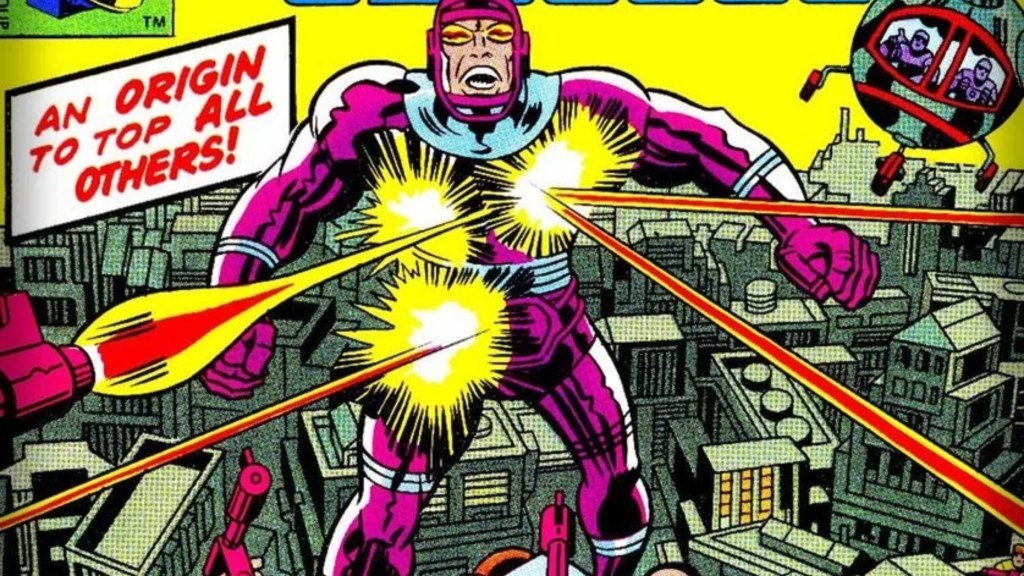
2001: A Space Odyssey #8 saw Jack Kirby introduce a new character into this world. The story was titled “The Capture of X-51,” and it had the Monolith mold a new character origin, this one about a machine in search of a soul with dreams of becoming a man. The machine was known only as X-51. The story opened with military soldiers attacking a machine known as X-35, threatening it. As the soldiers tried to destroy it, the machine only wanted to know one thing: “Why was I built?” This was the classic sci-fi story about what it means to be human and whether a machine could have a soul. Once again, it was classic Kirby storytelling.
The story saw the scientist detonate a self-destruct in all the robots, leaving only X-51, who was given to Doctor Stack to mold, still needing to self-destruct. Stack considered the robot to be a son, and he even named it Aaron Stack. For anyone who follows the AI and robot side of Marvel Comics, that name should sound familiar. It is the name of the superhero known as Machine Man, and this issue of 2001: A Space Odyssey was his origin story. Dr. Stack then took the device out of Aaron, sent him to safety, and then let the explosive device detonate while he held it to remove the evidence that X-51 had lived.
The story was very typical for Marvel Comics in the 1970s, with authorities and the military opening fire and trying to destroy anything they don’t understand. It was almost the same story that Jack Kirby and Stan Lee told when the Silver Surfer made his debut, and with that, Machine Man was introduced into Marvel Comics. Machine Man then starred in the final three issues of the series, and he later got the chance to star in his own comic, Machine Man, starting in 1978, with Jack Kirby still working as the writer-penciler.
25 Years Ago Today, Grant Morrison Introduced a New Era of Bizarre X-Men Heroes
More Comics
-
Image Courtesy of Marvel Comics Comics
21 hours agoThe X-Men Don’t Need Another Krakoa, And The Current Era Is Finally Proving It
-
Image Courtesy of Marvel Comics Comics
2 days ago50 Years Ago Today, Marvel Comics Gave Its Most Popular Superhero a Second Ongoing Title for the First Time
-
Image Courtesy of DC Comics Comics
2 days ago15 Years Ago Today, DC Introduced Its Darkest Team of Heroes (& Its Best Version of the Justice League)
-
Image Courtesy of Marvel Comics Comics
2 days ago10 Iconic Avengers Villains From the 1960s Who Defined Multiple Decades
-

Comics
2 days agoWe’ve Reached a Critical Level of Doctor Doom and Marvel Needs to Slow Down
-

Image Courtesy of DC Comics Comics
2 days ago5 DC Characters Who Need to Retire
