

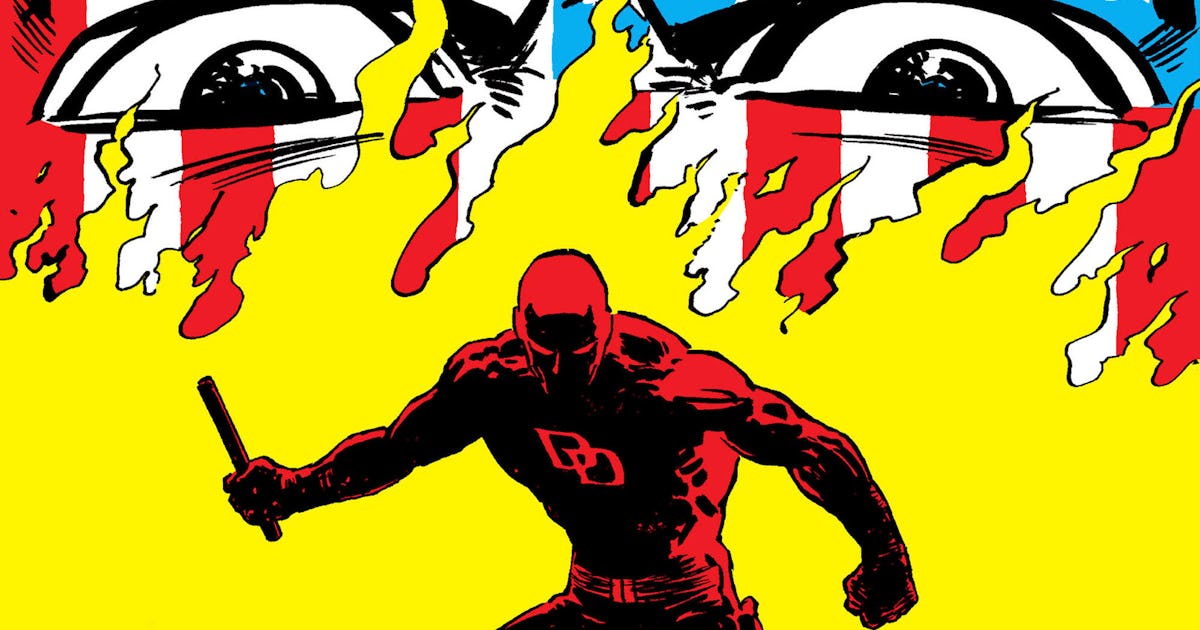
The original Daredevil: Born Againranks as one of the greatest comics ever.
Whenever people discuss superheroes who have it rough, there are a couple of names that usually stick out. Spider-Man’s day-to-day life is notoriously bad, so the term “Parker luck” was coined because of it. Batman has had his back broken, several of his sidekicks killed, and consistently fights monstrosities and aliens all while just being a normal human being.
But it’s safe to say that few comic book characters have trials and tribulations comparable to those of Matt Murdock, aka Hell’s Kitchen’s own Daredevil. Those who love him can’t quite seem to stay alive, those who hate him can’t quite seem to stay in jail, and the Man Without Fear himself can’t quite seem to keep a handle on his own secret identity (a problem that has just recently followed him to the MCU in Daredevil: Born Again). But 40 years ago, one of the most celebrated comic book writers of all-time took it upon himself to drag Matt Murdock through hell and back, and in the process wrote not just one of the best Daredevil stories ever but one of the best comic arcs of all-time: the original 1986 Born Again.
When Stan Lee and Bill Everett first created Daredevil all the way back in 1964, they were responsible for many of the character’s everlasting traits: he’s a blind lawyer named Matt Murdock, his father was a murdered boxer named Battlin’ Jack, and he works alongside Foggy Nelson and secretary Karen Page at a legal firm named Nelson and Murdock. But the original depiction of the character was a quippy, lighthearted Spider-Man-adjacent swashbuckler – it wasn’t until the late 70s and early 80s, when the title was in danger of cancellation because of declining sales, that Frank Miller took over as writer and forever changed the perception of the book. Instead of fighting vampires or villains pulled from science fiction B-movies like Stilt-Man, Miller emphasized the psychological turmoil of a Catholic vigilante and fleshed out the contours of Hell’s Kitchen’s criminal underworld (converting The Kingpin from a Spider-Man villain into a Daredevil villain), ultimately giving the book a hard-boiled, seedy film noir atmosphere that was instantly popular and has influenced other Daredevil writers to this day.
After briefly stepping away from the title, Frank Miller returned with what is maybe his greatest narrative contribution to the Daredevil mythos: 1986’s Born Againstoryline, which played out from February to August in the pages ofDaredevil #227-233. A culmination of everything he’d built up over his original five years writing the character, Born Againopens with the reveal that Karen Page, who had been absent from Daredevil comics since 1969 (she left Nelson and Murdock to become an actor after discovering Matt’s secret), has become an adult film actor and heroin addict. In the throes of her addiction, Karen sells Matt’s secret identity for a fix, and that information ends up in the hands of The Kingpin, who decides that if he can’t defeat Daredevil the vigilante, he’ll defeat Matt Murdock the civilian by systematically destroying his personal life.
The pop culture idea of the character inspired by the TV show is a far cry from the joced readers to in 1964.Marvel Comics
Born Againwas arguably the storyline that set the precedent for Matt Murdock’s continued suffering in comics, and at least half the arc is dedicated to watching the slow unfolding of Wilson Fisk’s plan – his bank assets are frozen by the IRS, his apartment is foreclosed by the bank, he’s barred from practicing law (courtesy of a false testimony from a police officer paid off by Fisk to testify he saw Matt bribing a witness), and in the finale of the arc’s first issue, his apartment is firebombed in an assassination attempt by his archnemesis. There’s always been an ebb and flow between Daredevil and The Kingpin, with the vigilante serving as a stubborn reminder that Fisk can’t escape his criminal illegitimacy, but Born Again makes Fisk imposing and insurmountable, a nightmarish combination of his endless criminal resources and his ability to weaponize America’s flawed systems of law and order.
Born Again sees Matt spend most of his time outside of the costume, and it’s because the book is dedicated to stripping the character of every comfort he could possibly have and dragging him to his lowest point to see what makes him tick, to expose what makes Matt Murdock so virtuous. Left homeless and wracked with paranoia, Matt resolves to murder his longtime enemy at last, a decision that leaves him worse off as The Kingpin savagely beats him, drenches him in whiskey, and pushes him in a cab into the East River. Luckily Matt escapes, but collapses on the verge of death…where he’s nursed back to health by Sister Maggie Murdock, his long-lost mother.
One of the best parts of the arc is David Mazzucchelli’s art — it’s stark and bleakly realistic, but it has the pacing and focus of an intimate character drama, with larger-than-life characters dominating each panel and a deeply cinematic sense of motion carrying through the compositions. The art is also where the religious iconography of Born Again shines the hardest: each issue opens on Matt sleeping and eventually escalates until they recreate the crucifixion pose and the Pietà, drawing readers’ attention to the fact that Daredevil functions as something of a Messianic figure, absorbing the sins of Hell’s Kitchen to redeem them through his own suffering and the pain inflicted upon him
Eventually, Matt and Karen reconnect (the latter having made her way from Central America to rectify her drug-addled mistake), and for a while it seems as if Matt might be content leaving the Daredevil persona behind. But as he recuperates, The Kingpin loses himself in his quest for revenge, eventually hiring an unhinged super-soldier named Nuke (a character who showed up in Jessica Jones) to draw Murdock out of hiding. Their battle not only draws in the attention of The Avengers (who eventually catch on to Wilson Fisk’s plans), but it draws Daredevil back into action, reaffirmed and rebuilt as Hell’s Kitchen’s defender through his experience of penance and redemption.
Born Againwas used as the basis for both the third season of the original Netflix show and bits and pieces of the revival Daredevil: Born Again,and it’s easy to see why.
Frank Miller didn’t just write arguably the greatest Daredevil story ever told, but he also changed the way that superhero stories deal with human drama. Matt Murdock is a running joke for comic book fans because he’s a character who can’t escape his own suffering, but over four decades ago, Frank Miller showed us that the reason why Daredevil can handle it is that the hero is the man underneath the costume, not the bright red costum he’s known for.
Daredevi: Born Againstreams on Disney+.
- Superheroes
- Marvel Universe
