


Why Gaming Communities Are More Influential Than Ever
Gaming has changed far beyond the games themselves. Players no longer log in only to complete missions, climb rankings, or test new mechanics. They also join conversations, exchange ideas, create content, and shape discussions that reach far outside a single title. Community activity now affects how people discover games, learn new skills, organize events, and spend their free time.
Digital platforms have made these connections much easier. Forums, social channels, streaming platforms, and community hubs allow players to communicate every day instead of waiting for official announcements. At the same time, many users also explore other forms of online entertainment through digital platforms such as cowboyspin, showing how gaming communities often exist within a much broader online ecosystem rather than in isolation.
Developers, tournament organizers, content creators, and everyday players all contribute to this environment. Every guide, discussion, tournament recap, and strategy post adds value for someone else. Instead of consuming information alone, community members actively create it.
This shift explains why gaming communities now play a much larger role than they did only a few years ago. Their discussions influence purchasing decisions, shape public opinion, encourage participation, and even affect long-term support for games.
Communities create information faster than official sources
Developers publish updates on schedules that fit production cycles. Communities work differently. Thousands of players test new features immediately after launch and begin sharing observations within hours.
This process creates several advantages:
● Players identify bugs quickly.
● Strategy discussions appear almost immediately.
● New mechanics receive practical explanations.
● Hidden features often surface before official documentation expands.
● Newcomers receive answers from experienced members.
Because thousands of people contribute simultaneously, information spreads very quickly. One player may discover a useful tactic, another confirms it, while others improve or challenge the original idea. Within a short period, the discussion becomes far more complete than a single guide.
Communities also correct mistakes. If someone shares inaccurate information, others usually respond with screenshots, statistics, or direct testing. This constant review helps maintain higher accuracy over time.
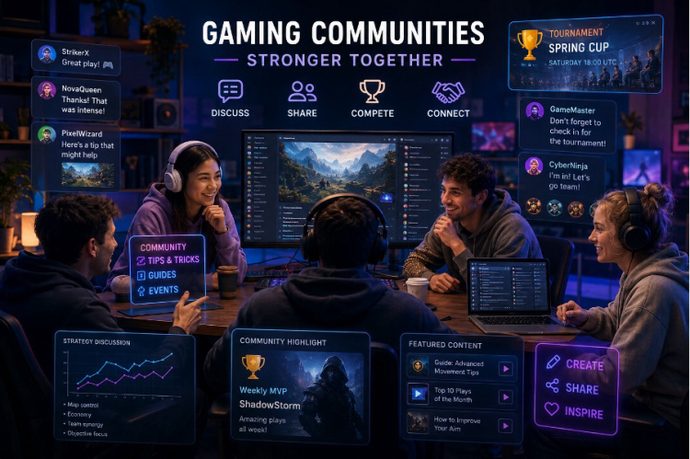
Shared experience builds stronger engagement
Many people continue playing because they enjoy interacting with others rather than focusing only on gameplay. Conversations before and after matches often become part of the entertainment.
Players discuss updates, compare strategies, analyze balance changes, and organize group activities. Even people who cannot play every day often stay connected through community discussions.
Several factors encourage long-term participation:
| Community activity | Effect on players |
| Strategy discussions | Better understanding of mechanics |
| Community tournaments | Regular participation |
| Fan-created guides | Faster learning |
| Creative projects | Stronger interest outside gameplay |
| Daily conversations | Continued engagement |
These activities create reasons to remain active even during periods without major content updates.
Player knowledge grows through collaboration
Gaming communities function as large learning networks. Every participant contributes different experiences, skill levels, and perspectives.
New players often ask basic questions. Experienced members explain mechanics, recommend settings, or suggest practice methods. Others contribute detailed calculations, performance testing, or technical advice.
Learning becomes much faster because people solve problems together instead of working alone.
Community-created educational content often includes:
Many players improve because they study community discussions instead of relying only on trial and error.
Feedback now reaches developers much faster
Communication between players and developers has become far more direct than in previous years.
Community discussions often highlight recurring issues before formal reports appear. Large numbers of players discussing the same concern create clear signals about gameplay balance, technical problems, or quality-of-life improvements.
● Frequently requested features
Large discussions also help identify which problems affect the greatest number of players.
Although developers make final decisions independently, community conversations frequently highlight priorities that deserve attention.
Content creators strengthen community activity
Modern gaming communities produce enormous amounts of original content every day.
Players publish tutorials, reviews, gameplay analysis, challenge videos, statistical breakdowns, podcasts, and educational material. Others create artwork, music, animation, or written fiction inspired by games.
Different types of content attract different audiences.
Some viewers seek entertainment. Others search for technical information. Competitive players study advanced strategies, while casual players simply enjoy community conversations.
This constant flow of material keeps discussions active throughout the year.
Communities shape the success of multiplayer games
Multiplayer titles depend heavily on active player participation.
Strong communities encourage players to return regularly because social interaction becomes part of the experience. Friends organize sessions together, discuss updates, and recommend games to new participants.
Healthy communities usually demonstrate several characteristics:
- Regular discussion.
- Helpful responses for newcomers.
- Active moderation.
- Community events.
- Consistent content creation.
These elements encourage continued activity even when no major expansion arrives.
Communities also organize tournaments, seasonal competitions, charity events, and educational sessions without waiting for official involvement.
Competitive gaming increases community participation
Esports continues to encourage interaction beyond professional matches.
Fans analyze drafts, compare strategies, predict tournament outcomes, and debate roster decisions long before competitions begin.
Community discussions extend every event.
People review statistics, explain tactical choices, and compare performances. Many participants also create detailed breakdowns that help newer viewers understand complex situations.
This educational role makes competitions more accessible to wider audiences.
Instead of watching passively, many viewers actively participate through discussion channels, prediction games, and analytical communities.
Social identity now extends beyond individual games
Many players identify with broader gaming interests instead of limiting themselves to one title.
- CS2 Premier Season 5: Start Date, Changes & What to Expect (44243)
- Palworld 1.0 Beginner Guide: How to Start Right in the Full Release (1138)
Communities often include people who enjoy similar genres, hardware discussions, speedrunning, modding, accessibility improvements, or technical experimentation.
Shared interests create connections across different games.
For example, someone interested in strategy games may join multiple discussion groups rather than focusing on one specific release.
This broader participation encourages continuous learning and introduces players to experiences they may never have discovered independently.
Community projects expand the gaming experience
Players regularly create projects that extend enjoyment beyond official content.
These initiatives often continue for years because volunteers enjoy contributing their knowledge.
Community projects preserve information that might otherwise disappear after updates or server closures.
Many older games remain active largely because dedicated players maintain documentation and organize regular events.
Trust often develops through consistent participation
People generally pay closer attention to advice from community members who regularly contribute thoughtful discussions.
Trust develops gradually through:
Long-term contributors often become recognizedte experience and transparency
However, healthy communities also encourage verification instead of accepting every opinion without question.
Constructive disagreement frequently improves the overall quality of discussion.
Technology continues to expand community interaction
Modern communication tools allow players from different regions to participate together regardless of physical distance.
Translation tools reduce language barriers.
Voice communication improves team coordination.
Streaming platforms allow live interaction during gameplay.
Cloud services simplify file sharing.
These improvements make participation easier than it was only a decade ago.
Players now exchange ideas almost instantly through multiple communication channels rather than relying on a single forum.
Communities encourage responsible discussion
Well-managed communities establish expectations that encourage respectful behavior.
Moderators, experienced members, and community guidelines help reduce disruptive activity while encouraging productive conversations.
Successful communities usually support:
These standards improve the experience for both experienced players and newcomers.
Communities that maintain respectful conversations often retain active members for longer periods.
Data and analytics improve community discussions
Players increasingly use statistics when discussing gameplay.
Instead of relying entirely on personal opinions, many conversations now include measurable information.
Community analysts often examine:
| Data type | Purpose |
| Match statistics | Evaluate performance |
| Pick rates | Identify trends |
| Win percentages | Compare strategies |
| Equipment usage | Study player preferences |
| Tournament results | Track competitive changes |
Data alone does not answer every question, but it helps communities discuss topics with greater accuracy.
Combining statistics with practical experience often leads to stronger conclusions.
Communities influence future gaming culture
Gaming communities now affect much more than individual titles.
They encourage creativity, support education, organize events, preserve gaming history, and introduce new players to unfamiliar genres.
Many discussions extend into hardware, accessibility, artificial intelligence, digital creativity, and online communication. As technology continues to develop, communities will likely expand into additional areas connected to interactive entertainment.
The strongest communities succeed because members actively contribute rather than simply consume information. Every guide, discussion, tournament recap, technical explanation, and creative project helps someone else learn something new.
Don’t miss esport news and update! Sign up and recieve weekly article digest!
Sign Up
Gaming has always connected people through shared interests. Today, those connections reach farther than ever before. Communities no longer serve only as places where players gather after finishing a match. They help shape conversations, spread knowledge, encourage collaboration, and support continued participation across the entire gaming ecosystem.
Kateryna Prykhodko is a creative author and reliable contributor at EGamersWorld, known for her engaging content and attention to detail. She combines storytelling with clear and thoughtful communication, playing a big role in both the platform’s editorial work and behind-the-scenes interactions.
Palworld 1.0 vs Early Access: Everything New in the Full ReleaseEverything that changed in Palworld 1.0: new regions, 72 Pals, Awakening, Mutation, reworked combat and story. Compare Early Access vs 1.0 in one guide.fauesde

Palworld 1.0 Best Base Locations (With Coordinates)The best base locations in Palworld 1.0 with in-game verified coordinates: starter spots, ore and oil outposts, Sunreach and water builds for all 4 base slots.stawraith
LoL Classic Pass Act 1 Overview: Reward System and Classic Mode LootA complete guide to the LoL Classic Pass Act 1. Farm Classic Coins in the 2009 retro mode to claim nostalgic loot, including the rare Rusty Blitzcrank skin.Chillplay
AC Black Flag Resynced Best Weapons: Every Sword and Pistol RankedPersian Scimitars are the best weapons in AC Black Flag Resynced. Here’s every sword and pistol ranked, with full stats.vitaliiD

