

Good hardware doesn’t necessarily make for a successful product.
When Apple launched the Vision Pro headset in early 2024, it was the most ambitious device the tech colossus had released in recent memory. To find another device that so fundamentally wanted to change how we use tech, you’d probably have to go back to the original iPhone.
But from our vantage point in 2026, it’s clear the Vision Pro was doomed from the start. Despite its extraordinary capabilities, design flaws and a lack of apps at launch held it back significantly. But perhaps most damaging of all was its price. For $3,500, you’d expect the Vision Pro to do everything your MacBook does and more, but for many users, it became a glorified and overcomplicated external monitor. After an initial wave of hype, the Vision Pro faded away.
The Vision Pro got a single, half-hearted M5 update in October 2025, but the writing was on the wall. Apple was already pulling staff from the project to focus on cheaper, more approachable smart glasses and, by June 2026, analyst Ming-Chi Kuo suggested that Apple had dropped its headset program entirely, leaving only a couple of smart glasses in development.
But other VR and XR headsets have fared better, most notably the Meta Quest 2, which became the best-selling VR headset of all time, and its successor, the Quest 3. Why did Meta succeed enough to remain in the market while Apple failed despite releasing a polished first-generation product? The answer is twofold: Apple doesn’t need the Vision Pro as much as Meta needed the Quest, and the Vision Pro sacrificed mainstream accessibility to meet Apple’s notoriously rigid product standards.
Sticker shock sunk Apple’s spatial computing ambitions
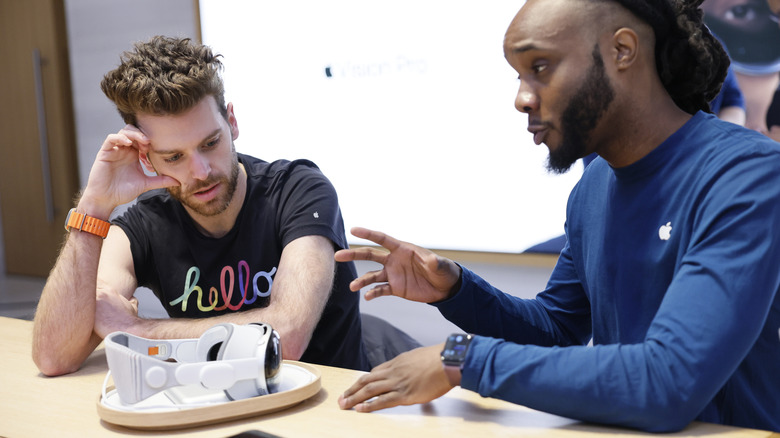
When the Apple Vision Pro arrived, some analysts were astounded by its $3,500 price, a number that suggests Apple never intended it to become truly mainstream. Apple might be able to get away with charging $1,000 for an iPhone or $2,000 for an iPhone Duo (especially with carrier subsidies, deals and purchase plans), but more than triple that for a device that required users not only to learn an entirely new operating system in three dimensions but also to find a practical use for it in their daily lives? It was never going to tempt anyone beyond the wealthiest subset of Apple enthusiasts, especially since it lacked any killer apps at launch.
More charitable onlookers insisted Apple had a larger vision for the Vision Pro. The first generation was for developers, some said, and mass appeal would materialize as future headsets got cheaper and added more apps. But a classic chicken-and-egg problem emerged: no one wanted to develop for a platform with so few users, and few users wanted to buy into a platform with so few native apps. It’s a tale as old as time, with products like the Windows Phone and Apple’s own Newton PDA falling victim to the same dilemma.
While Apple hasn’t released concrete sales data for the Vision Pro, estimates generally put the figure at around or under 500,000 units. That’s far below Apple’s initial expectations and less than what such a complex, cutting-edge device would need to sell to make financial sense. Demand for a device that costs more than your mortgage payment and makes you look like you’re wearing the world’s dorkiest ski goggles was, as it turns out, not very high.
Even Meta couldn’t make VR headsets popular
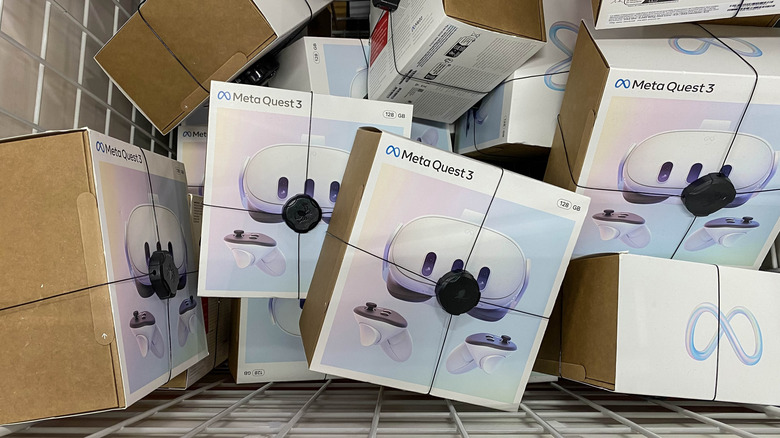
Despite the Meta Quest line’s relative success, it hasn’t really made VR and XR that popular. While the Quest 2 is widely considered the best-selling VR headset of all time, even the most generous estimates put sales at around 20 million units. By way of comparison, the Sony PlayStation 4 sold more than 100 million units, and Apple sold around 226 million iPhones in 2024 alone. Compared to sales numbers for popular tech products, VR’s best-selling product barely registers. Its follow-up, the Quest 3, was even less impressive, only unseating the Quest 2 as the most popular headset on Steam in late 2026.
The Quest 2’s figures can’t be fully chalked up to consumer enthusiasm, either. Facebook poured over $80 billion into the so-called metaverse starting in 2021, even renaming itself to Meta as part of its effort to dominate what Mark Zuckerberg called the “next chapter for the internet.” The Quest 2 was Meta’s flagship headset at the time, so it makes sense it got more attention than other VR headsets. For his part, Zuckerberg could not have been more wrong and, while Meta has seen success with its AI-equipped Meta glasses, it has failed to move the needle on full-fat VR and XR headsets.
One warning sign for Apple in the lead-up to the Vision Pro’s release should have been Meta’s own high-end headset, the Quest Pro. Launched in October 2022 for $1,500, the Quest Pro promised everything Meta couldn’t afford to put in its budget-priced Quest 2: eye tracking, productivity software and better passthrough. It was an immediate flop, prompting Meta to slash $500 off the price about six months later before discontinuing it in 2024. In that context, it’s no wonder Apple’s $3,500 headset didn’t fare much better.
