

Getting your Trinity Audio player ready…
Everything you need to know about virtual reality headsets
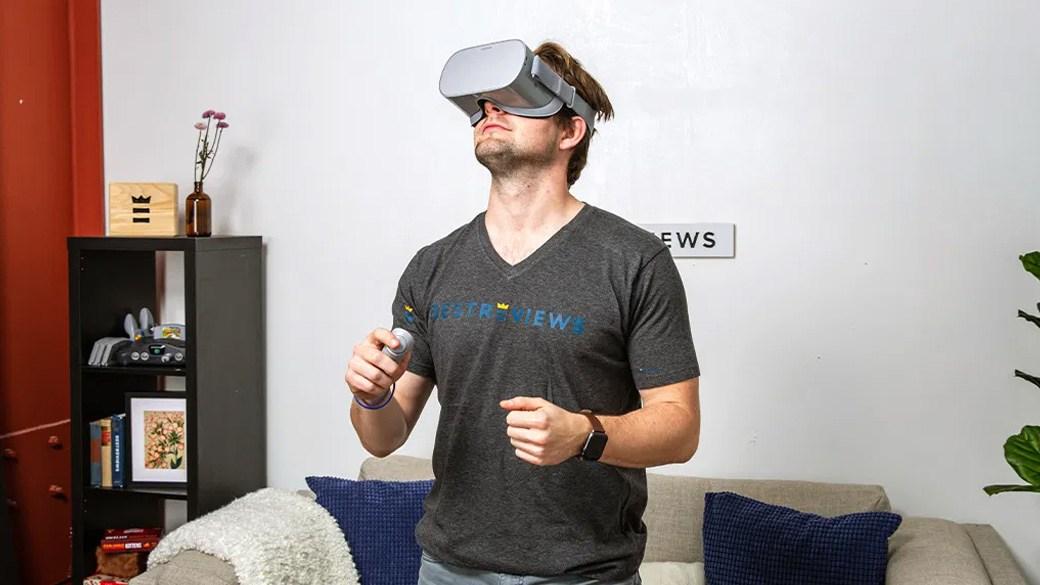
Most people have seen someone wearing a virtual reality headset and waving their arms around, totally oblivious of their real-life surroundings. It can look quite silly to an outsider, but for the person wearing the headset, the simulation can feel very real. VR allows the user to feel as if they exist in a simulated world.
The technology might still be developing in some respects, but VR headsets now fill a large niche in the gaming world. VR is also impacting other industries, such as health, retail and education.
What is VR?
Put simply, VR simulates 3D environments with computer technology. Unlike traditional video games where the player stares at a screen, VR seeks to place the player inside the game and fully immerse them in this new world. They can interact with the game with multiple senses, including sight, sound, touch and sometimes even smell. So far, this has mostly been achieved by using headsets that are either tethered to a console or a computer.
AR vs. VR
Smaller devices, like smartphones, are able to simulate augmented reality, which bears some resemblance to VR. However, there are some key differences. AR takes real-life surroundings and adds artificial simulations to those environments, whereas VR is a fully simulated environment with the player being the only real-life component.
What to know before you buy a VR headset
There are some key terms to understand before choosing which VR headset to buy. Understanding some of these terms will allow you to make a smarter purchase and avoid problems like having incompatible hardware/software, feeling nauseous while using the headset or having a less than optimal experience.
- Field of view refers to what range of the virtual world a user can see at one time. Having a bigger FOV means the player will see more and feel more immersed in the world. Conversely, a larger FOV decreases the angular resolution, since the pixels are dispersed across a wider area of the screen.
- The screen door effect refers to when a player sees the black spaces between each pixel, like looking through a mesh screen in real life. This issue is more prevalent with lower screen resolution. Newer VR headsets with higher resolution are less likely to have this issue since there are so many more pixels jammed together and the spaces between them are narrower and much harder to see.
- Refresh rate refers to how often the content on a screen refreshes. If the VR headset has a refresh rate of 90Hz, it is refreshing 90 times per second. The higher, the better. Low refresh rates can cause lag, stuttering and even cause the player to feel sick.
- Inside-out tracking is when tracking devices for the VR are in the headset itself, making the tracking more accurate. There are also outside-in tracking devices, which are placed elsewhere in the room.
- In lighthouse tracking, beacons are set up in the room, and much like a real lighthouse, they emit invisible lights and scan the room. These lights track the player’s movement and mathematically predict what motion they are making and where they will move. This kind of tracking is the most accurate but also the most expensive.
Hardware requirements
Most VR headsets are still tethered to computers. Even the wireless Oculus Quest 2 can be connected to a PCe minimum PC specs required to run the VR software efficiently. However, potential purchasers ideally want to have PCs with better specs to ensure the software on their VR headset runs smoothly without frame-rate drops, which can cause nausea
Software requirements
VR headsets all feature different libraries of games. For instance, the Steam Index is compatible with the Steam software, since Valve developed both the software and the VR headset. Luckily, Steam is compatible with most VR headsets, including Oculus Rift S. Nevertheless, it is always important to research what software is compatible with the VR headset you intend to buy.
VR controllers
Different VR headsets will have different controllers, but most controllers work largely the same. The player holds onto the controller, but unlike most console controllers, there are straps or grips that keep them safely in the player’s hands.
Most controllers and VR headsets send invisible light signals to one another or infrared signals may be used.
How much can you expect to spend on a VR headset?
VR headsets still cost a pretty penny. Consumers can expect to pay $200 to $300 on the lowest end of the spectrum or up to $1,500.
The average cost for a VR headset is sitting between $300 and $1,000, and that only includes the hardware. Some manufacturers will throw in a free game or subscription, but for the most part, games need to be purchased separately after getting the actual headset.
Best VR headsets
Offering high-resolution gaming, this high-end set is packed with premium features. You’ll get an immersive experience with 5K resolution and body tracking, with auto IPD providing the most precise view possible. Dual-driver speakers deliver superb spatial 3D audio.
An excellent value, this headset from a top brand has a high-resolution pass-through and gets 2.5 hours of battery life. Plus, it doesn’t need to be tethered to a computer by a wire, so you can move around freely. You can even use it to watch movies.
A top-notch PC gaming headset, this one connectssts for up to two hours with Wi-Fi use. Its powerful speakers provide sharp, immersive audio, and its lightweight design is adjustable for a comfortable fit
HTC offers the most immersive VR headset on the market with LCD displays, 2880×1700 resolution and a 90Hz refresh rate. This headset comes with built-in headphone jacks, and nearly everything on the headset is adjustable to maximize comfort.
Prices listed reflect time and date of publication and are subject to change.
Check out our Daily Deals for the best products at the best prices and sign up here to receive the BestReviews weekly newsletter full of shopping inspo and sales.
BestReviews spends thousands of hours researching, analyzing and testing products to recommend the best picks for most consumers. BestReviews and its newspaper partners may earn a commission if you purchase a product through one of our links.
Distributed by Tribune Content Agency, LLC.
