

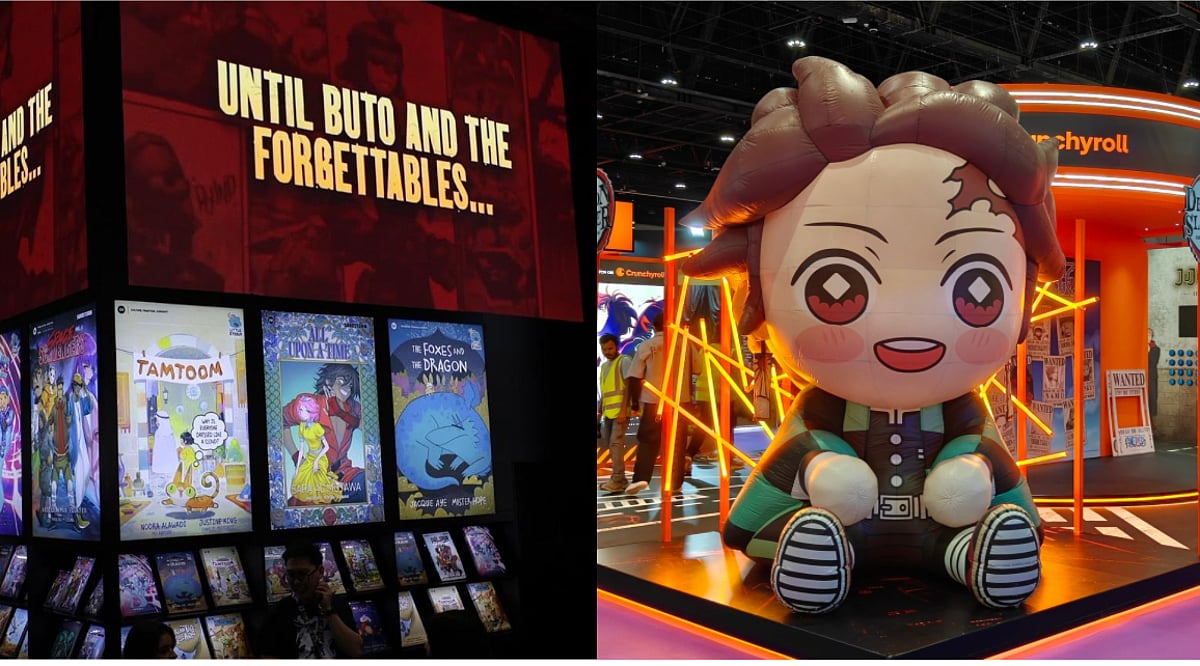
How anime and manga culture in the UAE is shifting from import to origin
Crunchyroll, Boss Logic and Sandstorm Comics on anime and manga’s rise in the Middle East
Dubai: For decades, anime in the Middle East has meant one thing: watching something made somewhere else. That’s beginning to change.
At this year’s Middle East Film and Comic Con (MEFCC) in Abu Dhabi, three very different voices, a streaming executive, a digital artist turned studio founder, and the editor-in-chief of an Emirati comics publisher, all pointed toward the same shift: a region that spent generations consuming Japanese and Western pop culture is now starting to produce its own.
What is Anime?
Anime is a style of animation that originated in Japan, though the term itself is simply the Japanese word for animation more broadly. What makes it distinct outside Japan is a specific visual language: expressive, often oversized eyes, dynamic action sequences, and character designs that can range from hyper-stylised to strikingly realistic depending on the genre.
What makes anime genuinely interesting is how little it resembles the “cartoons are for kids” assumption many Western audiences grew up with. Genres span everything from sprawling fantasy epics and cyberpunk thrillers to quiet, slice-of-life dramas and horror, often tackling themes, grief, war, identity, mortality, that mainstream animation elsewhere rarely touches. Studio Ghibli’s films such as My Neighbour Totoro and Spirited Away sit in the same medium as something as violent and philosophical as Attack on Titan.
Its roots trace back to early 20th-century Japanese animators experimenting with techniques borrowed from Western cartoons, but anime developed its own visual grammar over decades, shaped heavily by manga, the comics it’s frequently adapted from. Today it’s a global industry worth billions, with simulcasts allowing fans to watch new episodes within hours of their Japanese broadcast, a shift that’s transformed anime from a niche import into appointment viewing for millions worldwide, the Middle East very much included.
A market anime forgot it already had
I asked Akshat Sahu, VP of APAC and MENA at Crunchyroll, how new the region’s relationship with anime actually is, and his answer runs counter to the usual assumption that this is a recent trend. “Anime has a long history here. I think anime started streaming or at least on broadcast back in the 70s. A whole generation has grown up on anime,” he said.
What’s changed isn’t the audience’s existence, in his telling, but its visibility. Younger viewers, he explained, “are living the lifestyle a lot more,” turning what used to be casual Saturday-morning viewing into something closer to an identity.
Streaming has done a lot of that work. Where broadcast anime meant appointment viewing, missing an episode meant losing it, platforms like Crunchyroll turned the format into something people could pick up on their own schedule. Sahu pointed to the platform’s scale as part of the pitch: “The library of content which we have is unparalleled. We have almost 1,350 shows.” Dubbing, he said, has been just as central to that growth. Crunchyroll currently dubs into more than 15 languages globally, and in the Middle East specifically has produced 40 Arabic-dubbed titles so far, with a stated goal of reaching the top 100 shows.
“Arabic dubs have been there in the market, but they are far and few,” he said, framing the current push as an attempt to close that gap. The results, he added, have been immediate: “Our Arabic dubs have grown 3X in viewership in the last 6 months.”
The dubbing challenge, and the piracy problem it grew out of
Arabic isn’t one language for dubbing purposes so much as a family of them, and Sahu shared with Gulf News about the compromise Crunchyroll has settled on for now. “We are dubbing in what we understand is modern standard Arabic. That’s the most commonly understood in the world of entertainment,” he said, while leaving the door open to regional dialects as the catalogue and fandom grow, pointing to how the platform already dubs into three different languages in India and multiple dialects in Spanish.
Behind that expansion sits a problem the region knows well: piracy. Sahu didn’t dodge the question when it came up. “Fans turn to piracy when they don’t have a clear, convenient, easy to use, affordable option,” he said, arguing that legitimate access, done well, tends to win people over on its own. “Somebody who experiences Crunchyroll likes the experience, does not go back to piracy.”
He also pointed to Demon Slayer’s theatrical run as a case study in how a single release can pull new fans into the wider ecosystem, describing viewers who “don’t really watch anime” turning up for the film with friends and getting hooked afterwards, a pattern he said showed up clearly in the platform’s own viewership data once the film reached streaming.
From fan art to the Russo Brothers’ inbox
If Sahu represents the supply side of imported anime, Kode Abdo, known online as Boss Logic, represents something closer to its cultural feedback loop. Originally from Syria and now based in Melbourine, Abdo built a career out of fan casting art, the kind of speculative posters imagining who should play a given superhero, before that work started shaping the industry it was imagining. “A lot of the creative rooms would have fan art pictures that I’ve made that have inspired the outcomes of the series,” he said, citing Star Wars, Black Adam and The Witcher as productions where his work fed directly into casting conversations. “It’s a surreal moment, what you can do and achieve online.”
For years, that influence came with a condition: anonymity. “At the earlier stage of my career, I never showed my face. I wore a mask,” he said, describing the eventual decision to step into view, once studios like the Russo Brothers’ production company wanted to work with him directly, as more unsettling than exciting at the time. “I was hesitant. Even though it was a surreal, amazing moment, it was actually a fearful moment because I didn’t want to show myself. I wanted to stay hidden and make my work speak.”
Asked about AI’s growing presence in digital art, Abdo drew a sharp line rather than dismissing the technology outright. “If you’re starting to use it as, it’s creating your whole artworks and it’s creating your whole personality, are you even the artist anymore? That’s the line you have to draw,” he said, framing the real question as one of authorship rather than tool use.
His own defence against being replaced by it is consistency of voice. “I try to infuse my style to whatever genre I pick, even if it’s gaming, music, sports, comics or movies, because that’s what AI can’t do.”
Building something of his own, from the Middle East
Abdo’s next move points toward the same shift Sahu and Sandstorm’s Mo Abedin both described, a region moving from consuming IP to producing it. He’s currently exploring setting up a Boss Logic studio in the UAE, with plans to launch original intellectual property from the region rather than about it. “Imagine the whole MCU, Marvel universe. That’s what my IP will be, but coming from the Middle East,” he said. The choice of location isn’t incidental. “I’m from Syria originally, and UAE is the hub of entertainment, but it’s still the Middle East. I still find it close to home. If I can elevate the people from here, that’s a win for me.”
Sandstorm and the search for something distinctly Emirati
That same instinct, building something recognisably local without imitating what already exists elsewhere, sits at the centre of how Mo Abedin runs Sandstorm Comics, the Abu Dhabi-based publisher behind titles like Solarblader.
Gulf News asked whether Sandstorm feels pulled between readers raised on Marvel, DC and manga and international buyers looking for something distinctly Emirati, Abedin pushed back on the idea that those audiences need different books at all. “The story always comes first. I don’t think something has to look traditionally Emirati to feel Emirati,” he said. “That comes through in the setting, the characters, the way people speak, and the small details and experiences that come from actually living here.”
Solarblader, Sandstorm’s best-selling title, makes the case directly. Set in Abu Dhabi five hundred years in the future, the series imagines a world powered by a concentrated liquid form of solar energy Abedin calls XON, or Liquid Sunshine, a premise he traces straight back to the UAE’s own renewable energy ambitions. “Visually, it’s science fiction, but the idea behind that world came from what we’re already doing in the UAE around renewable energy and sustainability,” he said. “That’s what makes it ours.” International readers, in his experience, respond well to exactly that unfamiliarity. “They’re seeing something they haven’t seen before.”
The manga instinct
Sandstorm publishes both American-format comics and manga-style graphic novels, and Abedin said the sales numbers have settled an argument he didn’t expect to have this early. “When we looked at our own sales, our manga books were outperforming our American-format comic books, which was really interesting to us,” he said. This year’s MEFCC reinforced that further, with smaller, manga-sized editions of Sandstorm titles, introduced alongside the standard larger format for the first time, drawing a strong response from attendees.
He’s careful not to frame that appetite as imitation, though. Asked how he tells apart a submission that’s genuinely using manga’s visual language from one that’s simply copying it, Abedin said the tell isn’t stylistic at all. “You can usually tell quite quickly whether someone has a story they genuinely want to tell or whether they simply like the look of a particular manga or anime,” he said. “The important thing for us is what’s underneath the art style. Who are these characters? What’s the story? Why does this world exist?” That standard, he added, applies regardless of who’s submitting. “We’re not trying to create Japanese manga in the UAE. We’re seeing what happens when creators from here take that influence and make something of their own.”
The seven-year-old author
Nowhere does that philosophy show up more clearly than in Sandstorm’s youngest published author. Sultan AlWahshi was seven when his story, about a child pulled through a black hole into the year 3045, was approved through the publisher’s open submissions process, with no special programme or age category involved.
“He submitted a story and we liked it,” Abedin said. Sultan worked alongside Greg Baldwin, of Lost Bear Studios, whose credits include Ratchet & Clank, to develop the book, now published under Sandstorm’s children’s imprint, Little Storm. Abedin described the editorial approach in the same terms he’d use for any adult creator. “Whether you’re seven or twenty-seven, the principle is the same. If there’s something genuine there, we want to help bring the best version of it out.”
What’s changed since Sandstorm started
Asked to reflect on how far the industry has come since Sandstorm launched, Abedin didn’t point to a single milestone so much as the disappearance of a gap that used to define the region entirely. “There wasn’t really an established comics industry in the UAE. There wasn’t a large pool of writers, artists or editors with experience making comics professionally, and there wasn’t a clear path for someone here who wanted to enter the industry,” he said. That’s no longer true in the way it once was. Submissions have grown, workshops and camps are running regularly, and Sandstorm is heading into its third year exhibiting at New York Comic Con. “People come to the booth already knowing Sandstorm and looking for specific titles,” he said, “that’s a massive difference from where we started.”
His stated ambition for what comes next stays close to the reason he started in the first place. “When I was growing up here, if you told someone you wanted to write comics or become a comic artist, there wasn’t really a path for you,” he said. “I want a kid growing up in the UAE today to know that there is one.”
Between a streaming platform racing to catch up with a decades-old fandom, an artist whose fan work reshaped real Hollywood casting decisions before he’d even shown his face, and a publisher proving that a story can be Emirati without looking like anything that’s come before it, the picture that emerges isn’t of a region discovering anime and manga for the first time. It’s one that’s had the audience all along, and is now building the infrastructure to match it.
Simu Liu on Shang-Chi, the comics and Marvel at MEFC
How two UAE cosplayers took on the world stage in Japan

Get Updates on Topics You Choose
Inside MEFCC: Cosplay, anime and sold-out sessions
MEFCC 2026: 10 things to do at ADNEC this weekend
How to meet Mackenyu at MEFCC: prices and times
John Cena is coming to Abu Dhabi and here’s the scoop

1 Comment
Pingback: OC Japan Fair returns to California packed with all kinds of Japanese culture - Comic Vibe