

Spider-Man has often been called the most popular Marvel hero of them all and it feels like the last few years have gone out of their way to prove that. This year, we got Spider-Man: Brand New Day, the Wall-Crawler giving Marvel Studios another billion dollar success. The Spider-Verse movies showed that the rest of the Spider-Man mythos can be just as popular and the success of Ultimate Spider-Man (Vol. 3) shows that comic fans still love the hero. Spider-Man is the Marvel character in a lot of ways; he took the “hero with feet of clay” approach to its ultimate extent and has become the window through which Marvel often looks at big events in world. In 2001, 9/11 shook the United States, in Spidey’s city no less, and Marvel was going to use the character to talk about the disaster.
Videos by ComicBook.com
The Amazing Spider-Man (Vol. 2) was on the come up again in the early ’00s. The Clone Saga had ravaged the Spider-books, and the John Byrne relaunch of the late ’90s didn’t work at all. In the year 2000, new Marvel editor-in-chief Joe Quesada set out to fix the problems of the previous decade, hiring Babylon 5 creator J. Michael Straczynski to take over The Amazing Spider-Man. He was able to put the book on track throughout 2000 and 2001. 9/11 was a massive shock for the world, one that every piece of pop culture had to deal with. The Amazing Spider-Man (Vol. 2) #36 would be one of the first comics to deal with the attack and it remains one of the strangest pop culture artifacts ever, especially when you think about what it meant for Doctor Doom.
The Amazing Spider-Man #36 Was Marvel’s 9/11 Memorial
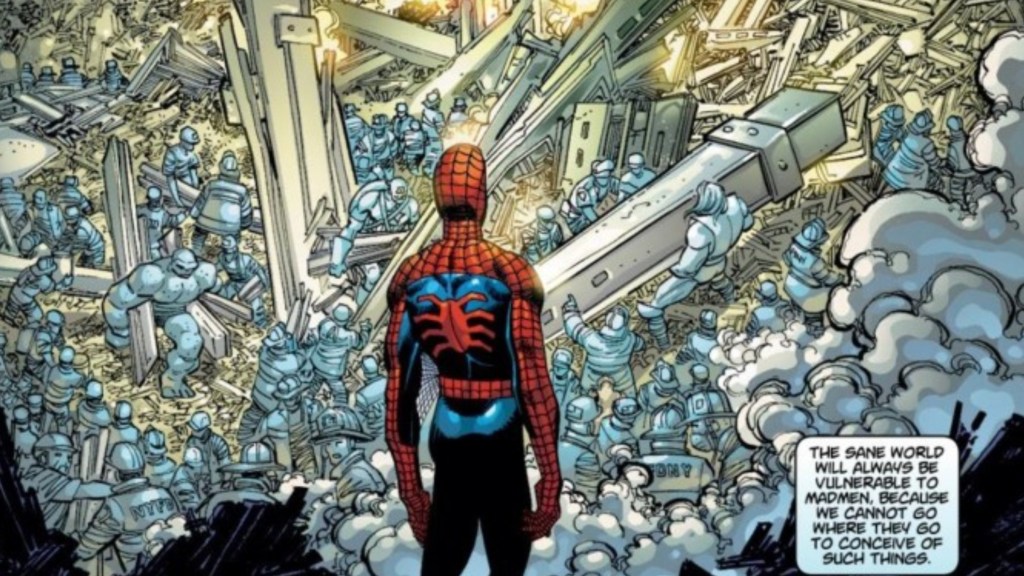
9/11 is the kind of day that you never think you’ll encounter in your life. One of the fun parts of fiction is that it allows you to “experience” tragedy in a safe way. Events like 9/11 feel like they came out of fiction – who would even fly a plane into a building other than some insane fictional supervillain – and we often use fiction to talk about our feelings on events like this. Fiction allows us to put our mind around the events that seem like they never would have happened and Americans in the days after 9/11 craved that.
The Amazing Spider-Man (Vol. 2) #36 dropped on November 14th, 2001, two months and three days after the disaster, from Straczynski, John Romita Jr., Scott Hanna, Dan Kemp, Richard Starkings, and Wes Abbott. The issue is simple – Spider-Man is swinging through Manhattan and witnesses the attacks, rushing to Ground Zero to help. The comic showcases various Marvel characters helping out police and fire fighters as they comb through the wreckage. There’s no dialogue; it’s not a story like that. Spider-Man is Marvel’s most relatable hero and this issue used that to its advantage.
Straczynski used the hero as a mouthpiece for what we all were feeling at the time – the confusion, the sadness, the anger, the fear. I was able to get my hands on a copy a year or two after it come out and it is a truly gorgeous book; Romita Jr. was a lifelong New Yorker and he drew his heart out. I’m not ashamed to admit that I bawled like a baby the first time I read it. It was written to be a cathartic moment for a country that had just went through something terrible and it honestly did a good job of that.
25 years later though, it’s become one of the strangest pieces of Marvel ephemera out there. To begin with, the idea that 9/11 would happen in the Marvel Universe, especially in the city where all the superheroes are, was a strange one. It sort of proved the idea that superheroes are, in the end, kind of useless. What good are they if they can’t stop this sort of thing? Comics are often used as a window to the world around us, but there are times when they aren’t the right lens to view things through. The Amazing Spider-Man (Vol. 2) #36 is one of those moments.
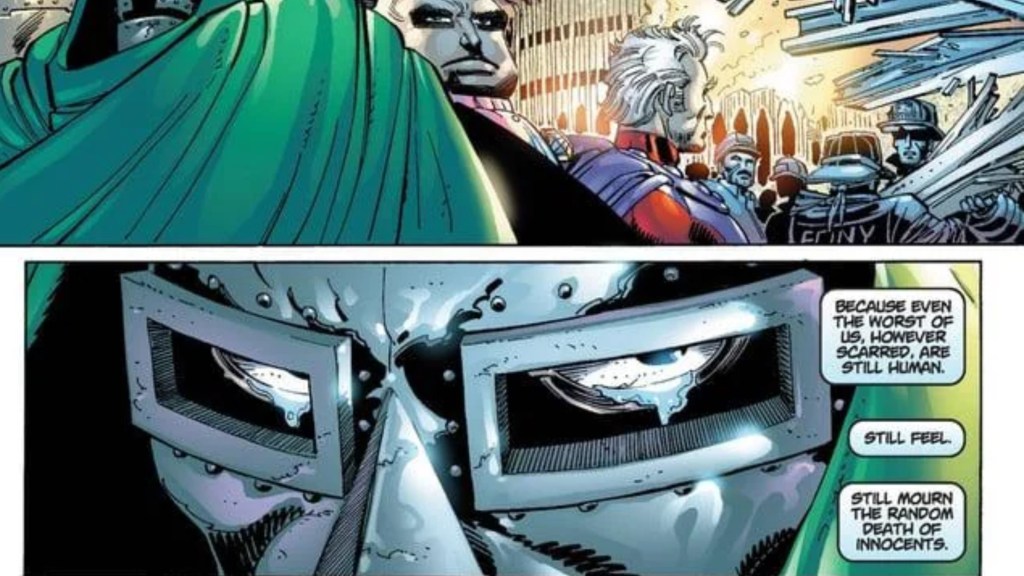
There are times when the issue seems to be hitting moments of parody, even though you can tell that it is one hundred percent earnest, especially the moments with the villains. One of the pieces of 9/11 propaganda we were sold was that it brought all of use together, so putting Magneto, Kingpin, and Doctor Doom at Ground Zero was meant to show that kind of moment. However, in the case of Doom, and to a lesser extent Magneto, 9/11 was the kind of thing that he tried to make happen on a regular basis.
We’ve all seen the panel where Doom is shedding tears over 9/11. It’s been memed to high heaven by now and it’s the moment that truly breaks the whole thing. Before this image, the issue was schmaltzy and emotional, meant to help you make sense of your feelings of the day. It was emotionally manipulative in the best possible way. However, this moment just sort of takes you out of the whole thing.
The view of 9/11 has changed a lot over the years. There was a time when people would legitimately fight you if they thought you were making light of it. Now, Gen Z makes 9/11 joke memes. Time gives us distance from all things, and that distance allows us to take a passionless look at the past. Back then, this comic was a moving, emotional moment for readers. Nowadays, it honestly feels kind of tone-deaf at times, playing on the tender feelings of a country that just wanted someone to make sense of the whole thing.
Time Changes the Meaning of All Things
Dealing with tragedy is always a difficult thing. Every person deals with everything differently, so there’s no one size fits all cure for it. In the modern day, pop culture has become a bigger part of our lives than ever and we often look to it to help us make sense of things. However, as comforting as something like The Amazing Spider-Man (Vol. 2) #36 can be, it represents the commodification of our grief. It’s taking advantage of a disaster to make money for the wealthy. There’s something that will always be a bit disgusting about it, even when you realize that the creators were working through their feelings as well. Therapy as commerce is always a strange thing.
Seeing Spider-Man process 9/11 will always be one of the strangest moments in comic history. Spidey’s often been used as an audience surrogate, so from that perspective, this comic definitely felt right. However, there’s something about the idea of a 9/11 Spider-Man comic that just feels weird. There are some interesting moments and the art is gorgeous, but there’s just something about seeing a guy who one hundred percent would be celebrating if a plane hit the Baxter Building cry over 9/11 that will always make you feel kind of strange.
What do you think about The Amazing Spider-Man (Vol. 2) #36? Do you think it’s strange or a stirring piece of pop cultural importance? Sound off in the comment section below.
5 Marvel Heroes Who Save the World (But Drive Their Fellow Heroes Crazy)
More Comics
-
Image Courtesy of DC Comics Comics
1 day agoRed Hood’s Latest Story Is Finally Giving Him Direction, and It Starts With a Return to His Roots
-

Image Courtesy of Marvel Comics Comics
1 day agoBlack Cat Has Found Her New Favorite Treasure, and It’s About to Lead to an X-Men Heist
-
Image Courtesy of Marvel Comics Comics
2 days agoDaredevil Has Been Unmasked More Times Than You Can Count, and He’s Still Not Learning
