

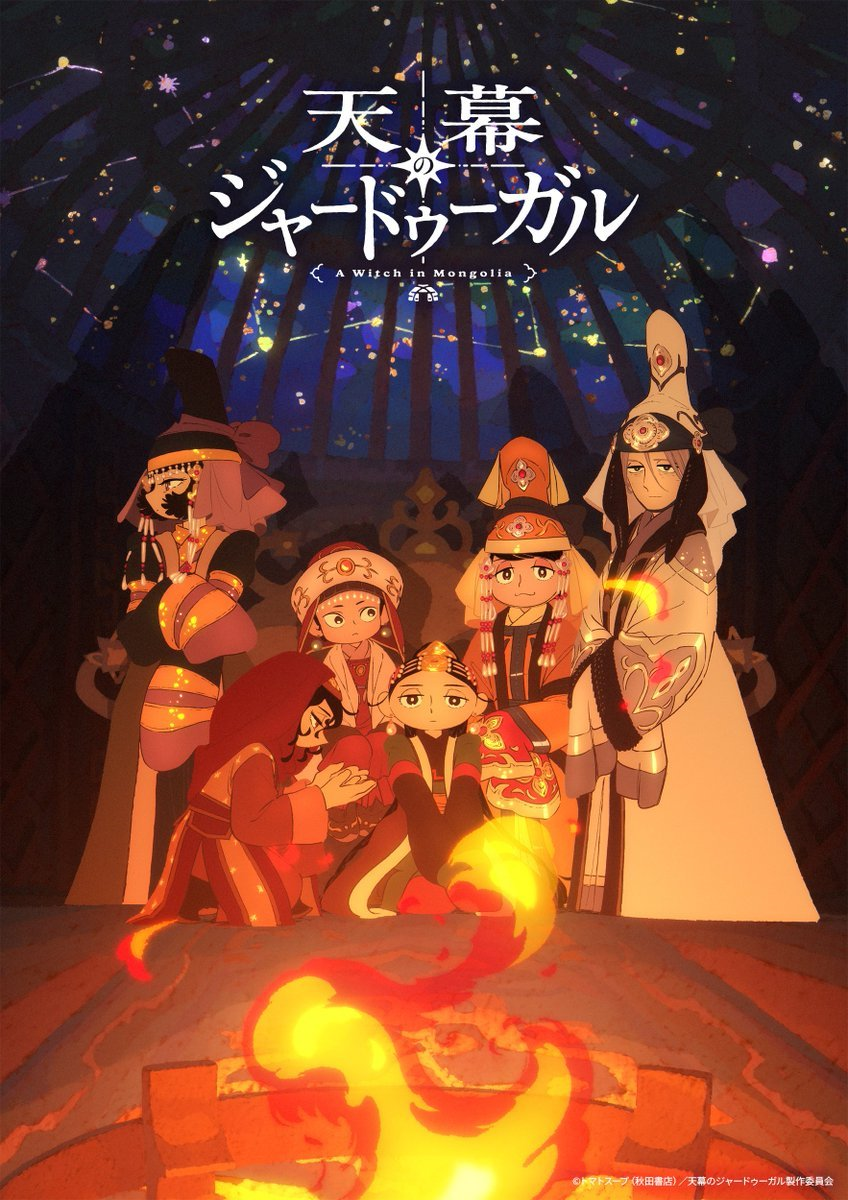
Summer 2026 might have been a record one in terms of high temperatures – but what about Summer Season anime? Did the two highly anticipated Science Saru anime, Jaadugar and The Ghost in the Shell, put the other contenders in the shade – or were there others that turned out to be equally memorable? The Anime UK News writers are back to share their verdicts with you… and maybe suggest a series or two that might have slipped under the radar.
Beloved studio Kyoto Animation returned to us this summer with Sparks of Tomorrow, a series 8 years in the making, based on a light novel written by Hiro Yuuki. Set in an alternative version of Kyoto where technological progress was delayed and people came to rely more heavily on steam power, we meet Inako Momokawa. She’s the daughter of a family that brews sake and she dreams of following in the footsteps of her late mother but often finds herself being lectured by her father and frequently visits shrines to pray to the gods for salvation. It’s on one such visit that she meets Kihachi Sakamoto, a boy who once dreamed of bringing in the age of electricity with his inventions and the help of his deceased older brother, Seiroku.
Time begins to move anew for these two, whose dreams had come to a halt after the passing of their loved ones. Inako wants Kihachi to follow his dreams, and Kihachi begins looking for the 20th Century Electrical Catalog that Seiroku carried around, as this is the key to helping him bring about the age of electricity. But he’s not the only one looking for it, as there’s also Yosuke, Seiroku’s former friend who clearly had strong feelings for him. And Yosuke is talented, rich and stubborn. He’ll do whatever it takes to claim the catalog for himself, regardless of Kihachi’s feelings on the matter.
Sparks of Tomorrow is a show that tries to be a lot of things. It’s ambitious in its setting, narrative and character relationships, and it doesn’t always pull that off. But there’s a clumsy charm to the whole thing, and if nothing else, I was eagerly awaiting every episode from week to week because the whole thing was so much fun. It’s a comedy but also a drama, and it walks the line between both incredibly well. Of course, it’s beautifully animated by the team, who often lean into exaggerated expressions to ensure there’s a light atmosphere. Both Kihachi and Inako have a lot of depth to them, and the series spends a great deal of time developing them, but that goes for Yosuke as well, who ends up in the position of antagonist.
Strictly speaking, Yosuke is not ‘evil’; he’s just overwhelmed with the grief of losing Seiroku. And that kind of grief drives people to extreme ends. Quite a few viewers felt that this was a show about capitalism and letting those with money and power take control of technology and perhaps even messaging about the usage of AI (to which I would like to remind people this book was written in 2018, which actively predates AI!). But my take was that this was a story about finding yourself after losing something important to you, about not letting go of your dreams and that you are capable of so much more than you think you are. Perfect for Kyoto Animation’s recurring themes, don’t you think? And more than anything else, it was tremendously fun to watch.
Back when we wrote our Summer Preview article, I picked Love Unseen Beneath the Clear Moonlit Sky as my hotly anticipated. Having been a fan of the manga and live-action adaptation, I had been eagerly awaiting the anime. And I have not been disappointed! Fair warning: this will contain some spoilers for the latter half of the series.
Across the series, we’ve been following the story of university students Kakeru Sorano and Koharu Fuyutsuki, who have built up a strong relationship. However, we come to learn that Koharu lost her sight due to cancer and the cancer unfortunately resurfaces toward the middle/end of the series. And this is where the careful balance of the series takes a turn, no longer focusing on the two as a duo but instead on their very different ways of dealing with the weight of such a horrific illness. Koharu chooses to push Kakeru and her friends away, pretending to have forgotten them. Kakeru, meanwhile, refuses to give up and continues to do his best to build a relationship with Koharu anew, encouraging her not to give up on living and to do her best so they can watch fireworks together.
Of course, having experienced this series in another form before, I knew about the twist going in. But I think many viewers were blindsided, since the narrative does a good job of hiding Koharu’s illness and history with cancer prior to the reveal. And with this shift in narrative focus, we lose some of what made this an appealing romance before. Mainly that Koharu had a lot of agency of her own but after the turning point, the story becomes a lot more about Kakeru, and that’s not always for the best. However, I do think this difficult subject matter is handled well. The anime team don’t shy away from showing the harsh realities of going through chemotherapy and the effect that it has on Koharu. But it’s not overly grim in how it shows this either; the team strikes a good balance, I feel.
Most of all I finished the series with a sense of satisfaction. This is one of those rare cases where the original work is only a single volume, which allowed the anime team to spend as much time as necessary slowly bringing it to life for TV. And that certainly paid off since it feels well paced. The ending may not be the outcome that you expect, either, so if you find yourself even a little bit interested in the premise, I’d encourage you to see it through to its conclusion.
Having enjoyed the manga forI Want to Love You Till Your Dying Day and been impressed by a celebratory PV when the anime was announced, I was very much looking forward to this project. And it certainly delivered!
The story is set in an orphanage/school in a fantasy world, where the orphans are taught magic and raised as weapons to be used in a war the country has found itself in. Many that are sent to the battlefield never make it home, and protagonist Sheena has gotten used to losing those with whom she shares classes. When the series begins, she’s just lost her roommate, and that same day meets Mimi, who later becomes her new roommate.
Mimi, we find out, is immortal. Sheena never has to worry about her losing her life on the battlefield, but that somehow makes it worse. Mimi has led a sheltered life due to having to keep her inability to die a secret, and she has no understanding of what it means to lose someone you love. Sheena wants to teach the girl what it means to be human, and somewhere along the way the two become inseparable, despite their very different outlooks on life.
Much like my other two picks for this article,I Want to Love You Till Your Dying Day is another series that’s dealing with loss. And I think the team at studio ROLL2 have done an excellent job bringing this one to life. It’s got a bright, colourful palette, which contrasts well with the darker themes and embraces the hopeful, optimistic nature of the young cast. There are some original scenes as well as things slightly moved around to flow better, and of course some absolutely terrific action scenes that are breath-taking to watch unfold. But perhaps what I appreciated most is that this is an anime with no intention of being overly grim or graphic with the violence. In fact, there’s only graphic detail a handful of times, in instances where it really intends to hammer home the themes. This is a team that acknowledges there is far more impact from letting the viewer imagine a situation than outright showing it.
Existing fans of the manga are sure to greatly enjoy re-experiencing the story through a new lens; I certainly did. And newcomers are in for a real treat as they get to enjoy the twists and turns for the first time. I really hope that once there’s more material available (this takes us to around Volumes 6 or 7) that there will be a second season.
Sparks of Tomorrow is available on Netflix, while I Want to Love You Till Your Dying Day and Love Unseen Beneath the Clear Moonlit Sky are both available on Crunchyroll.
Summer has now moved on (well it will when the weather turns), as has this anime season. I thought this was a pretty solid season in terms of what I watched, again leaning towards continuations with a handful of newcomers which bore mixed results from an enjoyment perspective. One title I very much enjoyed, The World is Dancing, seemingly never became available on HIDIVE for the UK, so I’ll give the passing comment that this was a great shame for an original highlight this season.
Hotly anticipated/(Sort-of) Returning Champion
The Ghost in the Shell gets another focus here, having concluded after ten episodes and completing the story of the original manga which inspired numerous adaptations later on. What kept this unique, as you’d expect, is that it sticks close to the manga and its execution, with more humour initially before packing a punch the further the series progresses, laying the groundwork for future storytellers to lean more heavily into the cold and often brutal cyberpunk attributes, and mostly stripping back the exaggerated expressions of Masamune Shirow’s 1995 manga, in favour of characters like the Major to be overall more stoic, but no less engaging and badass to follow.
I’m glad we finally got an adaptation like this, and even if a project isn’t always A-Grade, I’ll always welcome more Ghost in the Shell in an anime season.
Dara-San of Reiwa gets an upgrade to full Hidden Diamond status as, after 13 episodes of supernatural happenings and silliness, I found this to be one of the original highlights of the season. To recap, the premise deals with the supernatural as two siblings who live in a town in the mountains stumble upon a legendary half-human, half-snake creature from folklore. The demon, at least according to legend, curses anyone caught trespassing in the area, as she guards a shrine to the Yamatagi Madara.
In true anime fashion, the eccentric siblings, tomboy Hinata (Minami Tsuda) and the younger crossdressing scamp Kaoru (Momoka Terasawa) quickly befriend the demon, giving her the namesake Dara-San (Mutsumi Tamura), and gradually integrate her into their social lives and the modern world in general. Where this story succeeds is that it manages not to cause a clash of tones whenever we do see flashbacks of how Dara-San ended up the way she is; it’s handled seriously, but doesn’t jar when we resume the story in the modern world, especially as foes from the past come back to threaten Dara-Sans’ new friends. You could class this as an ecchi anime owing to some of the nudity featured, but there’s otherwise some oddly wholesome content amongst the comedy and supernatural shenanigans at play, and I’m glad I stuck with this to the end.
Grow Up Show: Sunflower Circus was a series that showed promise, detailing the story of a circus troupe struggling to hit it big, with its members dealing with their own dilemmas. In execution, however, I found it to be a bit lacking, namely relying rather often on still images, and sometimes montages to showcase their circus performances, instead of just letting it play out, that is until the final episodes wherein they performed a rendition of “The Wizard of Oz” and we almost saw it in its entirety, which was very entertaining.
I also personally found the cast a little forgettable, and the epilogue raised both eyebrows (no spoilers here), so all-in-all a bit of a mixed bag, and I’d sooner revisit say Kaleido Star than step back into the tent with this offering, which is perhaps a shame.
The Ghost in the Shell is available to stream on Amazon Prime Video, Dara-San of Reiwa and Grow Up Show: Sunflower Circus are streaming on Crunchyroll.
With only twelve episodes, Smoking Behind the Supermarket with Youwas never going to be able to adapt all nine volumes of the ongoing manga series – and yet I’ve seen commentators (yes, even a reviewer on that Other Site) expressing disappointment that forty-something salaryman Sasaki and his night-time smoking companion Tayama (aka supermarket employee Yamada) haven’t declared their unspoken feelings for each other and become an item. That would certainly have brought things to a close. But would it have done justice to the original manga? Hell, no! This manga is a very slow burn indeed and is all about the everyday, weaving in the lives of the people Sasaki and Yamada interact with. That’s what makes it so watchable. It’s difficult not to root for Sasaki and Yamada to get together and maybe one day Jinushi, the mangaka, will bring that to pass… but that’s not the way this manga works. For one, Sasaki has to learn that sweet Yamada-san and sexy Tayama-san are one and the same person – and then forgive her for deceiving him. (That might hurt his pride.)
If there have been any quibbles, for me they’re all to do with the way the adaptation has given greater prominence to Sasaki’s horrible work situation and Suzuki, his university friend, now fellow harassed employee at Genki Trading. Of course, Suzuki is there to show us what Sasaki’s life might have been (a wife who prepares his healthy bento lunches, a daughter, family trips and holidays). This would be fine except Suzuki’s Japanese VA plays up the loud, annoying qualities of the man (he uses a really irritating voice which is maybe supposed to be funny?) and a little goes a very long way. The other vocal irritant, sadly, is Obata, the young head of produce at the supermarket who thankfully doesn’t appear until Episode 10. I like Obata in the manga (gangling, shy, lacking in self-confidence) but, again, the Japanese VA has been encouraged to deliver all Obata’s nervous overreactions (he jumps at everything) at top volume. I had to turn the sound down. After watching anime for a quarter of a century, I can’t help observing that East and West do certain emotional reactions differently and Japan tends to favour loud raw sounds (including screeching) for shock, horror, pain, grief etc. which must surely do harm to the actors’ vocal cords and certainly upsets my ears. Luckily, the US dub is much more nuanced and is recommended!
However, these are small issues compared with the delightful and sometimes poignant way the interactions between Sasaki and Yamada/Tayama have been portrayed (and the mischievous delight supermarket manager Goto has taken in watching over them, not to mention teasing them both as well). There might not be a conventional ‘happy-ever-after’ ending but this is slice-of-life and it’s rare for such things to happen so conveniently in real life. I know which version I prefer.
Another episode which captures so well that feeling of coming to the end of school days and the close companionship of your classmates which may/will never be repeated is #10 when all the friends begin to gather to share drinks and snacks in the classroom after lessons. It’s a very simple and low-key celebration but you can feel the vibes of genuine friendships that have developed over the years. It’s the kind of situation that other series often gloss over but here it’s given prominence and it really counts – and how different from other high school series that are too keen to give us over-hyped drama, relationship crises and testosterone-fuelled aggression. It’s delightful to watch as we’ve had many episodes to get to know these high schoolers, their friendships as well as their budding romantic relationships, and this shows us why it’s been such a relatable series.
Hopefully, no longer a Hidden Diamond, and renewed for a well-deserved second season, Draw This, Then Die!has gone from strength to strength in its depiction of one high school girl’s love of manga that leads to many life-enhancing experiences and friendships. But it doesn’t sugar-coat what it means to move from loving to read manga to creating it yourself – far from it! Some of the most painful scenes depict the sheer hard slog that mangaka and their assistants have to go through, only to have their work pulled apart and even rejected by editors.
But under the watchful eye of stern Miss Teshima, the manga club is flourishing on the island and when a club trip to Comitia takes place (they go by ferry) the girls work really hard to make the manga they’re going to try to sell there. Miss Teshima, of course, has turned out to be the mangaka of Ai’s favourite manga ever, Roboto and Pokota, and interspersed with the girls’ club activities, we see what a desperately hard time she had as a young aspiring mangaka to get anything published. Some of the most fascinating scenes are where she goes to act as an assistant to hugely successful mangaka Hebichika-sensei (notice the ‘snake’ in her name). The assistants work all the hours and then some – and in return, Hebichika deigns to look at Teshima’s work and offers blunt criticism. The anime never pretends anything other than that young Teshima is probably her own worst enemy, driven to make manga yet not always ready to take on-board the professional advice given to her time after time. This clever intercutting between young Teshima’s struggles and the firm yet fair advice the older (and wiser?) Teshima-sensei gives her eager young charges is fascinating to follow. She’s given up making manga to become a teacher – but will she feel able to take up her pen once more, inspired by her students’ enthusiasm and energy?
But as this is anime, some of the best moments are where the girls’ manga comes to life or they voice the soundtrack for the black-and-white images themselves (Episode 12 boasts an especially impressive sci-fi opening). And the scenes in which the colourful manga drawn by the fourth member of the group, the highly unconventional Hikaru, are brought to life in Episode 10 – and which well might be a story metaphor for her highly unconventional upbringing – are a delight to watch and unpack. What kind of family background could Hikaru have come from to produce such disturbing yet compelling story-telling? The answer, when it comes, certainly made me gasp out loud! Everything works well in this series: the voice acting, the music, the glorious background art of the island and, of course, the characters themselves. It certainly repays viewing more than once as there’s so much packed into these twelve episodes.
Smoking Behind the Supermarket with You, Draw This, Then Die! and You and I Are Polar Opposites are all streaming on Crunchyroll.
The BanG Dream! franchise has been putting out some excellent hits as of late ever since it reinvented itself with It’s My Go!!!!!, and in BanG Dream! Yume∞Mita, it turns its focus onto the VTuber trend as it shows the forming of virtual band Mugendai Mewtype.
The story revolves around main character Arale Nakamichi, a girl who used to be in a band but after a certain incident found herself bullied out of it by another girl, Viola. The incident damages Arale’s self-confidence, yet after posting some covers of songs from her favourite magical girl show, she ends up being picked up for this new band that uses virtual avatars.
Things start to go awry when she bumps into her old friend, Ritsu, who is still in their old band with Viola, who has her fingers neatly wrapped around her and the other band members. Arale wants to save Ritsu from Viola’s clutches but doesn’t know how, and Viola is determined to make Arale’s life a misery once again now they have reunited.
I’m going to put this up front because I think this is where the show gets a lot of its direction wrong – BanG Dream! Yume∞Mitais heavily inspired by the happy-go-lucky, everything will be alright at the end stories that make up children’s magical girl shows like PreCure. Yet instead of taking them as inspiration, the show feels like a parody.
At its core, the show wants to find a balance between the darker trends the franchise has been on and the lighter, cuter one set by its inspiration. You’ve got a story about victims rising up against a bully and taking her down a peg, all the while reuniting old friends and making new ones. On paper this sounds great, but in practice the show isn’t as nuanced as it should be and produces a childish good versus evil storyline with thin, one-dimensional characters that fit very strict character archetypes.
The writing oversimplifies and trivialises the conflict, while the spoken dialogue is especially grating as everyone is so sugary sweet towards each other. Yes, there is a sense of everything being fake that I think it’s trying to convey, but it goes too hard in on the concept. There are some good moments in here that go against the grain, like when Miyako blows up against the rest of the group, and seeing each of the girls eventually being accepted for who they are, but I think a lot of what the show has to offer is overshadowed by the single-minded focus on Viola. Ultimately, the pantomime villain becomes the show’s downfall.
There is also a real lack of music in here as most of the focus is on the drama, so it even fails at its main purpose of selling you the band. Several of the franchise’s bands I got into was because the anime gave them cool musical performances, but here I don’t get to have that same avenue to make that connection. My main impression is that they are all kind of annoying and have lots of baggage?
I don’t know. Honestly, I think there was a good idea and good intent in making the show, but the execution has fallen so far off-base that I’d be hard pressed recommending this to anyone whether they were a BanG Dream!fan or not. Definitely check out the rest of the franchise as it has so many great moments but maybe give this one a pass.
In what really was a surprise, Young Ladies Don’t Play Fighting Games came out on top as my favourite show of the season. In our season preview I compared it favourably to Rock is a Lady’s Modesty and I think it tracks along with that, hitting similar notes but doing it in slightly different ways.
The series essentially splits itself into two halves, and while both are great, they each have a very different feel. The first plays more as a slice-of-life show, showing the girls goofing off and taking the time to build the character relationships and establishing the different dynamics around the main cast. What I loved about this is that it’s really good at showing why this group of unlikely friends comes together around a shared love of Street Fighter, as each character has their own different circumstances. Aya tries to deny her nerdy side and become someone else but quickly learns you should just be yourself; Mio is rebelling against her strict parents; Tamaki has a fraught relationship with her older sister; Yuu grew up with the game and is mainly in it for the fun.
There are some great moments as they battle each other in the dorm at night and train to use certain techniques, but it can only take this so far as there is really nothing else surrounding it. It’s not quite as light and breezy as some school club comedies as a lot of the talking is done through the game itself as you see them battle each other. So, the natural way to take this forward is to put them into an actual competition where they go to Evo Japan.
Now, this is where the show really flies and goes absolutely nuts as it puts them in competition with some hardcore players, namely middle-schooler Arisa and the pro gamer duo of Gekido and Cafeore. The fights involving the latter two are fantastically fun as they’re basically these two delinquents who not only hurl insults at each other but severely underestimate how good Aya and Mio are when they go up against them. But when a switch is flicked, the show ramps up the intensity and leaves you on the edge of your seat because you don’t know who will win. Of course you’re probably rooting for the main characters, and seeing Aya and Mio struggle to overcome their opponents is frantic and thrilling.
I really liked Arisa’s arc as well. She initially goes in all guns blazing on the girls in a very gatekeeper-y way, yet while you’re meant to initially dislike her, the show opens her up across the second half as you see into why she became that way. It takes a fight with Mio to actually make her understand that the game isn’t just about winning – games are about having fun too! It does end on a bit of a damp note as we don’t fully get to see what becomes of Aya’s newfound jealousy over Arisa and Mio’s butting of heads, but overall, this was an absolutely fantastic and exhilarating watch.
There is probably less here for non-fighting games fans but just think of this as a sports anime and you’ll probably enjoy it fine. If you are a fighting game fan though, I think you’ll absolutely love this, and it serves as a perfect warm-up for the new live action Street Fighter movie coming into cinemas later this month.
BanG Dream! Yume∞Mita and Young Ladies Don’t Play Fighting Games are both available on Crunchyroll.
While going through something of a turbulent time in my life, I missed out on quite a bit this past Summer season and typically the one thing I made sure to watch every week had its last two episodes delayed by a month, so I can’t even technically talk about it definitively here, but let’s take a look of what aired at the very least. Bleach: Thousand Year Blood War: Part 4 finishes up the adaptation of the final story arc of the Bleach manga, though really that would be doing it a disservice as the sheer amount of brand-new content added by original author Tite Kubo makes this feel more like the definitive and “actual” end to the series he wanted, or at least wants now in retrospect. While some of the smaller events were only briefly touched up, the fight between good guy Quincy Uryu Ishda and bad guy Quincy Haschwalth was greatly expanded, but not as much as the big final showdown between our main protagonist Ichigo, his best friend/love interest Inoue Orihime and the main antagonist of the arc Yhwach. This was never more apparent than in Episode 45.
Nearly 30 minutes of almost entirely new material, the episode showed Ichigo gain an entirely new form and go on the attack but also showed Orihime, who has spent the vast majority of the series too timid to really get involved and chastising herself for her own weakness, not only go through hell to keep healing Ichigo but at the end of the episode gain new power herself and nearly sacrifice herself to successfully defeat Yhwach in one fell swoop. It goes without saying that it didn’t work, but it was a pretty stunning episode of anime nonetheless, both manga readers and anime watchers alike were watching with mouths open, helped by the episode having an even higher animation quality than we already normally get. After that, we’ve switched between having a bit of manga adaptation and a bit of new material, then an episode of entirely new story (though that calls back a little to the light novels “Can’t Fear Your Own World”, which was nice) and then ending with a mostly manga-adapted episode, which sadly meant fan favourite (and personal favourite) villain Sosuke Aizen didn’t get any extended scenes… so far anyway!
With two more episodes to go and only a handful of manga pages left to adapt, I’m looking forward to the new ending Kubo has cooked up, and if he and the animation team thought they needed an extra month to make the episodes of a similar quality to #45 then I’ll happily take the extra month of waiting and a somewhat awkward Summer Overview entry.
Bleach: Thousand Year Blood War is available on Disney Plus.
(Not So) Hidden Diamond – Jaadugar: A Witch in Mongolia
This was easily one of the best anime seasons in a long time. I ended up watching more shows in these three months than I typically do across a whole year, and there are even some on my watchlist that I have still to get to. However, each Saturday, there was always one anime that I always eager to dive into first: Jaduugar: A Witch in Mongolia.
Produced by Science SARU and helmed by both Naoko Yamada and Abel Góngora, the series quickly grabbed my attention with a premise that explored a region and history rarely touched by anime: ancient Persia, and the rise of the Mongol Empire. The series follows the slave Sitara (who is mostly known, and will be referred to henceforth, as Fatima). When Fatima’s way of life and those she saw as family were all ripped away by the Mongols’ savage conquest, she found herself forced into their servitude. However, Fatima once delighted in the pursuit of knowledge, and sets her sights on using that to bring down the Mongols from the inside.
Over the course of a 12-episode season, countless anime ebb and flow in quality, but Jaadugarremained consistently great – to the point that my editor and I even briefly wondered if we’d have anything more to add beyond just repeating our calls for everyone to watch it. However, the second half of the series is really where the gears of Jaadugar started turning, even if we haven’t seen the full extent of the machine yet.
Working her way into the Mongols’ inner circle, Fatima finds herself an unlikely ally in Princess Töregene, the sixth wife of Ögedei, who succeeds Gengis Khan as ruler of the Mongol Empire. Töregene is a tragic and fascinating character who doesn’t find solace in her position, but instead carries bags under her eyes from the years spent staring daggers into the people who took her own life away. Töregene is herself a victim, and recognising the pain of those she loved in the face of Fatima, the two pledge to one another that using her status and Fatima’s wits, the two will summon a storm. What I loved most about Töregene, though, wasn’t the role she played in Fatima’s at times over-eager manoeuvring towards revenge, but the quieter moments suggesting that, more than an ally, what Töregene really wants is a friend.
The wider cast of Jaadugar also grew as the series went on, where I found a particular soft spot for Möge, formerly a concubine of Gengis Khan, and later Ögedei (yes, we will just sidestep that because it’s history). Möge has a large head but clearly nothing in it, being far too trusting in a world with skulduggery all around her, leading to one the most widely circulated moments in the series where, after after being discovered where she shouldn’t be, Fatima is left bemused by how clueless Möge is. She’s just precious. Although, the same can’t be said about her close ally Boraqchin.
One of the most influential figures of the Mongol Empire and referred to with the title Great Khatun, Boraqchin was the second wife of Gengis Khan, and is now the first wife of Ögedei (again, history). Initially introduced as a sickly figure, it soon becomes clear that Boraqchin is an incredibly shrewd schemer. In the original Japanese version she is voiced by Kujira, who is most well known for Orochimaru in Naruto and Man-God in Mushoku Tensei: Jobless Reincarnation, if you want an idea of the kind of presence we’re dealing with. With Fatima so assured of her own intelligence and ability to manipulate people with a smile, I vividly remember the mix of excitement and dread at one particular cliffhanger, where it was revealed that her attempts to twist Boraqchin had landed Fatima right into her hands instead.
My one issue with Jaadugar is that it had to end. That might sound like a cliché, but while I enjoyed these first twelve episodes and strongly recommend them, it feels like the goal was to assemble all of the pieces for a grand political game that’s about to start. So, without confirmation of a second season, I suppose for now I’ll just have to read the manga to find out more.
Hotly Anticipated: Kaiju Girl Caramelise
Going into this anime season, Kaiju Girl Caramelise was the show that I was looking forward to the most. A big reason was my personal attachment to the original manga, as I adapted its first volume into a short film screenplay back at university. The series also has a rare premise where you could turn heads with a simple longline – a high school girl who turns into a kaiju when she’s flustered! However, even the most novel of ideas is only as good as its execution and as the weeks went on, I found myself feeling less urgency to watch each new episode.
With much of the cast established as of the episodes covered in our Summer Preview, the biggest question on my mind was whether the series would keep momentum, or if the formula would grow stale as Kuroe continued to transform into Harugon, with her golden retriever boyfriend Minami being none-the-wiser. Fortunately, the series alleviates those concerns for the most part with a natural progression to multi-episode storylines, such as Minami forming his own unique connection with Harugon after media coverage of their encounters (and a scheming TV producer) elevate him to the unwanted status of a minor celebrity. After finding Minami a bit too bland at the start of the series, I think that taking advantage of his trusting nature and thrusting him into the more distrustful media landscape was an inspired idea.
The execution felt wanting, though, with it largely being used to create the usual misunderstandings between Minami and Kuroe, including the introduction of a potential love interest for Minami who just ends up underdeveloped and one-note. Honestly, when Seina was still with the supporting cast during the climax, I couldn’t help thinking of those “bro thinks he’s on the team” memes.
The series also took swings by delving into the origins of why Kuroe is the way she is, including a delightfully ridiculous scene where her seemingly ditzy mother Rinko pulls out a gun (honestly, I love it when absurd things are played straight). This also sets up a series climax that leans more into the kaiju inspiration by pitting Harugon/Kuroe against a new threat.
While I adore Kuroe herself and am invested in seeing her happy with Minami, I found my patience tested with the supporting cast around them. Maybe I’ve just outgrown the more hyperactive energy of comic relief characters, but I found the more slapstick nature of Kuroe’s kaiju fangirl friend Manatsu exhausting in particular, and although I appreciated her storyline, the repeated gorilla gags with Rairi felt like that one friend who keeps repeating jokes that weren’t especially funny the first time.
I think that my issue with Kaiju Girl Caramelise is that the ideas are definitely there, and the series has aspects that I love a lot (notably Kuroe herself), but they all come together for an end result that is just okay. The series isn’t bad by means, but I can’t help but think of how it could have been better. Without saying too much, the series does end in a way that makes me curious about it handles what comes next, so I might have to catch up with the manga.
Well, there has certainly been no shortage of opinions about Goodbye, Lara shared on the internet. Back at the start of the season, I wondered whether this retro-styled little fish-out-of-water romance would find an audience, and it did with yuri fans yearning for more representation of Girls’ Love in anime. However, for many of those fans who I saw discussing the series and sharing clips on my feeds each week, the series’ ending clearly didn’t hit the mark. With all the memes circulating, I wouldn’t blame you for thinking that it was a Wonder Egg Priority level disaster, but at the risk of inviting their pitchforks myself, I think that the reaction has been overblown. I understand a number of the issues people had, but Goodbye, Lara remained a charming favourite of mine this season.
To briefly recap, the series centres around Lara, a young mermaid who after growing curious about humans, drank a potion so she could gain the legs to walk among them – with the condition that its effects will cease if she fails to find true love. When her human prince witnesses Lara’s true form and rejects her, she is turned to foam. Resurrected two hundred years later, Lara learns that her kingdom is in ruins and her family in a deep sleep, with the only way to save them being to find the light of true love.
Much of the series’ appeal came from the growing bond between Lara, and the tomboy boxer Mari, who Lara literally crashes into on her return to the present-day service. While Lara is a precious bumpkin, Mari seems more standoffish at first, but clearly harbours a sweet spot for Lara. The relationship between these two really was the narrative and thematic core of the series, so how it was handled was always going to be make-or-break for the series. It’s really hard to elaborate further without diving deep into spoiler territory, but at times Goodbye, Lara can be bold enough to declare “Live for love, not the laws” while being made in a country where same sex marriage still isn’t legal, yet also not commit to anything overt. The surrounding discourse reminds me of Symphogear XV, which ended with Hibiki and Miku hand-in-hand, and cutting to the credits right before a verbal confession could be spoken. I always maintained that a verbal confession or on-screen kiss wasn’t necessary because their love for each other was so obvious, but especially when LGBTQ+ representation in anime is still far behind even its sister medium manga, I understand how appreciated it might be here.
For me, the biggest issue with Goodbye, Lara was that it simply wasn’t longer. I appreciate that an original 2-cour show would be a hard ask in this economy, but the series really could have used more episodes to flesh out some of its ideas and bring more concrete conclusions to a number of plot threads. I would have even just liked to enjoy more slice-of-life moments with Lara and Mari between the more plot-heavy beats. Still, I’m grateful for the twelve episodes that we did get, because Goodbye, Lara was a unique, and utterly charming show. My only advice is to go in not expecting a revolutionary, overt romance, but more a classic tale spun into a coming-of-age story.
All that said, despite it not being a show that I highlighted myself, I have to agree with Onosume that Young Ladies Don’t Play Fighting Games ended up a real highilght of the season. I just have to respect how ingenious the adaptation was with incorporating Street Fighter 6 and the real fighting game pro scene, and I also just love full-throttle, earnest idiots.
Jaadugar: A Witch in Mongolia, Kaiju Girl Caramelise, and Goodbye, Lara are currently streaming on Crunchyroll.
Sarah
Sarah’s been writing about her love of manga and anime since Whenever – and first started watching
More posts from Sarah…
Demelza
When she’s not watching anime, reading manga or reviewing, Demelza can generally be found exploring some kind of fantasy world and chasing her dreams of being a hero.
More posts from Demelza…
Cold Cobra
Having watched anime since it was airing late night on the Sci-Fi channel in the late 90s, I consider myself… someone who’s watched a lot of anime, and then got hired to write reviews about them. Hooray!
More posts from Cold Cobra…
HWR enjoys anime and manga alongside a love for film, gaming, Classic Doctor Who and electronic music from the likes of Depeche Mode and more.
More posts from HWR…
Onosume
With a chant of “Ai-katsu!”, Matthew Tinn spends their days filled with idol music and J-Pop. A somewhat frequent-ish visitor to Japan, they love writing and talking about anime, Japanese music and video games.
More posts from Onosume…
Josh A. Stevens
Reviewing anime by moonlight, working in film by daylight, never running out of things to write, he is the one named Josh A. Stevens.
More posts from Josh A. Stevens…

1 Comment
Pingback: ‘It’s Almost Not Worth Being Number Two’ – How Live-Service Turned Games Into a Battle Royale for the Top Spot - Comic Vibe