

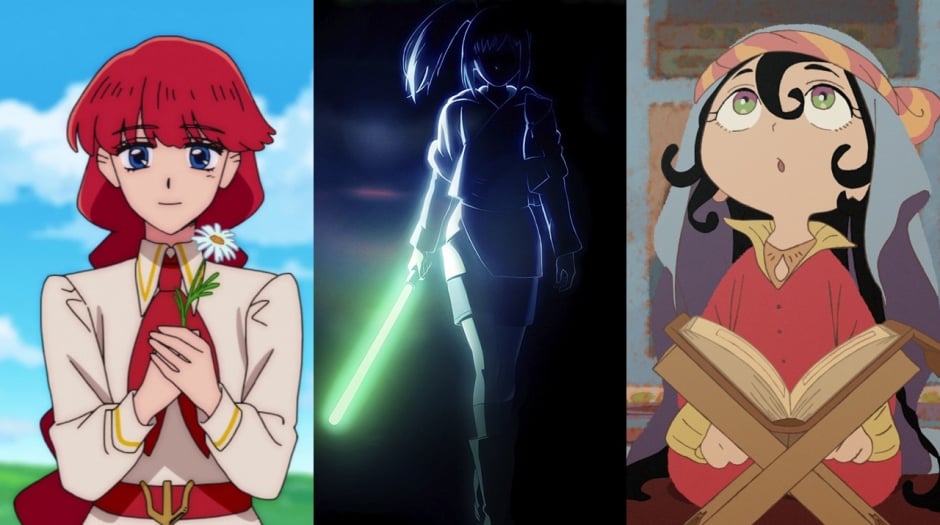
Columnist Andrew Osmond looks at 3 new shows: ‘Star Wars: Visions Presents – The Ninth Jedi,’ streaming on Hulu and Disney+, and the serials ‘Goodbye Lara’ and ‘Jaadugar: A Witch in Mongolia,’ both on Crunchyroll.
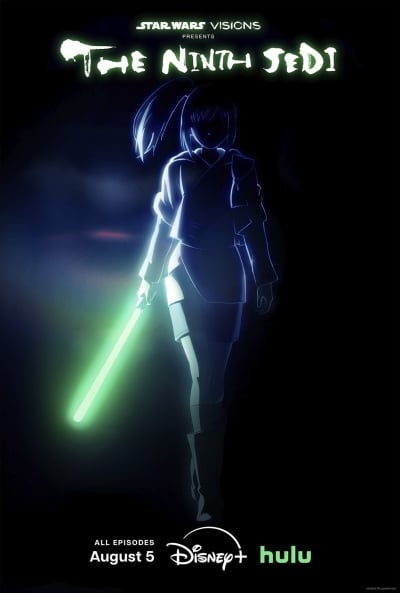 Star Wars Visions Presents – The Ninth Jedi (Disney+/ Hulu)
Among anime, this spinoff from a spinoff got most attention last week (its eight episodes all dropped last Wednesday), with much of that attention coming from outside anime fandom. In such ways it’s an important series, but it’s the least interesting of the three anime I’m covering this time.
It’s spun off from the anthology series Star Wars: Visions, which involved multiple anime studios (I reviewed Season 3 last year). Made by the Production I.G studio, The Ninth Jedi continues a story begun in a first season Visionsepisode, which wasalso called “The Ninth Jedi,” and followed up in a third season episode, “Child of Hope.” Like them, the new series follows the Force-talented girl Kara and her desperate search for her father, a forger of lightsabers. The adventure takes place in a turbulent universe without any all-powerful Empire or Republic. A new warlord is on the rise with a galaxy-scourging weapon, though it’s a bit different from those we’ve seen before.
As with the other Visions stories, the series is a “non-canon” Star Wars. That means it doesn’t have to fit anywhere into the films’ timeline, while it can still echo those films at every turn. Kara’s story has overtones of more than one of Star Wars‘ Skywalker heroes as she passes through doubt, loss and rage, hopefully to something better. There are familiar lines of dialogue and battles and backdrops; a verdant planet is pretty much Endor, but with the Ewoks switched out for bipedal platypi. There are episodes called “A New Threat” and “The Jedi Strike Back.” The music, by Nobuko Toda and Kazuma Jinnouchi, is relentlessly true to the John Williams house style.
I was bored for too much of it. The early episodes feel overwhelmingly like the ’90s prequel movies: the same turgid pacing, undramatic battles, and characters that are action figures, like Buzz Lightyears in search of sapience. (I’m normally forgiving of limited animation, but after a while I started to fixate on the characters’ eyes, blank and fixed.) At worst, I was reminded of one of the classic “geek” critiques of the prequel films, made by Mike Stoklasa (“Mr. Plinkett”) in his feature-length YouTube screeds. His challenge: try to describe one of the charactersas a character, without describing their appearances or professions.
Of Kara’s two earlier exploits in the Visionsanthology, the first got by on zippy fights and twists. The second told a moderately touching tale about a grieving droid, though with little room for action. With its longer format, the new series might have combined the virtues of both. Instead, it feels enervated, as if drained by the black hole round which the first skirmish is fought.
The series looks decent, but if anything that adds to its airless sterility. I often found myself looking at alien cities or landscapes with the same sense of non-immersion that I had from the greenscreens of Phantom Menace. The anime only starts to come “alive” with a flashback duel in Episode 3; this is framed as a tragic event, but has the swashbuckling flair that we’ve been waiting too long for. From then, the animated action livens up, but only gradually. There’s nothing else on the same level till an extended berserk battle in Episode 5, more than halfway through the series.
That’s followed by numerous good action moments till the end, but they don’t rival, for example, a cyborg woman tearing into a tank in Ghost in the Shell (the film). That was animated 30 years ago by The Ninth Jedi‘s studio, Production I.G. But then I.G also made a more interesting Hollywood spinoff than Ninth Jedi just two years ago. Terminator Zero on Netflix had undercooked action but good ideas, having fun with the Terminator movies’ spaghettified “canon.” It didn’t have a proper ending, though, whereas Ninth Jediseemingly wraps up everything… till a head-scratching coda, apparently designed for “What did thatmean?” sites. (The coda reminded me slightly of the ending of a film by Ghost‘s director Mamoru Oshii, though I won’t say which.)
Does Ninth Jedisubvert its own franchise? Perhaps: the series makes much of the iconic lightsabers’ colors, which can change for their wielders in ways confounding Star Wars’ usual lore. Fans of anime sci-fi might think of a series that’s most unlike Star Wars, the gory Psycho-Pass, where people’s crime tendencies are color-coded in a comparable way. The Psycho-Pass franchise was mostly animated by Production I.G too.
Ninth Jedi also softens what Star Wars fans expect to be killing blows with lethal weapons, whether aimed against people or planets. Maybe it’s a sign of Ninth Jedi‘s Japanese origins. In the original Star Warsfilm, a whole planet populated by millions of people was destroyed and forgotten in two minutes flat, a scene which might play differently in the country of Hiroshima and Nagasaki.
The series’ director is Shunsuke Tada, who previously helmed Production I.G’s 2010s sports series Kuroko’s Basketball. However, the writer and credited “Chief Director” is Kenji Kamiyama, director of Ghost in the Shell: Stand Alone Complex, Eden of the East(which I covered here) and the recently-announced next Gundam series, due next year. Of Kamiyama’s works, I likedNinth Jediless than his own previous Hollywood spinoff — the cinema film The Lord of the Rings: The War of the Rohirrim, made by Sola Entertainment.
It’s mermaids again. They’ve made regular appearances in anime through the decades, including such films as Hayao Miyazaki’s Ponyo, Masaaki Yuasa’s Lu Over the Wall and last year’s ChaO by Yasuhiro Aoki. All three had meetings between humans and mermaids, as did the enjoyably sinister TV series The Monster Wants to Eat Mewhich Icovered last December. Alas, there’s no word of a continuation of the latter. As with so many TV anime these days, it looks like you’ll have to read the ongoing comic to find out how the story ends.
That hopefully won’t be an issue with Goodbye, Lara, because it’s an anime-original story. It’s unusually accessible to Western viewers, taking its lead from the most famous mermaid tale of all. Episode 1 adapts Hans Christian Andersen’s “The Little Mermaid,” a little more faithfully than Disney. Lara is the mermaid’s name this time (Andersen didn’t name her). As in Andersen’s story, she falls for a human prince, then strives to become a human to be with him.
The episode’s downbeat end is different from Andersen’s, though again it’s closer than Disney. Her romantic dream shattered, Lara dissolves into foam… only to be resurrected centuries later, in 2026. She’s told that her actions have brought calamity on her people, and that the only way to restore them is by succeeding where she failed before and finding true love in the new world. So, she’s blasted back to the surface — a thrilling moment — to contend with modern Japan. (For anyone wondering why Lara’s in Japan now, given her previous adventure was in a standard fairy-tale Europe, that’s kind of explained eventually.)
In short order, Lara’s taken in by a human girl, a pugilistic tomboy called Mari who’s an aspiring boxer… and yes, that’s as odd a story turn as it sounds. To add to the oddness, Mari possesses a haughty pet fish which turns out to be from Lara’s world. If you remember the story, then she’s the sea witch who turned the mermaid human in the first place. No, she can’t compete with Ursula, the drag queen Disney star voiced by Pat Carroll, but this witch is entertaining nonetheless, voiced with tart relish in Japanese by Rika Fukami, also a dub actor for Julia Roberts, Angelina Jolie, Sharon Stone and more.
Despite the culture shocks of the 21st century, Lara continues searching earnestly for “true love” to the bafflement of those around her, with vibes of Anna in Frozen and Amy Adams’ Giselle in Enchanted. Of course, a large part of the audience will have decided immediately who Lara’s true love is, and they’ll only find that confirmed by Mari’s stand-offish attitude to this perplexing, endearing girl. There are other story strands — for example, there are more people from Lara’s world in Japan — but they take time to connect.
The quirky narrative shares elements with the recent Cosmic Princess Kaguya!, which I covered in May. Both take otherworldly heroines from fairy tales and transport them to modern Japan, where they meet “ordinary” girls and the stories head off in unforeseen tangents. Cosmic Princess Kaguya!, though, was largely comedic. Goodbye, Lara is straighter, especially in Episode 2, where Lara first confronts the modern world. You’d expect that to be comedy, but instead the tone is agitatedly off-balance, even nightmarish, thanks especially to Yuma Yamaguchi’s skillfully needling music. At one point, Lara tries to enter the “sea” — actually Lake Biwa near Kyoto — and is horrified that she can’tbreathe underwater, which I haven’t seen in any previous mermaid story.
In honesty, my interest diminished after Episode 2, once the nightmare urgency gives way to something gentler, but it’s picking up again as of writing. Urgent or not, it’s an eye-catching series, animated by Kinema Citrus, which also makes the lavishly disturbing cartoon fantasia Made in Abyss. Goodbye, Larahas some of the same ambition. It’s not cinematically beautiful like this spring’s Witch Hat Atelier, but there are moments of elemental power.
They include Lara erupting from the depths in Episode 1, an exquisite rainstorm in Episode 2, a furious girls’ boxing match in Episode 3. Episode 5 depends less on highlights than on a clever story where Lara works at a cake shop, caught between the demands of the arc plot and the mundanity of day-to-day life that anime has long celebrated. The latest episode I’ve seen (6) brings back the drama. A seemingly self-possessed character sobs like a child as she faces death in the dark. She’s part of a new plot strand that’s far from Disney musicals.
Then again, Goodbye Lara‘s first episode is worth watching by itself for its fusion of sources, with echoes of both Ponyoand Disney’s Little Mermaid — Lara’s red hair and mer-tail links her to both. (Like the Disney film, Goodbye, Laralays much stress on Lara’s conflict with her royal dad, who was barely in Andersen’s story.) Episode 1 also hints at shocks to come. In the first moments, a fish swims carelessly into baby Lara’s mouth and is chomped in half. Crunchyroll, take note, has rated the series “14+” so it might know something about the upcoming episodes that we don’t.
In my last column, I commented that fans can navigate anime by following their favorite directors, writers or animators. I forgot to add studios, such as Ninth Jedi‘s Production I.G and Goodbye Lara‘s Kinema Citrus. One studio that I’ve followed myself since starting this column is Science Saru, the most cheerfully cartoonish of anime’s purveyors. I profiled Saru in one of my first columns and followed its new releases: the hit DanDaDan (returning next year), the alt-Christmas tale Sanda and the current The Ghost in the Shell, not to be confused with Production I.G’s version.
Jaadugar: A Witch in Mongolia was a title that at first I thought might be a milestone, not just for the studio but for anime generally. The opening minutes break fully with any expected “style,” evoking Cartoon Saloon and Thief and the Cobbler, as a girl scurries up the steps and through the walkways of an ancient Persian city. A caption proclaims this is 13th-century Iran. Some critics might object that the name is anachronistic (it’s complicated), but this series is steeped in authentic-seeming detail.
The girl protagonist is introduced as Sitara, though she’ll go by Fatima later. A slave, she’s bought into a Persian family, but that’s only the start of her reversals of fortune, some shockingly harsh and traumatic. This is yet another anime that looks like a cute kids’ cartoon but isn’t. There’s a particular moment that could be captioned “safety bars down,” where a loveable character is struck down in a blobby eruption of blood. It’s the kind of blood you could find in a Cartoon Saloon film, if Cartoon Saloon went R-rated.
The girl’s city is sacked by all-conquering Mongols with none of the scruples of Matt Damon in this summer’sOdyssey. Our heroine is named Fatima by the time she’s brought to the Central Asian plains, where she’ll spend years among the forces assembled by Genghis Khan. That warlord’s own appearance is so fleeting it feels like a black joke; he’s a mostly off-screen earthquake of history, a bloodier analog of Christ in Ben Hur.
The series is spreading as of writing, with more characters and involved intrigues. But I hope it keeps sight of one of the main motifs in the early episodes: the smiles of girls and women. This motif stems from a scene in Episode 1 that shocks on first viewing, where the protagonist and her fellow slaves simper cutely at the Persians who’ve come to buy one of them. The point, though, is that the smiles are masks for their wearers’ suffering and fury. It’s feminism with teeth, doubly so in anime.
A Witch in Mongoliahas two directors attached. The Spanish-born Abel Góngora worked at Cartoon Saloon before moving to Saru, where his credits include directing Scott Pilgrim Takes Offand co-directing DanDaDanSeason 2. Meanwhile, Witch‘s “Chief Director” is the feted Naoko Yamada (albeit without her usual writing partner, Reiko Yoshida). When it comes to the smile motif, you might link it to the deaf heroine in Yamada’s film A Silent Voice, whose piteous smile was a desperate defense against her relentless bullies.
Over its first seven episodes, my feelings about Witch have oscillated between excitement and disappointment. Both the narrative and the visuals can be electrifying, charming or indifferently flat. In Episode 1, the joy of the opening dissipates after a couple of minutes, though the Arabic furnishings delight the eye, as in Thief and the Cobbleror Cartoon Saloon’s The Breadwinner. Episode 2 riveted me with its sheer cruelty. Episode 6 is an excellent self-contained story that parallels and diverges from the main narrative. Its most ravishing scene shows the vision of a tribal shaman as light breaks upon him.
The other episodes can be trying: the over-cuteness of some images, the times when the narrative gives way to a 13th-century travelogue-cum-illustrated history. The Central Asian steppes are represented with soft hues and abstract shapes, but they sometimes look dun and dowdy. Visually, I find the “cartoon drama” aesthetic less impressive than that of another anime, Studio Wit’s 2021 fantasy Ranking of Kings (trailer), which also evoked a darker Cartoon Saloon. Witch‘s story also sometimes parallels (though never derivatively) the Viking anime Vinland Saga, which at least began at Studio Wit.
But I’ll end by noting that another anime creator told a harsh story of Central Asia, sacked cities and traumatized youngsters. This wasn’t an anime, but a comic called People of the Desert, published from 1969-70 in a periodical of the Japanese Communist Party. It may have been the first solo professional work by its author, who wrote it under a pseudonym when very few people knew his real name: Hayao Miyazaki.
Andrew Osmond is a British author and journalist, specialising in animation and fantasy media. His email is [email protected].
Tags
It’s Anime-zing!
Summer 2026 anime
Star Wars: Visions Presents – The Ninth Jedi
Goodbye Lara
Jaadugar: A Witch in Mongolia
Star Wars: Visions
Star Wars
Production I.G.
Kinema Citrus
Science SARU
Kenji Kamiyama
Shunsuke Tada
Naoko Yamada
Abel Góngora
Nobuko Toda
Kazuma Jinnouchi
Yuma Yamaguchi
Rika Fukami
Hayao Miyazaki
Cartoon Saloon
Studio Wit
Crunchyroll
Disney+
Hulu
Andrew Osmond
Anime
TV anime
Anime Series
mermaids
streaming
SVOD
Animation
More From ANIMATIONWorld:
You’re currently viewing the most recent post.Previous Post
The Disarming Legacy of ‘Persepolis’ Author and Director Marjane Satrapi
