

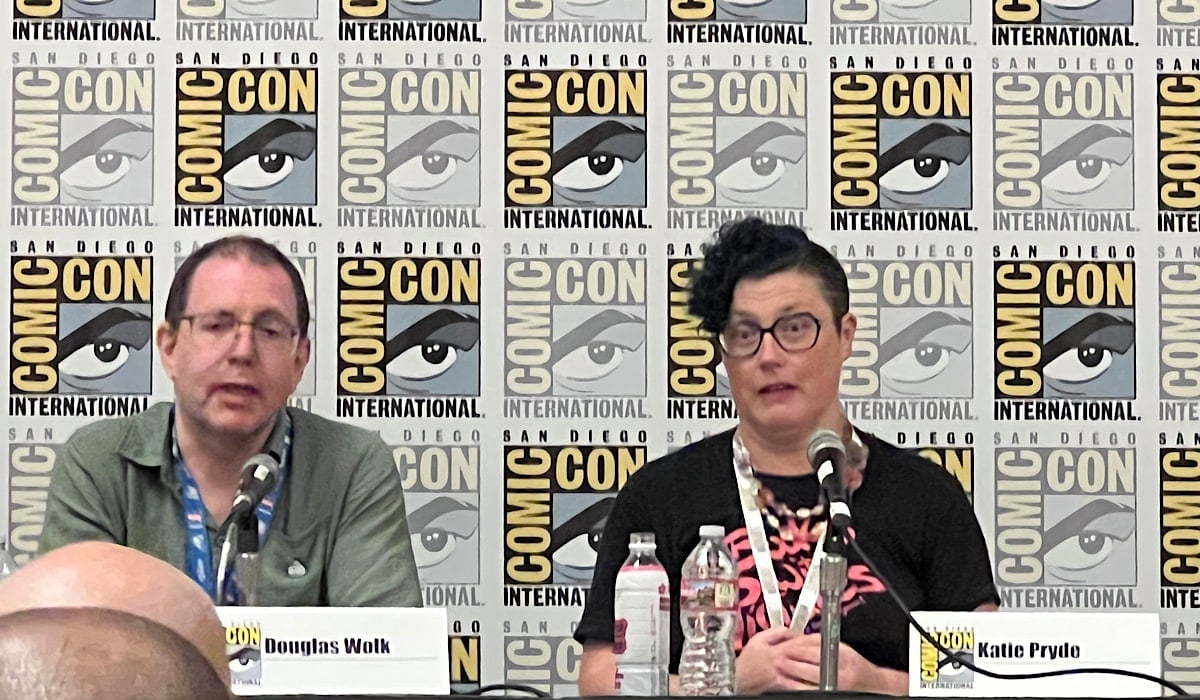

Imagine this: you see a wall of comics and have the sinking feeling of where do I even start? Never fear! Two comic book experts sat down to answer that exact question, one audience question at a time, with comic book recommendations to spare at San Diego Comic-Con on Thursday.
The panel paired Douglas Wolk, who teaches comics history using X-Men as a topic of discussion at Portland State University, with Katie Pryde, owner of the Eisner Award-winning Books with Pictures in Portland and an Eisner Award judge in the creative categories.
Below are the hour’s best moments, condensed for clarity.
Q: My kids are into comics. How do I find anything beyond Dog ManandCat Kid?
Pryde: Ask your local shop what’s new, and don’t skip the library. Even a thin selection is worth asking your librarian about, since your request gives them ammunition to request budget. I’ll always recommend Bone by Jeff Smith here, too: an unmitigated classic any reader can love. And don’t let anyone tell you comics don’t count as reading. Studies show they use a broader vocabulary than age-equivalent prose, with the art carrying less advanced readers past any hard word instead of stopping them cold.
Wolk:Bone actually proves that range. It was pitched for older readers, then serialized in Disney Adventures by Heidi MacDonald who thought kids would love it too, which is how it became a kids’ classic
Q: Does reading comics help kids actually comprehend a story, not just decode it?
Pryde: My own kid, a delayed reader, used to go through whole stacks of comics reading only the pictures and could still tell you exactly what happened. That’s a real pre-reading skill. There’s also a nice design accident here: comic fonts are usually unintentionally dyslexia-friendly, since every letter needs to look distinct, and publishers like Scholastic and Mad Cave now choose those fonts on purpose.
Q: How do you actually start reading superhero comics without getting lost?
Wolk: Stop thinking you have to start in 1962. Look for recent, self-contained stories. Anything with “Volume One” on the spine is safe, and you’ll know in three pages if it’s for you.
Pryde: Follow your favorite version of a character instead of the “original.” Modern issues also mark their place. Look for “Part 2 of 4” near the title, and give yourself permission to quit a comic that isn’t working. That’s not a personal failure; it’s the creators’ job to make a story followable.
Wolk: For binging, Marvel Unlimited and DC Infinite run about $10 a month for tens of thousands of issues. Check if your library has Hoopla, too.
Pryde: For a fuller arc, X-Men’s Krakoan age, starting with House of X/Powers of X, is one of the best runs in the book’s history, written to reward brand-new readers and 50-year veterans equally.
Q: Recommendations for gender- and identity-focused stories?
Pryde:Christopher Chaos (Dark Horse, by Tate Brombal and James Tynion IV). Kids who are different flavors of “monster” finding community. Tynion’s YA book Wynd is also a gay love story about a monster boy on the run. And, with a content note for how horny it gets: The Chromatic Fantasy (Silver Sprocket), where a trans man escapes a nunnery boyfriend. Full romantasy-crime joy, not for teens
Wolk:Lethal Legion, by trans sci-fi author Charlie Jane Anders, is a great X-Men-adjacent trans superhero book.
Q: I’ve genuinely never read a comic. Where do I start?
Wolk: If a cover catches your eye, read the first couple of pages. If it grabs you, keep going.
Pryde: For a folk-horror mood, there’s an ongoing Twilight Zone series — black-and-white, self-contained, a different creator each issue. Or try Beneath the Trees Where Nobody Sees. Richard Scarry–style cute-animal art hiding a serial-killer plot, starring an adorable bear who has to solve murders she didn’t commit. Deeply weird, and a great gateway drug.
Q: How do I get over the fear of starting a long series “wrong”?
Wolk: There’s no wrong way in. Plenty of series run six issues, get collected, and that’s the whole story. Read it like a novel. Watch new publishers, too: Ignition Press, only a year old, puts out short series with real endings, like The Dogsitter.
Pryde: The idea that a series should even stay in print is pretty recent, maybe 25 years old. Before that, every issue might be somebody’s first, and that was the creators’ problem, not the reader’s.
Q: Anything for child-assassin, Arthurian-legend type stories?
Wolk: For sideways Arthurian stuff, there’s a series where a grandmother secretly raises her grandson to guard Excalibur from white supremacists trying to steal it. For assassins, All-New Wolverine follows X-23 and her younger sister, both raised as assassins, building a life beyond that training.
Pryde: For hard sci-fi with Lovecraftian dread at the edges, Brink, a post-apocalyptic space police procedural by Dan Abnett and INJ Culbard, from Rebellion.
Stay tuned to The Beat for more news from SDCC ’26.

