

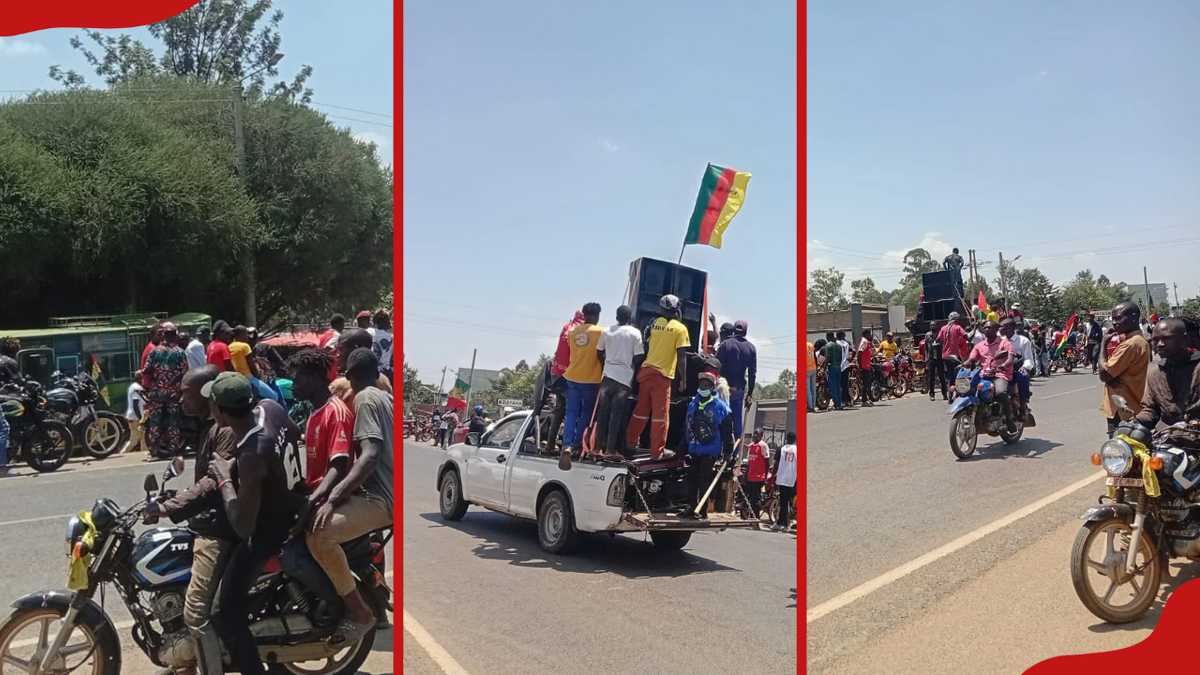
- Young people in Kakamega County have developed a motorcycle funeral escor-t tradition called Reggae Na Lami, drawing both praise and criticism across western Kenya
- Authorities in Kakamega and neighbouring areas moved to restrict the processions after traders and road users raised concerns about traffic disruption and rowdy behaviour
- Participant Godfrey Sakwa defended the culture as a sincere tribute to deceased members, while acknowledging that rogue elements have at times undermined it
Search option is now available at TUKO! Feel free to search the content on topics/people you enjoy reading about in the top right corner 😉
Almost a routine, every Thursday and Friday, a familiar spectacle plays out near the mortuary yards in Kakamega County, majorly at Kakamega County Referral Hospital funeral parlour and the Mukumu Funeral Home near the St. Elizabeth Mukumu Mission.

Motorcycle engines rev, reggae music blare, and groups of young men assemble before the hearse even pulls out.
The practice is known locally as “Reggae na Lami”, ordinarily meaning “reggae on the tarmac”, and has taken hold as an informal send-off tradition among young people in western Kenya.
The processions involve large convoys of motorcycle riders escorting a body from the mortuary to the burial home, with music playing along major roads throughout the journey.
Search option is now available at TUKO! Feel free to search the content on topics/people you enjoy reading about in the top right corner 😉
What the processions involve
John Sakwa, from Esumeyia in Kakamega County, is among those who regularly take part. He describes the riders’ role as a focused act of solidarity, not an attempt to override family or religious customs.
“We don’t take over all the funeral rites. Ours is just to escor-t the deceased’s body from the morgue to their home. This is not just done for anybody, but for those who belong to the group,” Sakwa said.
He explained that such groups are coordinated through groups, where members agree on timing, logistics and dress code before setting out in matching regalia and blow-ing vuvuzelas.
They, however don’t lock anyone out of it, as many moved by the vibe of the spectacle join in the course of the procession.
“We organise motorbikes, and sometimes a vehicle for the sound. We contribute to hire the sound and fuel. No one is coerced; they passionately do it for the culture,” he said.
They don’t interfere with the procedures in the mortuaries. Theirs, he says, he it to carry the body home; the coffin itself is most times strapped to one of the motorcycles rather than transported by a hearse.
He says the particular bike ferrying the body is the one that sets the pace. It is sandwiched by others that ride closely to offer support.
“Mortuaries don’t allow crowds in. We always have the family take charge of clearance as we wait outside. From there we take the body and ferry it ourselves until home. We don’t need a hearse to carry it. Normally we tie the coffin on one of the bikes and have others riding closely for support,” Sakwa said.
Beyond the escor-t, members, when called upon, contribute money to bereaved families and assist with tasks such as digging graves.
Bans and public backlash
Security officials have documented a pattern of riders stopping traffic, removing caskets from hearses and placing them on the road while music plays, leaving other motorists stranded.
The disruptions have been especially pronounced in Kakamega’s central business district on Thursdays and Fridays.
In May this year, Kakamega County police command formally banned funeral processions in the town centre and designated alternative routes for mourners heading to various directions.
The authorities warned that hearse owners whose vehicles participated in banned processions could have their licences revoked, and that bereaved families who entertained such processions risked arrest.
The concern extended beyond Kakamega in June, when the Ekwanda Assistant County Commissioner warned that the practice had become a hazard along the Kisumu-Busia highway, particularly on the Maseno-Luanda stretch, and said a ban was being prepared.
Sakwa acknowledged that some families, particularly those with strong religious values, disapprove of the culture, and that elements with ill intent occasionally infiltrate the processions.
Looking ahead, he expressed hope that the groups could expand their role.
“We sometimes have run-ins with the police because of the rogue elements that get themselves in, but generally we are always out to honour our colleagues, not to cause disorder. We want to make this more than mourning. We look forward to partaking in empowerment activities,” Sakwa said.
Kai Eli (Politics and current affairs editor)Eli Kai is currently working with TUKO as a politics and current affairs editor. He has six years of experience in digital journalism. Eli joined Tuko.co.ke in 2021. Email: eli.odaga@tuko.co.ke
