

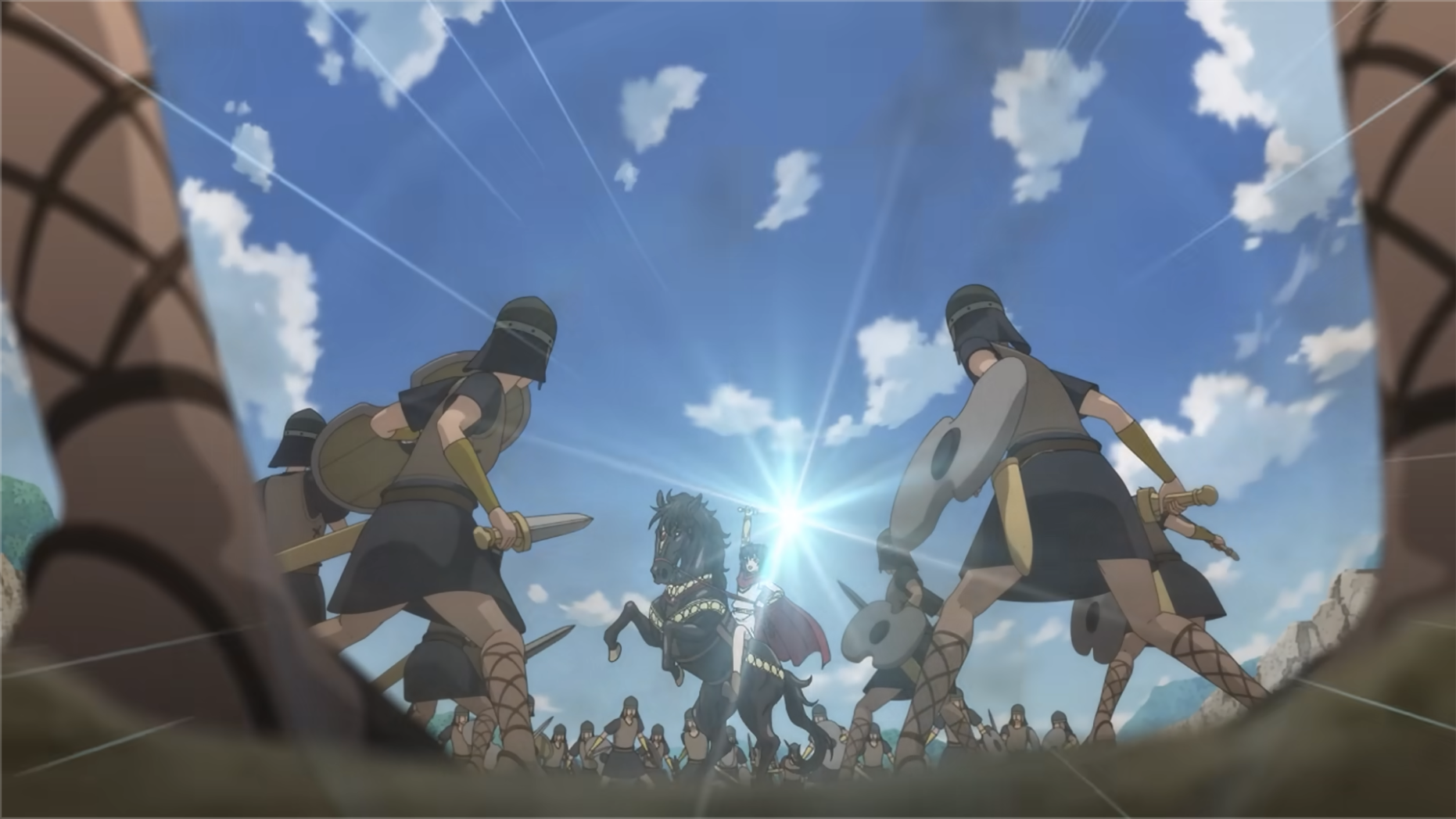
Red River’s third episode drops today, Tuesday, July 21, 2026, at 1:40 PM ET on Crunchyroll — and it lands in a Summer 2026 isekai field where a teenage girl can find herself stranded in almost any world except, apparently, the actual one. Red River is the exception. When Yuri Suzuki falls through a puddle and lands in the Hittite Empire of the 14th century BCE, she arrives somewhere that archaeologists have spent more than a century documenting in meticulous detail from over 30,000 surviving cuneiform clay tablets. That makes this shōjo adaptation — based on Chie Shinohara’s 20-million-copy manga — the only isekai series whose setting can be independently fact-checked against a UNESCO World Heritage Site.
That distinction is why the historical content in Red River carries weight no fantasy map could provide, even as the adaptation itself divides critics between those who love the
Red River Anime Streams Tuesdays, and Episode 3 Marks a Turning Point for Yuri
The series premiered July 7, 2026, on both Crunchyroll globally and Nippon Television’s AnichU programming block in Japan. Episode 3 — titled “I Can’t Go Back, I Won’t Go Back” per its TMDB listing — continues Yuri’s fight for survival inside the Hittite royal court. The title signals the moment the character stops trying to find her way home and starts choosing to engage on the empire’s own terms.
Tatsunoko Production is handling the adaptation, directed by Kōsuke Kobayashi with series composition by Yoriko Tomita (The Elusive Samurai, My Dress-Up Darling) and character design by Kenji Fujisaki, as announced in February 2026. Hiroki Nanami performs the opening theme “Akatsuki no Sora,” and Miisha Shimizu performs the ending theme “Reunion”. The anime currently has at least 12 episodes on its confirmed schedule, with a 13th date currently listed through September 29, 2026.
Crunchyroll is streaming the series in North America, Central America, South America, Europe, Africa, Oceania, the Middle East, CIS, and the Indian Subcontinent, with English subtitles. In Japan, new episodes air the following Wednesday morning local time on the AnichU block.
Anime News Network Critics Find Animation Disappointing — the Manga Remains the Gold Standard
The critical reception is worth knowing before you decide how to watch. ANN’s Caitlin Moore wrote about the premiere that “the animation and storyboarding of Red River leave something to be desired.” Anime Feminist called it “a treasured classic with a lackluster adaptation, meaning the magic of the original might not be fully conveyed.” Star Crossed Anime described “mixed feelings” about a series whose “storytelling and visual style make it a throwback to a bygone era.”
The consistent thread: reviewers who love Shinohara’s original manga are watching a faithfully structured but visually modest adaptation, and several recommend reading the omnibus alongside watching. VIZ Media re-released the complete 28 volumes in a 3-in-1 Omnibus format starting October 2024, making the comparison easy.
Where the anime earns genuine praise is exactly where the historical content does the work. Moore wrote that the series “gets you invested in the personal stakes of Yuri’s adventure, and I’m more than happy to learn all about the Hittites alongside her.” That dual value — decent isekai storytelling plus substantive ancient history — is what makes Episode 3 worth watching even for viewers who picked up the manga years ago.
Why Is Red River Different From Other Isekai? The Hittite Empire Is Real
The key structural difference between Red River and almost every other isekai in production is that Yuri does not arrive in a secondary fantasy world. She arrives in ancient Anatolia — specifically in Hattusa, the capital of the Hittite Empire during what historians classify as the empire’s zenith under Suppiluliuma I in the mid-14th century BCE. The Hittites were a real Indo-European civilization who controlled most of modern-day Turkey and northern Syria at their peak, rivaled diplomatically only by Egypt under the young pharaoh Tutankhamun.
That historical specificity is not incidental to the adaptation. When Tatsunoko announced the anime in February 2026, the studio named two professional archaeologists — Kimiyoshi Matsumura and Daisuke Yoshida, both members of the Japanese Institute of Anatolian Archaeology at the Middle Eastern Culture Center in Japan — as the production’s historical researchers. Their involvement means that the palace architecture, court rituals, military technology, and religious iconography depicted in the series have been reviewed against actual scholarship on Bronze Age Anatolia.
That is a different caliber of historical grounding than most fantasy anime achieves. The Hittite Empire left an archaeological record that includes the excavated ruins of Hattusa (now a UNESCO World Heritage Site), over 30,000 cuneiform tablets in what remains the largest Bronze Age royal archive ever found, and extensive diplomatic correspondence with Egypt, Assyria, and Babylonia that has been translated and studied since the late 19th century.
How Does Nakia’s Water Magic Work in a Real Hittite Context?
Queen Nakia’s blood-magic summoning ritual is the mechanism by which Yuri crosses time, and the anime’s treatment of it is more historically literate than it might initially appear. Hittite cuneiform archives document a category of ritual known as substitution rites — ceremonies in which a substitute figure (human or animal) is used to absorb a curse intended for royalty. The anime transposes this documented tradition into a temporal-targeting device: Nakia uses Yuri’s blood as an activating reagent, the logic being that a specific person’s biological signature can serve as an anchor across a temporal gap, pulling her body forward through a water-surface portal. The substitute king and scapegoat rite tradition is well-attested in Mesopotamian and Anatolian royal religious practice.
The water-as-threshold detail is also historically grounded. Mesopotamian and Anatolian cosmological traditions described the Abzu — a primordial freshwater sea — as a liminal space between the living world and divine or underworld domains. Water surfaces in Hittite and Hurrian ritual contexts were understood as permeable boundaries. When puddles and water sources react to Yuri’s presence in the early episodes, the anime is drawing on a coherent cosmological framework from the source traditions it depicts.
The narrative logic holds up precisely because Shinohara did her research and the anime’s historians kept it intact.
The Tawananna: Why Queen Nakia Doesn’t Need Supernatural Powers to Be Dangerous
One of the series’ most underappreciated historical details is that Queen Nakia’s scheming does not require a supernatural explanation. The Tawananna was the official title for the Great Queen of the Hittites — and the role came with real institutional power that made ambitious queens structurally capable of influencing succession.
The Tawananna held her title for life, not just during her husband’s reign. This meant that when a king died and his heir acceded, the new king’s wife could not assume the title of Tawananna until the previous holder died. The structural tension this created — a permanent queen from the old reign coexisting with a new king’s wife who had no path to queenship while the former Tawananna lived — generated documented historical conflicts within the Hittite royal house. The Testament of Hattusili I, preserved in a bilingual Akkadian-Hittite cuneiform tablet, records exactly this kind of bitter rivalry.
Beyond political leverage, the Tawananna served as High Priestess of the Hittite sun goddess and administered the economic reuence over religion and treasury while the king campaigned abroad. Far from being a ceremonial consort, the Tawananna was structurally a co-sovereign in everything but name
The anime’s villain, in other words, is operating within an institutional framework that actually existed in Bronze Age Anatolia and that actually produced the kinds of succession battles Shinohara depicted. The supernatural layer is the fiction. The political stakes are history.
Ishtar and Shaushka: How Ancient Communities Turned Real People Into Goddesses
As Yuri survives increasingly improbable situations in the Hittite court, the people around her begin identifying her with the war goddess Ishtar — known in the Hittite-Hurrian pantheon as Shaushka, the highest-ranked goddess in the Hurrian tradition, associated with love, war, healing, and incantations. She was depicted with two female attendant musicians named Ninatta and Kulitta, and her cult center was Nineveh; her worship extended from the Hurrian period (around 3300 BCE) through the Hittite Empire and into successor states.
The cognitive mechanism by which communities attribute divine identity to living individuals is well-documented in the cognitive science of religion. Pattern-matching is the core process: when a community holds established narrative templates for divine intervention, and a person’s actions repeatedly match those templates, the community applies the divine categorization to the individual present at those events. Yuri does not choose to be Ishtar. She is assigned the role by a community with ready-made interpretive frameworks.
This is not mythologized speculation. Alexander the Great was declared a son of the god Amun by Egyptian priests not because he claimed divinity but because the Egyptian priestly-political logic made that categorization appropriate for a world-conquering foreign ruler. The mechanism Shinohara depicts — reluctant deification through observable extraordinary action — is among the most historically accurate psychological dynamics in the series.
Bronze Age Science: Hittite Iron and the Oldest Documented Indo-European Language
The anime’s setting carries two pieces of STEM content that most viewers would not recognize without prompting.
The first is iron-working. The Hittites were among the earliest manufacturers of iron artifacts in the ancient world, beginning as early as the 14th century BCE — the exact period of the anime’s setting. Diplomatic correspondence from the Hittite royal archives records neighboring rulers specifically requesting iron goods and Hittite responses noting that iron was difficult to produce and in limited supply. The Hittites’ early iron-working knowledge gave them a strategic advantage comparable to a contemporary state possessing next-generation military technology ahead of its rivals.
The second is linguistic. The language spoken in the palace at Hattusa — Hittite — is the oldest attested member of the Indo-European language family, the same family that produced ancient Greek, Latin, Sanskrit, Persian, and eventually English. The language was written in a cuneiform script adapted from Akkadian, and it was entirely unread until Czech scholar Bedřich Hrozný deciphered it in 1915 by recognizing an Indo-European sentence structure in a single key phrase from a palace tablet. The scribes whose administrative tablets fill the Hattusa archive were writing in a distant ancestor of the same language family a modern English reader uses today — a connection that spans roughly 3,300 years.
When Yuri is shown interacting with palace officials in a language she should not be able to understand, the narrative convenience (a magic language gift) sits on top of a real fact: those officials were speaking the earliest recorded form of the Indo-European linguistic tradition that connects Bronze Age Anatolia to the modern world.
What the Manga’s Legacy Means for the Anime Adaptation
The manga spent more than 20 years without an anime adaptation despite its sales figures and award pedigree — a gap that made the February 2026 announcement significant for a specific generation of shōjo manga readers who grew up with the series.
The production choice to hire professional Anatolian archaeologists distinguishes this adaptation from purely commercial shōjo revivals. The historical content in the anime is not atmospheric decoration — it is the academic record of an actual Bronze Age civilization, and the production team appears to have treated it accordingly even when the budget did not stretch to match the ambition.
Whether the animation quality is enough to do justice to Shinohara’s artwork is a separate question, and critics have answered it cautiously. The historical and narrative content, however, is substantively in place.
Frequently Asked Questions
Is Red River anime faithful to the real Hittite Empire?
More so than almost any other historical anime adaptation. The production hired two professional archaeologists from the Japanese Institute of Anatolian Archaeology — Kimiyoshi Matsumura and Daisuke Yoshida of the Middle Eastern Culture Center in Japan — as historical researchers. The Tawananna institution (the queen’s title and its lifelong tenure), the substitution-ritual tradition that underlies Nakia’s blood magic, and the Shaushka/Ishtar goddess identity assigned to Yuri all reflect documented Bronze Age Anatolian history. The fictional elements (time travel, supernatural powers) sit on top of a historical framework that can be checked against surviving cuneiform records.
Does Red River anime differ from other isekai series, and how?
Standard isekai places protagonists in secondary fantasy worlds with no real-world referent. Red River places its protagonist in the historically documented Hittite Empire of the 14th century BCE — a civilization whose capital Hattusa is now a UNESCO World Heritage Site and whose 30,000-tablet cuneiform archive is still being studied by scholars. That means the setting can be independently verified, which is structurally unique in the isekai genre. It also means the series functions simultaneously as entertainment and as an introduction to one of the most significant Bronze Age civilizations in history.
Is Red River anime worth watching if I have already read the manga?
Critics are divided. ANN’s Caitlin Moore praised the storytelling’s investment in Yuri’s personal stakes while noting that the animation and storyboarding “leave something to be desired” compared to the manga’s lush artwork. If you read the manga and primarily want the visual experience of Shinohara’s art in motion, the adaptation may disappoint. If you want the historical content delivered in a new format — and the weekly episodic rhythm of a simulcast — it remains worth your Tuesday afternoons on Crunchyroll. VIZ Media’s 2024 omnibus re-release is available alongside for comparison.
What is the Tawananna, and why does it matter to the plot?
The Tawananna was the title for the Great Queen of the Hittites, held for life rather than only during her husband’s reign. A Tawananna served as High Priestess of the Hittite sun goddess and co-sovereign in the king’s absence. The title’s life-tenure structure created persistent political tension: the new king’s wife could not become Tawananna until the existing Tawananna died, producing documented historical succession conflicts. In the series, Queen Nakia holds the Tawananna title and uses the real institutional power it carried — religious authority, economic control, diplomatic standing — as the structural basis for her scheming. Her danger is not only supernatural; it is historically grounded in an institution that actually produced these kinds of palace conflicts.
ⓒ 2026 TECHTIMES.com All rights reserved. Do not reproduce without permission.
