

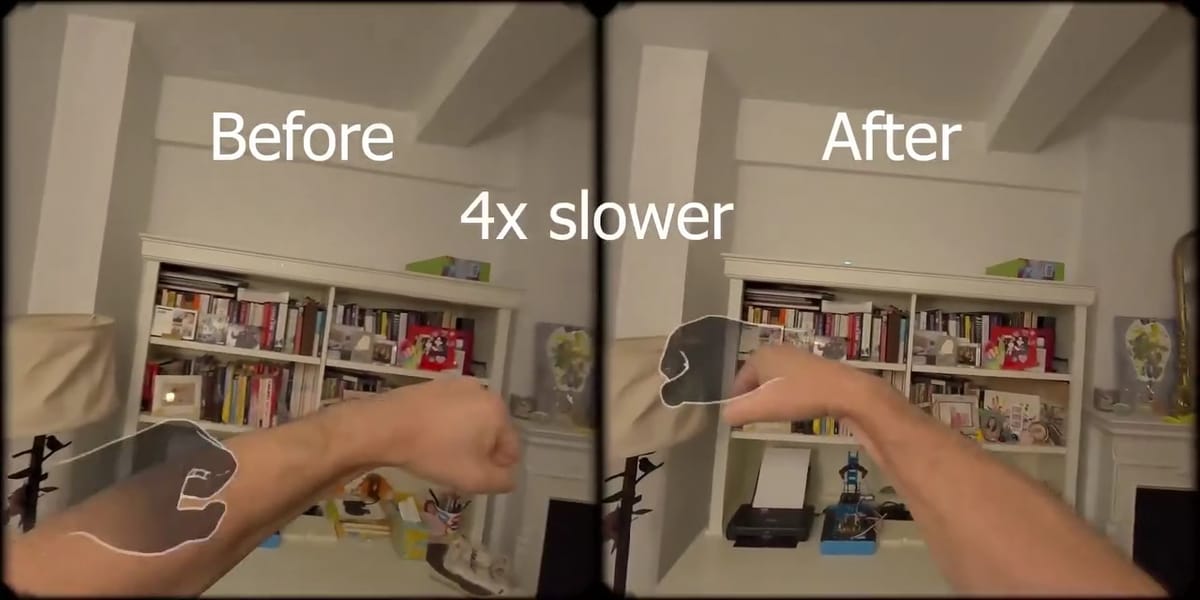
Quest’s Hand Tracking 2.4 update brings major improvements to Fast Motion mode, improving handling of fast movements such as punches and swings.
Since introducing controller-free hand tracking as a software update for the original Oculus Quest experimentally in late 2019 and generally available in early 2020, Meta has continued to improve its features and gradually close many of the gaps in tracking quality compared to controllers.
Hand Tracking 2.0 in 2022 improves handling of quick movements, occlusions, and two-handed contact. Hand Tracking 2.1 in early 2023 reduces tracking loss and the time to reacquire a hand after it is lost, and also improves the accuracy of fast movement predictions. Hand Tracking 2.2 in mid-2023 will reduce hand tracking latency, with Meta claiming up to 40% and up to 75% reductions in typical usage. Last year’s Hand Tracking 2.3 improved stability, improved accuracy, and further reduced latency.
Comparison of Fast Motion mode with 2.3 (left) and 2.4 (right).
Quest hand tracking typically samples the tracking camera at 30Hz. Optionally, app developers can enable a fast motion mode that samples the camera at 50 Hz or 60 Hz, depending on the country’s mains frequency, and synchronizes it with artificial lighting.
Fast Motion mode’s higher sampling rate improves fast motion tracking, but the tradeoff is that it may introduce jitter that can slightly reduce hand tracking accuracy. Fast Motion mode also requires brighter room lighting on headsets older than the Quest 3S. This is because the lack of an IR illuminator will further degrade tracking due to the camera’s lower exposure and less light.
Also, Fast Motion mode cannot be used with simultaneous hand and controller mode, and can only be combined with inside-out body tracking in VR, not with pass-through mixed reality. Additionally, Fast Motion mode cannot be used with eye tracking or face tracking on Quest Pro.
Still, these tradeoffs aside, Fast Motion mode is perfect for fast-paced, immersive games, and that’s what Hand Tracking 2.4’s improvements are focused on.
Quest 3S has better low-light hand tracking than Quest 3
Although the Quest 3S has an inferior lens and display, we found that head and hand tracking in low light was actually better than the Quest 3.
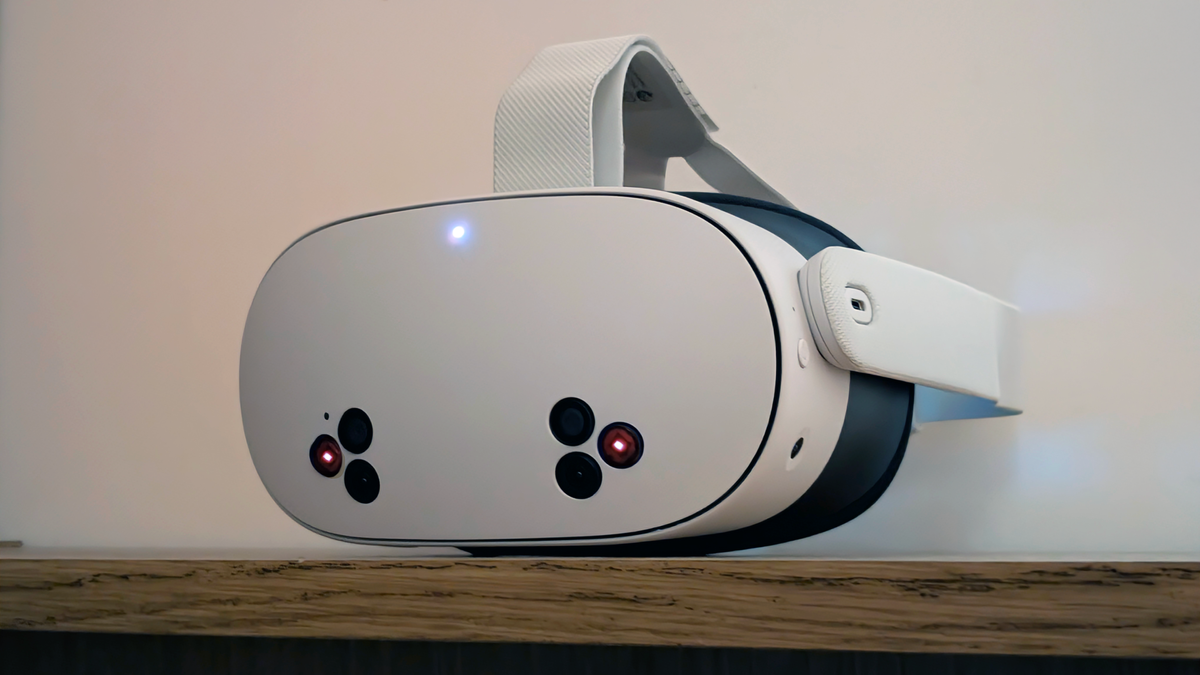
According to Meta, Hand Tracking 2.4 was introduced in Horizon OS v83, which began rolling out last month.
According to Meta, Hands 2.4 brings the following improvements to Fast Motion mode:
Faster hand acquisition: “Hands are detected faster when re-entering the view. This reduces the ‘lost hand’ feeling during fast movements. ” Advanced Motion Upsampling: “Smoothes quick gestures so movements appear continuous rather than choppy while minimizing motion artifacts.” Optimized Fast Motion Filter: “Helps eliminate perceived delay between hand tracking and controller input during high-energy interactions.”
But again, keep in mind that Fast Motion Mode is a feature that developers must enable in their apps, so you’ll only see it in games that choose to use it.
Starting in 2023, you should be able to test it with Meta’s free demo app called Move Fast. This app is designed to showcase how hand tracking can be used for immersive fitness games.
