

All news
Stocks
Crypto
Economics
Currencies
Commodities
Market Voices
Companies
In June 2026, crypto users spent a record $324 million on tokenized collectible items sold through random distribution mechanics, with Pokémon cards emerging as the segment’s primary growth driver. Blockchain technology has transformed this market into a hybrid of collecting, investing, and gambling-like mechanics, making it one of the fastest-growing sectors in Web3.
In recent months, one of the most talked-about niches in the crypto industry has been so-called on-chain gacha. The model allows users to pay a fixed amount for a random item.
Loading…
While the traditional version of gacha originated from Japanese capsule toy machines and collectible card booster packs, blockchain reduces the entire process to just a few seconds while providing instant liquidity for the acquired asset.
Although Pokémon cards have become the main catalyst behind the segment’s popularity, the phenomenon has evolved far beyond conventional collecting, according to a report by Blockworks.
Tokenization has brought the advantages of crypto infrastructure to the collectibles market, including instant settlement, high liquidity, and access to a global pool of buyers. As a result, buying collectible cards increasingly resembles gambling mechanics that have unexpectedly become one of Web3’s most profitable niches.
How Pokémon cards became a multi-million-dollar crypto business
According to Blockworks, users spent more than $324 million on tokenized collectibles sold through random distribution mechanics in June alone. One year earlier, the figure stood at roughly $50 million.
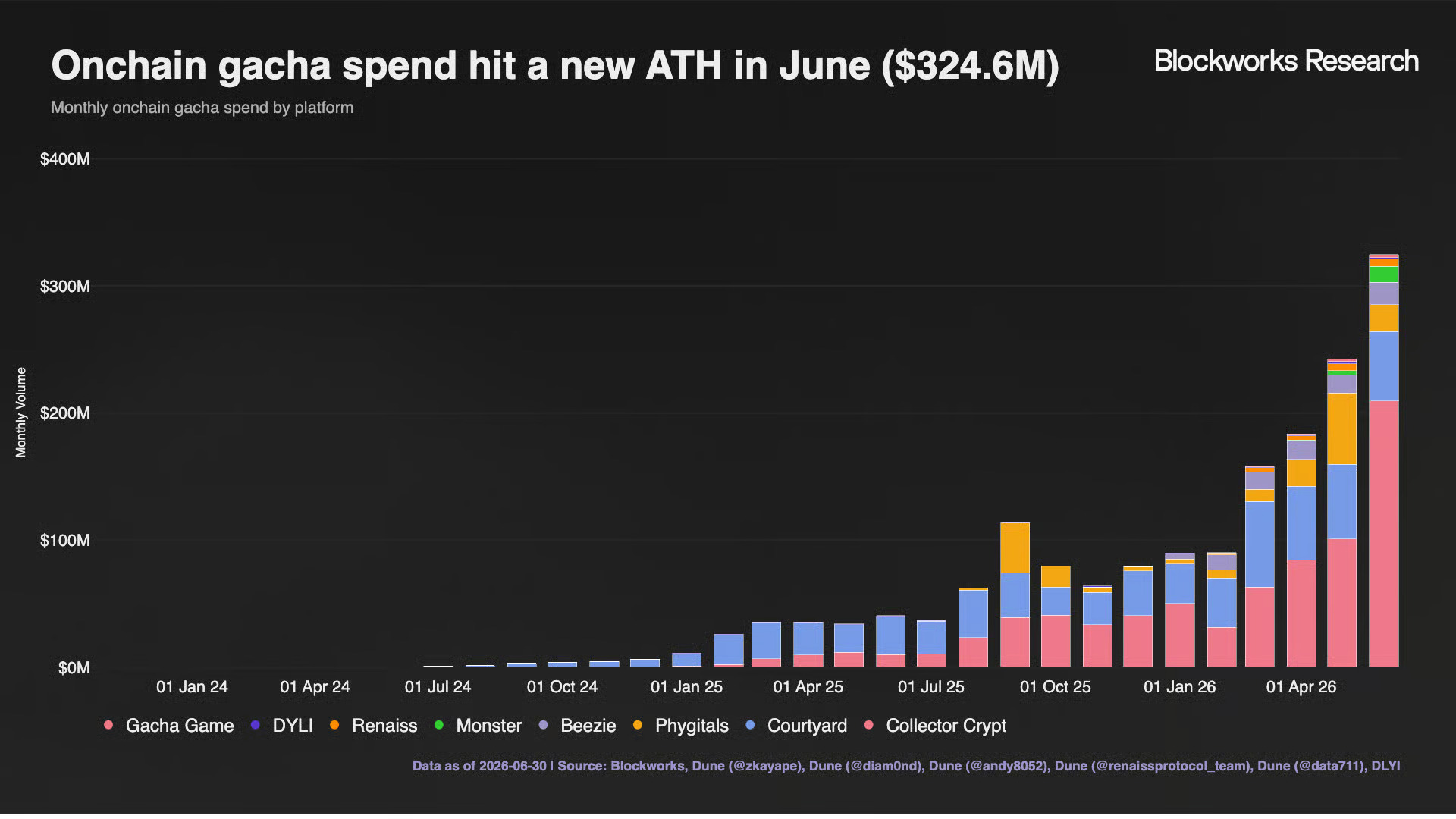
The onchain gacha market in June 2026
The primary beneficiary of the boom was Collector Crypt, which accounted for nearly 65% of the entire market volume. Users spent more than $209 million on the platform during June, while approximately $83 million came from sales of a new Pokémon card collection priced at $2,500, launched less than a month before the report’s publication.
The mechanics behind such platforms are straightforward. Users purchase a virtual card pack without knowing which specific card they will receive.
After opening the pack, they receive an NFT backed by a physical collectible card stored in a secure vault. They can keep it in their collection, sell it on a marketplace, redeem it for cash, or request physical delivery.
Interestingly, a significant portion of users actually claim their physical cards. Market participants report that thousands of tokenized collectibles are shipped to their owners every month, while others prefer to hold them as long-term collectibles.
Loading…
The segment’s popularity is not driven by tokenization alone. Pokémon itself is currently experiencing one of the most successful periods in its history. Since 2025, the brand has become the leader of the U.S. toy market. Demand for collectible cards has grown so rapidly that grading company PSA temporarily suspended new submissions after accumulating a backlog of more than 10 million cards.
Tokenization has simply been layered on top of an already multi-billion-dollar collectibles market. In essence, blockchain has addressed two of its biggest limitations: low liquidity and complex transaction processes. Selling a rare card previously could take weeks or even months. Today, it can effectively be completed as easily as a cryptocurrency transaction.
Where is the line between collecting and gambling?
As with tokenization itself, the success of these projects cannot be explained solely by Pokémon’s popularity or the growth of the collectibles market. The purchasing mechanics play an equally important role and closely resemble modern gambling models.
Users know only the pack’s price and the probability of receiving rare items. They purchase the product, open it within seconds, evaluate the cards they receive, and decide whether to keep or immediately sell them back to the platform.
If they are dissatisfied with the outcome, nothing prevents them from instantly purchasing another pack.
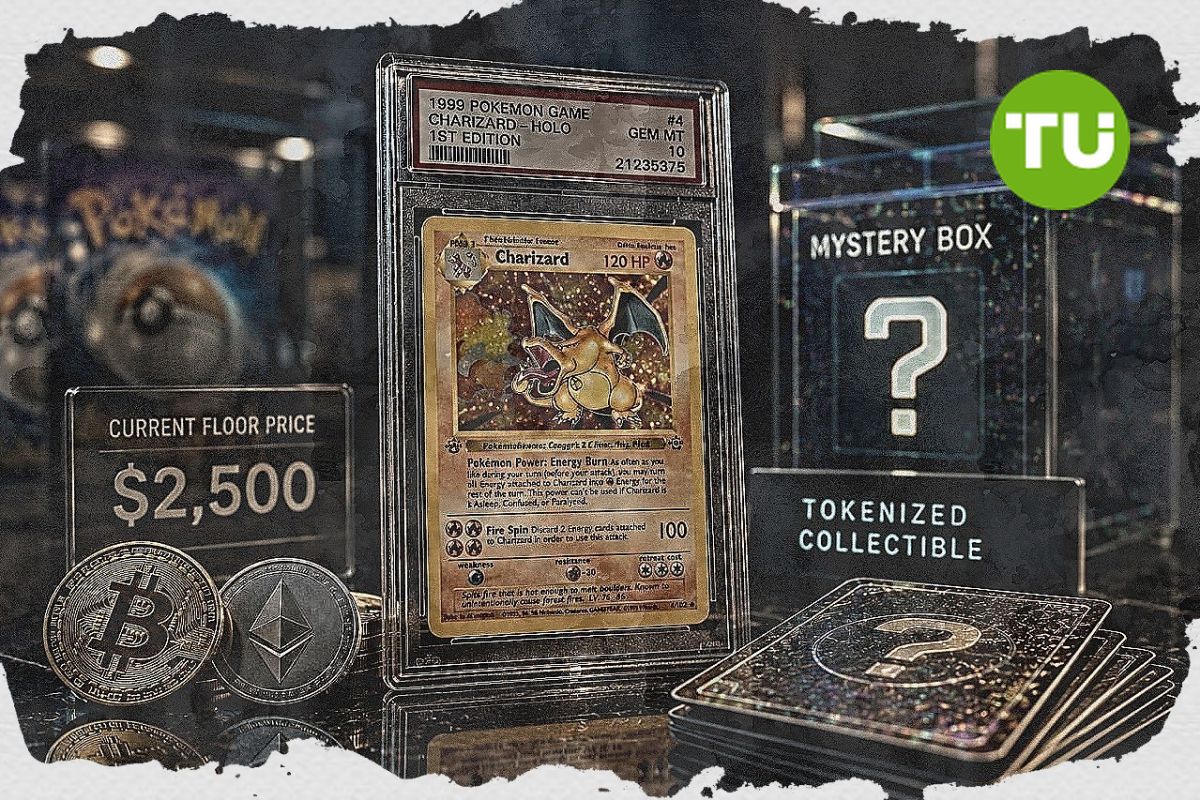
Prices of selected collectible cards
This is why comparisons with video game loot boxes have become increasingly common. Users pay a fixed amount for a random reward while knowing the odds of obtaining the most valuable items.
Several countries have already attempted to classify loot boxes as gambling or subject them to gambling-related regulations.
There is, however, one important distinction between tokenized collectibles and traditional gambling.
Unlike betting products or digital loot boxes, users always receive a real-world asset with its own market value. Moreover, the collectible card industry operated on a similar random distribution model long before cryptocurrencies existed.
Blockchain has not fundamentally changed the mechanics of collecting—it has merely made them significantly faster and more convenient.
How sustainable is the market?
Record trading volumes do not necessarily guarantee that demand for tokenized collectibles will continue growing at the same pace. A significant share of activity remains concentrated among a small number of platforms and large buyers, while the success of individual collections depends on a steady supply of rare cards and users’ willingness to continue purchasing randomized packs.
Another risk stems from the custody of physical assets. The value of the token ultimately depends on whether the underlying card is genuinely held in storage, properly authenticated, and available for redemption.
As a result, users rely not only on demand for collectible items but also on the reliability of the platform, its partners, and its authentication procedures.
The key question is whether this segment will remain a market for collectors or evolve into a highly liquid form of speculation. Blockchain has significantly simplified the purchase and resale of collectible cards, but it has also amplified their gambling-like characteristics.
The answer to that question will determine whether today’s record volumes represent the beginning of a sustainable new market or merely another short-lived boom within the crypto industry.
This material may contain third-party opinions, none of the data and information on this webpage constitutes investment advice according to our Disclaimer. While we adhere to strict Editorial Integrity, this post may contain references to products from our partners.
Did you like the article?
Thank you for your feedback!
What could we improve?
Latest Tokenization News
- By Mikhail Vnuchkov
- 16.07.2026
Tokenized stocks in the spotlight: How do they work and are they worth trading?Editors’ Picks
#Crypto#Stocks#Tokenization

- By Dan Blystone
- 15.07.2026
DTCC advances tokenization service with U.S. production tradesFinancial News
#USA#Fed#Tokenization

- By Dan Blystone
- 15.07.2026
DTCC advances tokenized securities trading in Wall Street blockchain pushCrypto
#Crypto#USA#Tokenization#JPMorgan Chase
All Tokenization News
- Pavlo Kot
- 16 min ago
Pokémon cards for $2,500: How collectibles became a new form of gambling
- Pavlo Kot
- Yesterday
The privacy paradox: How the crypto mixer market has changed
- Oleg Tkachenko
- Yesterday
Is Bitcoin right for you? Five traits shared by many cryptocurrency holders
- Eugene Komchuk
- 17.07.2026
Chasing hits: Why investors are losing interest in Netflix
- Mikhail Vnuchkov
- 16.07.2026
Tokenized stocks in the spotlight: How do they work and are they worth trading?
- Yaroslav Dmytrenko
- 31 min ago
Coinbase prioritizes making money over bitcoin ethics, Joe Nakamoto notes
- Hanna Syniavska
- 1 hour ago
Bitcoin needs guardians of neutrality to counter BIP 110, Michael Saylor argues
- Ivan Andriyenko
- 4 hours ago
SpaceX now valued at $120, Joao Wedson notes
- Anastasiia Chabaniuk
- 4 hours ago
Mario Nawfal: $250 oil could halt global economy
- Oleg Tkachenko
- 5 hours ago
Home prices continue to challenge affordability, Andrew Lokenauth notes
Weekly Top Bonuses

up to
$2,500
deposit bonus for all clients
CLAIM BONUSYour capital is at risk.
Top News
- Pavlo Kot
- 16 min ago
Pokémon cards for $2,500: How collectibles became a new form of gambling
- Pavlo Kot
- Yesterday
The privacy paradox: How the crypto mixer market has changed

- Hanna Syniavska
- Yesterday
U.S. futures fall as Nvidia and chip stocks weaken

- Andrey Mastykin
- 17.07.2026
UBS and Deutsche Bank back Europe’s stock rally

- Olga Shendetskaya
- 17.07.2026
Oil rises as Gulf tensions deepen

- Anton Kharitonov
- Now
Microsoft rebounds from key support as AI momentum improves sentiment
- Anton Kharitonov
- Now
Apple breaks into record territory as AI optimism lifts shares to new highs
- Mykhailo Ihnatenko
- Now
AMD tests key support as AI profit-taking accelerates
- Anton Kharitonov
- Now
Bitcoin retreats below $63,500 as Middle East tensions trigger fresh risk-off selling
- Anton Kharitonov
- Now
WTI holds above $80 as Middle East tensions keep geopolitical premium elevated
