

Innovative projects which save policing time and money while improving the service provided to victims and witnesses of crime have been recognised at a national awards ceremony.
The awards, held following the first day of the National Police Chiefs’ Council Innovation and Digital Summit, celebrated a variety of projects, including one using immersive virtual reality to train officers on violence against women and girls (VAWG), and another harnessing AI technology to help policing better understand information held within control rooms.
Individuals inspiring and leading technological change within their forces and across wider policing were also recognised.
Organised by the Police Digital Service, the three-day conference brings together around 800 people from policing, the public sector and industry and is one of the biggest events in the police technology calendar.
Forces from across the country submitted nominations for the awards, with competition strong across the categories. A number of projects were also named ‘highly commended’ after narrowly missing out on the top awards.
Full list of winners:
Excellence in Learning & Development
Winner: West Midlands Police – Immersive VR Empathy Training for VAWG
West Midlands Police, working with social enterprise Calico, has developed virtual reality (VR) training to strengthen officers’ understanding of violence against women and girls (VAWG) and help build trust with communities.
Developed in response to the NPCC National Framework for Delivery 2024–2027, the immersive training gives new officers practical experience of recognising risk, taking safeguarding and protective action, making appropriate referrals and communicating in a trauma-informed, non-judgemental way.
The programme brings together VR technology, research, Calico’s expertise and frontline policing to support changes in both policing culture and operational practice.
Excellence in Innovation
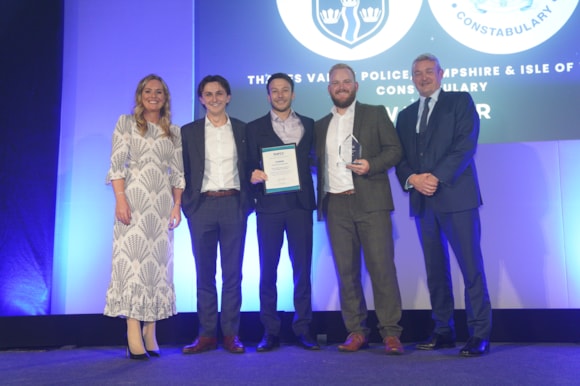
Winner: Thames Valley Police and Hampshire & Isle of Wight Constabulary – Transformational use of Robotic Process Automation within the Multi-Agency Safeguarding Department
Thames Valley Police and Hampshire & Isle of Wight Constabulary introduced intelligent automation to improve safeguarding processes related to the Domestic Violence Disclosure Scheme (DVDS), where disclosure reports previously required an average of 295 minutes of manual research.
Rather than developing a single automated process, the team created a reusable safeguarding framework combining robotic process automation, digital workflows, automated triage, case monitoring, dashboards and proactive prompts. This has supported the deployment of 13 automations across domestic abuse, child protection and adult protection.
The project has increased proactive safeguarding activity by nearly 200%, while saving 30,000 hours and hundreds of thousands of pounds. It has also enabled vulnerable people to receive faster and more consistent safeguarding interventions.
Pioneer in Policing Data
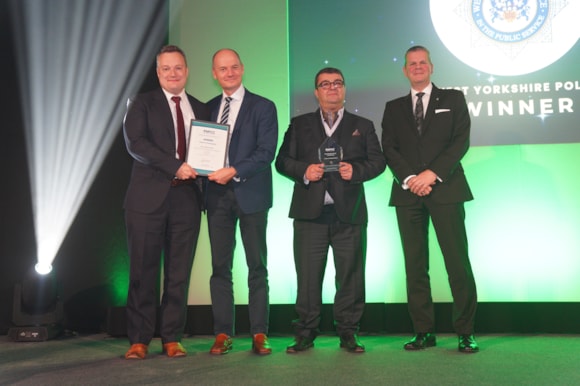
Winner: West Yorkshire Police – Post-Call Analysis Artificial Intelligence
West Yorkshire Police, Hertfordshire Police, the NPCC Digital Public Contact Programme and Deloitte have collaborated on Post-Call Analysis (PCA), which uses artificial intelligence to unlock information contained in police control-room calls.
The technology turns unstructured audio into searchable transcripts and summaries, while identifying vulnerability indicators and classifying demand. This allows policing to analyse information that may previously have gone unrecorded or been captured only in brief operator notes.
Evaluation found PCA achieved 97.6% accuracy in identifying key call characteristics, compared with 82% for human reviewers, and identified vulnerability indicators in 99.3% of relevant cases. It captured around 5.7 times more contextual information than existing processes and can process around 150 times more calls per hour than manual review.
West Yorkshire Police became the first force in England and Wales to operationally deploy the capability, providing a model that could be scaled more widely across policing.
Excellence in Cyber Security
Winner: Police Service of Northern Ireland – Network Security Team (NeST)
The Police Service of Northern Ireland has significantly strengthened its cyber resilience through the development of a coordinated, centralised and in-house network and security operations capability.
Its comprehensive approach includes enhanced threat and vulnerability management, stronger perimeter, email and internet security, improved access controls and network protections, and secure cloud connectivity.
The work has helped establish a more mature and resilient cyber security capability, better protecting PSNI against internal and external cyber threats.
 |
 |
 |
 |
Resilience in Innovation
Winner: City of London Police – FCCRAS Programme Team
The Fraud and Cyber Crime Reporting and Analysis Service (FCCRAS) Programme Team took on Action Fraud, the National Economic Crime Victim Care Unit and the National Fraud Intelligence Bureau at a time when legacy technology, previous procurement challenges and strained supplier relationships were creating significant difficulties.
The team ran existing and new services alongside each other and established data-sharing arrangements between platforms, helping maintain services for victims while the programme progressed.
Throughout the programme, lessons from setbacks were applied to delivery, with an emphasis on learning, challenge and transparency. The changes have contributed to a more resilient and future-ready national service.
Excellence in Business Change
Winner: Warwickshire Police – From hesitation to habit: Embedding Copilot Chat across Warwickshire Police
Warwickshire Police developed an organisation-wide programme to increase awareness, confidence and trust in Copilot Chat and encourage its safe, practical use in everyday work.
Using behaviour-change principles, the programme combined online guidance and practical examples with Q&A sessions, CPD events, Microsoft expert sessions, peer-led ‘Show and Tell’ activities and a four-week Copilot Challenge. Viva Engage and a force-wide innovation competition were also used to share ideas and identify useful applications.
Within eight weeks, 849 colleagues were using Copilot, equivalent to 42% of the workforce, while reported confidence increased from 27% to 93%.
Digital Equity & Wellbeing Champion
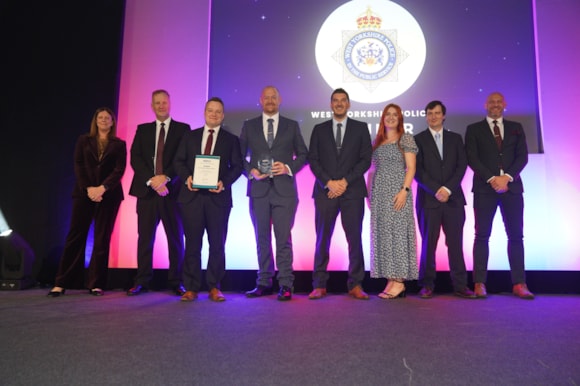
Winner: West Yorkshire Police – Trauma Tracker
West Yorkshire Police’s Trauma Tracker is a digital wellbeing tool designed to help identify and respond to cumulative exposure to trauma across the workforce. It uses the Police Traumatic Events Checklist methodology and Microsoft Power Platform to combine automated monitoring with supervisor debriefing and wellbeing support.
The tool is designed to shift wellbeing support from a reactive to a preventative approach. Secure dashboards give supervisors oversight at team level, while senior leaders can see aggregated and anonymised information about workforce wellbeing.
More than 117,000 trauma indicators were analysed during development and the solution was piloted with more than 250 users. The project has also incorporated ethical governance, DEI considerations and input from national partners.
Excellence in Collaboration
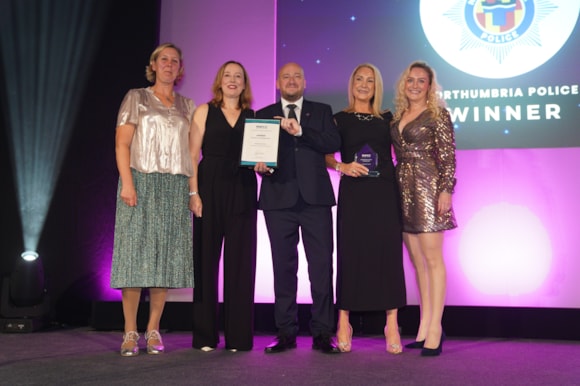
Winner: Northumbria Police – Youth Trainee Detective Programme
Northumbria Police’s Youth Trainee Detective Programme is a knife crime prevention initiative delivered in partnership with education, health, safeguarding and community organisations. It focuses on young people considered most vulnerable to serious violence.
Co-designed by partners, the programme combines immersive 360-degree environments with evidential material from a live murder investigation and input based on lived experience.
The collaborative approach provides an alternative to traditional classroom-based learning while reinforcing safeguarding messages. Its model is now informing wider safeguarding practice and longer-term early intervention approaches.
Excellence in Productivity and Value for Money
Winner: Cleveland Police – Secure Redact AVMM Redaction Project Team, Digital Services
Cleveland Police explored how AI-assisted technology could reduce the time officers and staff spend manually redacting growing volumes of video, audio and other digital evidence, while retaining human oversight, evidential integrity and appropriate governance.
Working across operational policing, Criminal Justice, Legal Services, Professional Standards and investigative support, the team piloted Pimloc Redact using operational material. Users continued to review and quality-assure the results, meaning professional judgement remained central to the process.
The pilot found redaction tasks could be completed around six to ten times faster, with average processing times reduced by approximately 85–90% per file. Users reported saving two to four hours on individual jobs, while some complex workloads that had previously taken weeks were completed in under two days.
Users rated accuracy at approximately 4.5 out of five, and all those surveyed recommended wider adoption.
 |
 |
Innovation & Digital Ambassador
Winner: John Derryman – Wiltshire Police
John Derryman developed Wiltshire Police’s DDaT Vision and Strategy 2030, translating ambitions from the National Policing Digital Strategy into a roadmap for the force’s digital, data and technology work. The changes included stronger governance, clearer accountability and investment in people and capability.
His work has included the adoption of artificial intelligence and robotic process automation, as well as collaboration between the five South West forces on shared solutions.
John Derryman also chairs the National DDaT Change Board, through which he contributes to digital reform work and the sharing of practice across policing.
Innovation & Digital Leader
Winner: Chris Bell – City of London Police
Chris Bell, Service Delivery Director and Deputy Senior Responsible Owner for the Fraud and Cyber Crime Reporting and Analysis Service (FCCRAS) programme, has worked on the modernisation of Action Fraud within a programme involving government, policing and industry partners.
The programme has included redesign, procurement and implementation work around a critical service component, alongside changes intended to improve the processing of reports and intelligence.
The resulting service has reduced report-processing times and call abandonment rates, while intelligence assessments that previously took weeks can now be delivered almost instantly. New capabilities include automated triage, configurable solvability logic, real-time intelligence sharing and disruption tools.
The service has also supported safeguarding interventions for vulnerable victims and thousands of fraud disruptions.
