

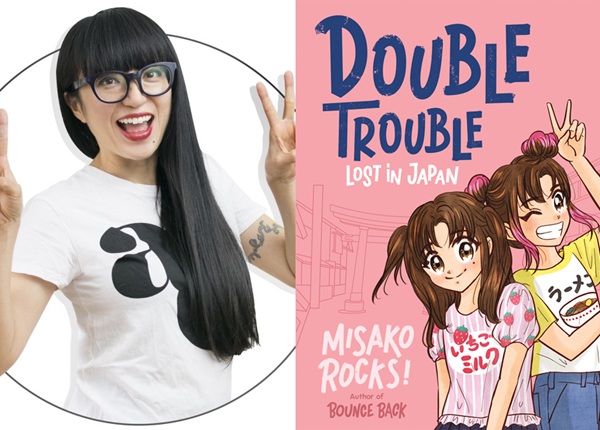
Originally from Japan, Misako Rocks! is a U.S.–based manga artist. Her new book,Double Trouble: Lost in Japan: A Kid-Friendly Manga Adventure(Feiwel and Friends, Sept.), is the fourth title in her Bounce Back series for young readers. In addition, she created the activity book series How to Draw Kawaii Manga with Misako Rocks (Quarto), and teaches kids through her online school, Learn Manga with Misako. Here, the author-illustrator reflects on her creative journey and how manga provides a cultural bridge between Japan and the U.S.
“Dad, Mom: I’m moving to America when I grow up!”
I probably said those words to my parents almost every day, starting around seventh grade.
Growing up in Japan, I fell in love with classic American movies like Back to the Future and The Goonies. They filled my imagination with adventure, freedom, and endless possibilities. America seemed like a place where dreams could come true.
Years later, I earned a scholarship to study abroad as an exchange student in Missouri. I couldn’t believe my dream was finally coming true.
But reality was much harder than I expected.
Even though I had studied English for years before moving to the U.S., I was completely over my head. I could barely understand what my American classmates were saying. During my first month, I felt like I said the same sentence over and over again: “I’m sorry, could you say that one more time?”
The language barrier and cultural differences challenged me every single day. I had to push myself harder than ever just to keep up. Even simple conversations took courage. Some days I felt exhausted, but I reminded myself, “This is the adventure you’ve always dreamed of.”
After college, I moved to New York City to chase another dream: becoming a puppeteer. Like so many artists, I worked different jobs while trying to make that dream come true. Eventually, I had to admit that it wasn’t going to.
I had moved across the world to start a new life, but I still didn’t know where I belonged. Then something unexpected changed my life.
While working at a children’s museum, I began meeting kids who absolutely loved Japanese manga, anime, food, and language. They’d ask me to write something in Japanese, then sit right beside me and carefully practice writing the characters themselves. They also loved watching me draw manga and would try drawing the characters on their own.
I remember thinking, “Wow, they really love Japanese culture!”
To be honest, I had no idea that manga had become so popular in the United States. In Japan, manga is simply part of everyday life, so seeing American kids embrace it with so much excitement amazed me. Ironically, I didn’t realize how big manga had become until after I left Japan.
For a long time, I had been searching for where I belonged in America. Being among those kids who shared their love of manga with me felt like seeing a light at the end of a long, dark tunnel. I recognized something familiar: they were looking toward Japan with the same curiosity and imagination that I had directed toward America.
Then it finally hit me: I didn’t have to leave my Japanese identity behind to build a creative career here in America. I could build one because of it. For the first time since moving to America, I knew exactly what I wanted to do. I wanted to become a manga artist and share Japanese culture through my work. That realization inspired me to study everything I could about creating manga. Years later, it also led me to become a manga teacher.
Teaching introduced me to thousands of American kids. Listening to them talk about their dreams, friendships, worries, and excitement inspired my own stories. Those experiences eventually informed my graphic novel series, Bounce Back.
Today, I visit schools across the country, where students eagerly tell me about their favorite manga series. Watching reluctant (and passionate!) readers discover a love of reading through manga is something I never imagined when I first came to America.
I now spend my days creating graphic novels, teaching manga, and encouraging young artists to tell stories of their own. Sometimes a student tells me they dream of visiting—or even moving to—Japan because of manga and anime. Every time I hear that, I smile. It reminds me of the seventh-grade girl who dreamed about America after watching Back to the Future.
American culture opened a door for me and inspired me to come to the US. Years later, Japanese manga helped me find my place on the other side of the door.
I came to America searching for an exciting future far from home. I found it by bringing home with me.
