

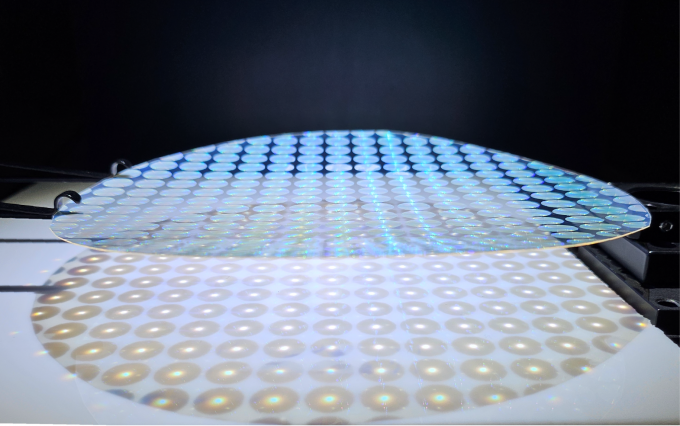
Meta-lens for clear full color
POSTECH Professor Roh Jun-seok Development Team
Expected for mass production
Meta-lens technology, which overcomes the limitations of thick and heavy glass lenses, is quickly approaching commercialization. Professor Noh Jun-seok of POSTECH, who has been leading commercialization, has further increased the possibility of commercialization of meta-lenses this time. The target of commercialization this time is augmented reality (AR) and virtual reality (VR) glasses.
Professor Roh Jun-seok of POSTECH announced on the 11th that he has developed a technology to make clear full-color images with meta-lenses. Using the developed meta lens, AR and VR glasses lenses can be two to three times thinner and lighter than before.
AR and VR lenses are thicker than general glasses lenses because they have to refract a lot of light emitted from their front eyes. The display light comes from just a few centimeters away from the eye, but it needs to look further away to secure a viewing angle.
The thicker the regular lens, the more it refracts light. Accordingly, while general glasses lenses are about 5 millimeters, AR and VR lenses are often 20 to 30 millimeters. It is a major factor that made equipment heavy and difficult to commercialize.
Meta-lenses can refract a lot of light even with a thin thickness. This is because nanostructures smaller than the wavelength of light are densely contained in the lens, so that the phase of light can be finely adjusted. Accordingly, it was selected as a powerful material that can replace general lenses.
However, it was difficult to solve the problem of “color aberration” in meta-lenses, which is refracted differently depending on the color of light. If chromatic aberration is not solved, light cannot be accurately collected in one point, and an image with a clear focus cannot be made.
Professor Roh, who is called a master of commercialization of meta-lenses, has developed meta-lenses that solve the chromatic aberration problem. By adjusting the height of the nano-column contained in the meta-lens, the refractive index could be adjusted for each color of light, and various colors of light could be collected in one point.
Professor Roh succeeded in making the principle into a real product and mass-producing it. The nano-posts were directly printed with 3D precision printing technology and properly placed in meta-lenses using artificial intelligence (AI).
As a result of experiments on organic light emitting diode (OLED) displays, the newly created meta-lens implemented a clear full-color image without spreading color even with cheap materials.
It is also possible to mass-produce it like a stamp. Professor Roh succeeded in mass-producing meta-lenses for the first time in the world in 2023, and this time, he even mass-produced meta-lenses that solve chromatic aberration. By improving the existing nanoimprint process, nano-pillar meta-lenses with height were also produced through the same process.
The study brings MetaLens closer to real industrial demand. Analysts say that the possibility of replacing actual lenses has increased as clear and clear screens can be placed in the desired location. Professor Roh established both pillars of commercialization of meta-lenses by improving the performance of meta-lenses and securing mass production technology at the same time.
Professor Roh said, “We presented a manufacturing technology to utilize full color colorless aberration meta-lenses for AR and VR in real industries as a high-dimensional nano-processing technology. It will be widely used in various optical industries such as imaging and optical sensors, as well as lighter and thinner AR and VR glasses and next-generation displays.”
![Professor Noh Jun-seok of POSTECH's Department of Mechanical, Chemical, and Electronic Engineering and Graduate School of Convergence. [Picture = POSTECH]](https://comicvibe.com/wp-content/uploads/2026/08/news-p.v1.20260811.9b6125c1e54d4868941da97eb0db7821_P3.jpg)
