

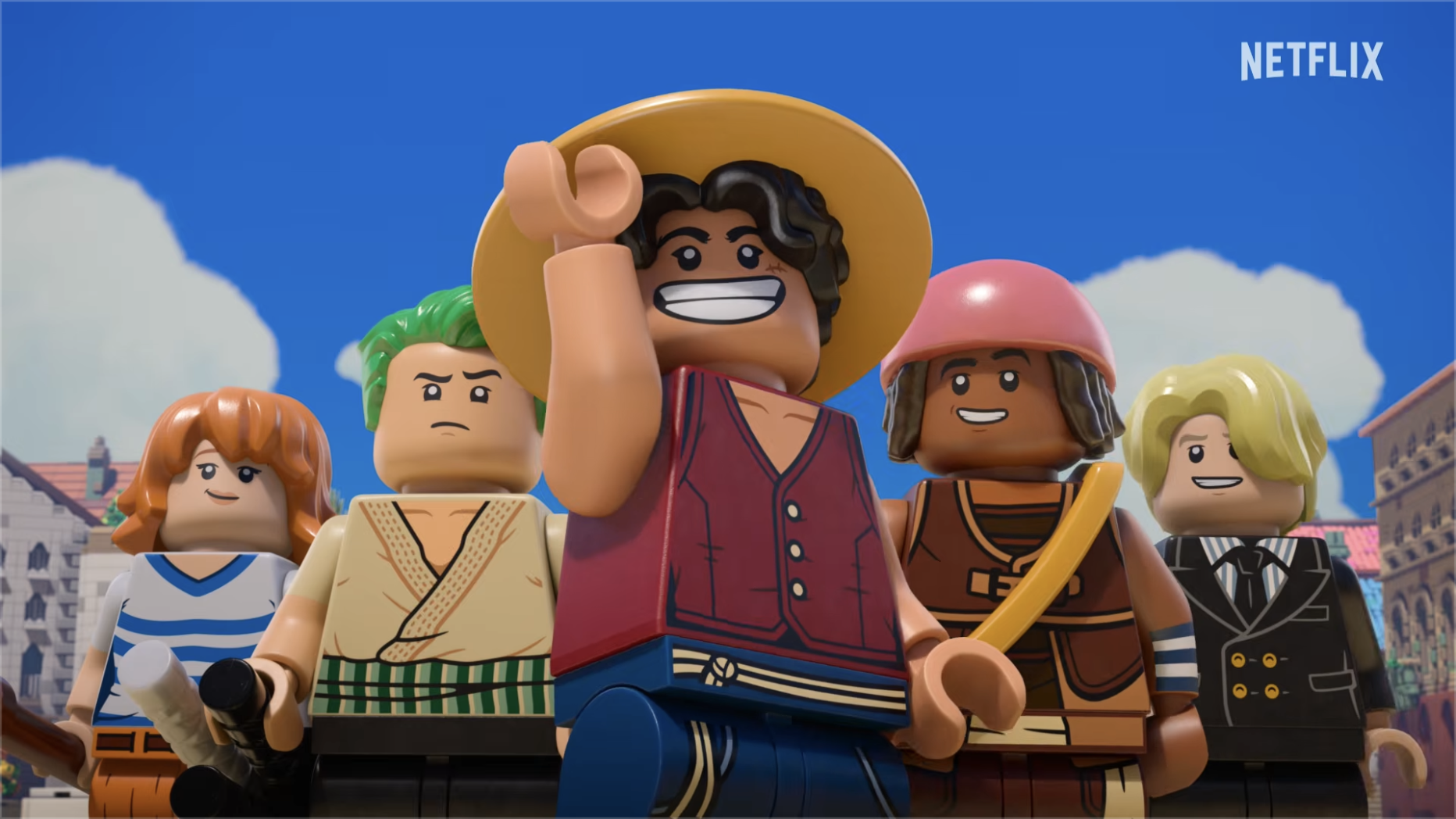
Netflix dropped the first official trailer for LEGO ONE PIECE on Monday, and it makes the proposition clear from the first frame: Usopp, the Straw Hats’ most spectacularly unreliable member, is narrating the crew’s entire East Blue saga to an unsuspecting Chopper — and the rest of the crew keeps breaking into the frame to correct him. The two-part animated special premieres September 29, 2026, exclusively on Netflix, and it brings back the full live-action English voice cast alongside the original Japanese anime actors in a dual-dub production covering the events of Seasons 1 and 2.
The trailer arrived July 20 alongside a full cast update that confirmed Jeff Ward returning as Buggy the Clown, with Katey Sagal joining as Dr. Kureha and Callum Kerr as Captain Smoker — characters central to Season 2. Charithra Chandran voices both Nefertari Vivi and her Baroque Works alias Miss Wednesday, doubling up as she did in the live-action series. Eiichiro Oda, who has guided the Netflix adaptation since Season 1 as executive producer, holds that same credit here alongside showrunner and writer Tom Hyndman, who created the Usopp-narrates-to-Chopper framing specifically to let new viewers enter the franchise without prior context.
Production is handled by Vancouver-based Atomic Cartoons, in partnership with Shueisha and the LEGO Group, with Chelsea Ker directing.
Usopp Lies to Chopper: What the Unreliable Narrator Frame Actually Does
The choice of Usopp as narrator is not a random conceit — it is structurally precise. American literary critic Wayne C. Booth defined the unreliable narrator in his 1961 The Rhetoric of Fiction as a storyteller whose account demonstrably diverges from a reconstructible true version of events, through self-deception, motivated distortion, or sincere confabulation. Usopp is the textbook instance of what later critics called the “clown narrator” — a figure in the tradition of the court jester whose unreliability includes irony, deliberate self-aggrandizement, and comic inversion of who did what.
The frame is structurally clever because Chopper is an epistemically naive audience: he wasn’t present for the events being recounted and has no basis for fact-checking. This eliminates any natural correction mechanism — until the other Straw Hats intrude into the frame story. In the trailer, Zoro is visibly incredulous at Usopp’s account; Luffy seems entertained. This produces what narratologists call intradiegetic counter-narration: the primary narrative is challenged from within the same story world, not from without.
The result is a dual-channel design. Newcomers get an entertaining, compressed, fictionalized recap of Seasons 1 and 2 told by the most fun possible narrator. Returning fans get a second simultaneous layer: meta-comedic commentary on specific events — Arlong, Baroque Works, Dracule Mihawk — that only land if you already know what actually happened. Hyndman described this explicitly: “We wanted to make something that would ease new viewers into the massive world of ONE PIECE while also giving longtime fans a new, fun perspective to see the iconic stories of the first two seasons.”
The franchise-level implication is larger than a single creative choice. One Piece has sold more than 600 million manga volumes globally, making it the best-selling manga — and one of the best-selling comics — of all time. Oda’s life’s work is a story in which Usopp’s lies and exaggerations gradually become true through force of will and the belief of his crewmates — the entire character arc functions as a form of narrative self-fulfilling prophecy. Putting Usopp in charge of retelling the story, with full license to reimagine himself as its hero, is not a comedic detour from that theme. It is the theme, applied to the format.
Inside Atomic Cartoons’ Brick-First Pipeline
The visual world of the special is where the engineering challenge is concentrated. LEGO CGI is not simply animated content that happens to look like plastic toys — it is a discipline built around enforcing physical constraints that do not exist in the software.
When Animal Logic produced The LEGO Movie in 2014, the studio established the production standard that all subsequent serious LEGO animation has followed. Their mandate was specific: everything visible on screen must be theoretically assemblable by hand using real LEGO bricks. This means water effects are not particle simulations — they are LEGO brick assemblages arranged in wave shapes. Explosions are brick-rendered, not fluid-dynamics-rendered. Fire is a construction, not a shader.
The pipeline Animal Logic developed for the LEGO films began with LEGO Digital Designer, the toymaker’s own brick-layout tool, then moved content into Autodesk Maya for modeling, Softimage XSI for rigging and animation, and Houdini for effects. Critically, the studio disabled motion blur on minifigures — a standard tool in CGI animation for conveying speed and fluidity — to maintain the visual contract with an audience that knows what real stop-motion LEGO animation looks like.
Atomic Cartoons brings LEGO animation experience from prior Star Wars and Marvel projects, as well as a substantial Netflix production history that includes CoComelon Lane, Red Fish Blue Fish, Oddballs, and Dogs in Space. The TV-production context differs from a theatrical feature: episode timelines are compressed, budgets are different, and the pipeline must achieve physical-accuracy rendering at speed. The ABS plastic surface that defines LEGO bricks has a specific sub-surface scattering profile, distinctive specular highlights, and visible injection mold seam lines and stud geometry that must be modeled accurately — any departure from how actual ABS plastic behaves under light reads as visually wrong to viewers who have handled real bricks, even when they cannot articulate why.
Expressive animation under these constraints requires an additional technique: because minifigure heads carry fixed printed expressions rather than flexible faces, emotion is conveyed through rapid alternation between head variants — the digital equivalent of the replacement animation method used in stop-motion studios — combined with compensatory whole-body blocking that communicates through posture and staging what facial microexpressions cannot. Achieving this at TV-production speed, with physically accurate surface rendering, is the specific engineering challenge Atomic Cartoons is solving for this production.
One Piece Has Three Simultaneous Properties on Netflix
The LEGO special fits into a franchise calendar that Netflix has been building methodically. Season 2 of the live-action series — subtitled Into the Grand Line — premiered March 10, 2026, ran eight episodes totaling 481 minutes, and accumulated 320.7 million hours of viewing, equivalent to approximately 39.5 million views over its run on the global charts. Season 3, officially titled One Piece: The Battle of Alabasta, completed principal photography in Cape Town and is expected in 2027.
Simultaneously, WIT Studio — known for Attack on Titan — is producing a full anime remake titled The One Piece for Netflix, also expected in 2027. That means three distinct One Piece properties will exist on Netflix by 2027: the live-action series, the LEGO animated special, and a prestige anime remake of the East Blue saga — each occupying a different audience register and media format.
This is what media scholar Henry Jenkins described in Convergence Culture as transmedia storytelling: a story unfolding across multiple media platforms, with each new text making a distinctive and valuable contribution to the whole. Each platform does what it does best. The live-action series provides dramatic fidelity and cinematic production scale. The LEGO special provides accessibility, comedy, and family reach. The WIT Studio anime provides prestige visual artistry for the core anime audience. The three properties reinforce rather than cannibalize each other — and LEGO concurrent physical set releases priced from $9.99 to $329.99 extend the engagement into physical space.
The bridge-release function is also deliberate. The LEGO special lands on September 29, 2026, filling an 18-month gap between Season 2 (March 2026) and Season 3’s anticipated 2027 arrival. Audience retention between seasons on long-form franchise properties is a documented challenge in streaming; a two-part special produced at lower cost than a full season is a well-established mitigation strategy.
How Does LEGO One Piece Fit the Franchise for Someone Who Hasn’t Watched?
The Usopp-narrator framing was designed with this reader specifically in mind. The special is a compressed comedic retelling of everything that happened in Seasons 1 and 2 of the live-action series — the East Blue arc and the Grand Line entry — as filtered through Usopp’s magnificently self-serving memory. It is self-contained: a viewer who has never seen One Piece can follow it as a standalone adventure comedy. A viewer who has seen Seasons 1 and 2 will catch the constant inaccuracies and find an additional layer of meta-humor in them.
The LEGO format additionally signals something specific to newcomers: this is a safe, playful, family-accessible register. LEGO animation carries decades of connotations of humor and accessibility that the live-action series — rated TV-14, with genuine combat stakes and emotional weight — does not. It is a lower-threshold entry point deliberately constructed to expand the franchise’s age range downward while the live-action series holds its own audience.
Frequently Asked Questions
When does the LEGO One Piece special premiere, and where can you watch it?
The two-part LEGO ONE PIECE animated special premieres September 29, 2026, streaming exclusively on Netflix worldwide. Both parts will be available simultaneously on that date. No theatrical release is planned.
Is the same cast from the Netflix live-action series in the LEGO special?
Yes — all five core Straw Hats return in voice roles: Iñaki Godoy as Luffy, Emily Rudd as Nami, Mackenyu as Zoro, Jacob Romero as Usopp, and Taz Skylar as Sanji. Jeff Ward returns as Buggy, and Season 2 cast additions including Katey Sagal as Dr. Kureha, Callum Kerr as Smoker, and Charithra Chandran as Vivi also appear. For Japanese audiences, the original anime voice cast — including Mayumi Tanaka as Luffy and Ikue Otani as Chopper — provides the Japanese dub.
How is LEGO CGI animation technically different from regular animation?
Standard CGI aims to transcend physical limits — giving characters fluid, expressive motion impossible with real joints or materials. Constraint-based LEGO CGI does the opposite: it enforces physical restrictions in software that faces none. Minifigure arms rotate at fixed angles, motion blur is disabled, and every environment element must be theoretically buildable with real LEGO bricks — including water and fire effects, which are rendered as brick assemblages rather than particle simulations. Expressive emotion is achieved through rapid head-variant switching (the digital equivalent of replacement animation) and compensatory whole-body blocking. Achieving this at TV-production speed, with physically accurate ABS plastic surface rendering, is the specific engineering challenge Atomic Cartoons is solving for this production.
Does the LEGO special spoil anything from Season 3?
No. The special retells events from Seasons 1 and 2 only — the East Blue and early Grand Line arc — and does not advance the main story forward. Season 3, titled One Piece: The Battle of Alabasta, is expected in 2027 and will cover new material.
ⓒ 2026 TECHTIMES.com All rights reserved. Do not reproduce without permission.
