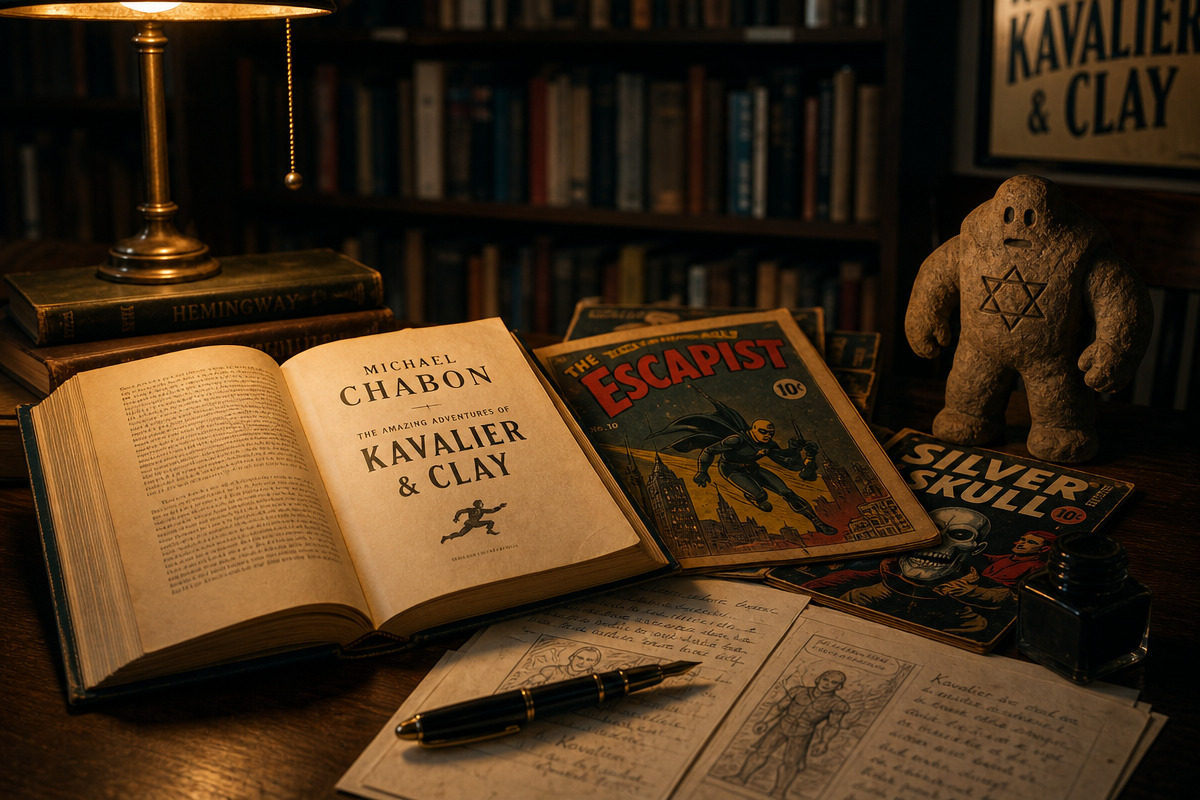
The Amazing Adventures of Kavalier & Clay turned 25 this year, and I have spent a good part of that quarter century convinced it is the book that argued the American comic book into the room where serious literature sits. By Michael Chabon’s own account the novel came out on September 19, 2000. It won the 2001 Pulitzer Prize for Fiction, per Pulitzer.org, which is a strange and wonderful thing to hand a story about two kids inventing a man in tights.
A quick warning before we go on: I discuss the plot in full, including where Joe and Sammy end up, so tread carefully if you have not read it yet.
The anniversary did not pass quietly. On September 21, 2025, an opera adaptation by Mason Bates and Gene Scheer opened the Metropolitan Opera’s new season, as the New York Classical Review reported. Chabon marked the same date on his own terms, and when he wrote on the book’s 25th anniversary he explained what the project had felt like in 2000: “No writer, as far as I knew, had ever published a novel in which superhero comic books and the lives and sundry aspirations of the people who created them were taken seriously.” That sentence is the whole book in miniature, and the theme that carries it is escape.
Escape Artists
Start with the title. The story follows two Jewish cousins: Josef Kavalier, a Czech artist trained in Houdini-style escape, and his Brooklyn cousin Sammy Clay, a writer with big pulp ambitions. Joe smuggles himself out of Nazi-occupied Prague inside a coffin that also hides the Golem, so the escape in this book is literal long before it becomes a metaphor.
Once they land together in New York, the cousins invent a superhero called the Escapist, and both the joke and the ache of the novel live inside that name. Joe draws a hero who slips every chain while his own family stays locked inside occupied Europe, beyond the reach of any comic he can pencil. Escapism works here as salvation and as evasion at the same moment, a way to fight fascism on the page when you cannot yet touch it in life.
That doubleness is exactly why the book refuses to treat comics as kid stuff. When the Escapist punches Hitler on a cover months before America enters the war, the fantasy does real cultural work, and it also lets Joe dodge a grief he is not ready to feel. This is the genre that 25YL has argued you can read a comic book as philosophy, and Chabon hands it its fullest novelistic defense.
The Golem in that coffin is not set dressing. In interviews quoted by literary scholars, Chabon has connected the Golem to Superman and to the superhero as a messianic figure who would redeem the helpless, which places the American caped hero inside a much older Jewish story about protection conjured out of clay. That lineage is the same one 25YL followed when writing about the American myth of the hero, and Chabon’s twist is to make the myth a refugee’s invention.
Taking the Funny Books Seriously
The reason the book can carry that weight is that Chabon took the actual history seriously. The novel’s texture comes from the lives of real Golden Age creators, and Wikipedia’s account lists Jerry Siegel, Joe Shuster, Jack Kirby, and Will Eisner among them. I want to be careful here, because the easy move is to play matching game and declare that Sammy is Siegel or that Joe is Shuster. Chabon has resisted that reading, and the book is richer for drawing on the era’s events instead of tracing any single career.
Where those real creators enter is in the working conditions: the sweatshop studios and the men who signed away Superman for a flat fee. Chabon put the genesis plainly when he told BookBrowse in 2001, “I started writing this book because of a box of comic books that I had been carrying around with me for fifteen years.” A grown novelist opening a box of childhood comics is the origin story this book keeps retelling in fiction.

The result convinced the committees paid to notice such things. The Pulitzer arrived in 2001, and the novel was a finalist for the National Book Critics Circle Award, per Kirkus, which for a story about pulp heroes counted as a small revolution in what the literary establishment would honor. Chabon’s own retrospective framing, that no writer had taken this material seriously before, reads to me as an accurate weather report on the year 2000.
Twenty-five years on, that verdict looks obvious, because the medium has kept comics climbing from newsstand to prestige screen in ways Chabon half predicted. The novel got there first as literature, and it did so while loving even the odder corners of superhero storytelling that most critics still waved off as embarrassing.
The Adaptation That Kept Escaping
Here is the irony I cannot get over. A novel whose hero is an escape artist has spent a quarter century unable to escape onto film. Scott Rudin bought the screen rights for Paramount before the book was even published, and as Deadline reported, the project then passed between studios and directors for two decades.
Sydney Pollack attached to direct first, with Jude Law circling the role of Kavalier, and Stephen Daldry later took over the chair. Per that same Deadline report, the film came close to a green light in 2004 and again in 2006 before each version fell apart. Chabon himself, as The Hollywood Reporter recounted, “declared the film dead” by late 2004, and the next real headline was a Showtime limited series announced in December 2019, which as of this writing has produced no confirmed update.
The story kept slipping into other forms while the film stalled. Beginning in 2004, the publisher rolled out a Dark Horse comics anthology built around the Escapist, and that anthology, not the novel, went on to win the Eisner Award and the Harvey Award for Best Anthology, per Dark Horse’s own listings. Then came the Met Opera in 2025, so the book that could not become a movie became comics and grand opera instead.
I have come to think the resistance is the point. This is a story about the impossibility of adaptation, about how the thing you make can never fully carry the thing you meant, so it makes a grim sense that Hollywood keeps failing to pin it into a single frame. Like another Golden Age throwback we’ve revisited, it lives most fully on the page that dreamed it up.
Twenty-Five Years Later
So where does that leave the book at 25? I think it has aged better than the cynical superhero deconstructions that arrived around it, the ones that treated the cape as a lie waiting to be exposed. Kavalier & Clay makes the opposite wager and wins it, insisting that escape is survival, the necessary work of imagining a door when every real one is bolted shut. Joe draws his way through grief while Sammy writes his way toward a self he cannot yet live openly, and the comics they make together become the truest rooms in their lives. That is why the novel still reads as the strongest argument of its century that fantasy is a form of courage. Twenty-five years on, the Escapist has outlasted the men who doubted him, and I suspect he will quietly outlast the rest of us too.